Current Affairs 14 July 2026
Add as a preferred Source on GoogleTable of Contents
International Current Affairs
Syria Opens First Temporary Parliament
Syria’s transitional People’s Assembly held its first session in Damascus on 12 July 2026, marking the restoration of a national legislature after the fall of Bashar al-Assad’s government.
The session opened a new political chapter after decades of authoritarian rule by the Assad family. Hafez al-Assad ruled Syria from 1971 until 2000, after which his son Bashar al-Assad remained President until his removal in December 2024. Together, the family dominated Syrian politics for more than five decades through the Ba’ath Party, security agencies, and a highly centralised political system.
Bashar al-Assad’s government collapsed after opposition forces launched Operation Deterrence of Aggression on 27 November 2024. The offensive was led by Hayat Tahrir al-Sham (HTS) and allied groups, which rapidly captured Aleppo, Hama, and other areas before entering Damascus. Assad’s fall on 8 December 2024 ended more than 50 years of Assad family rule.
During its renewable 30-month mandate, the Parliament is expected to enact transitional laws, contribute to drafting a permanent Constitution and prepare the ground for future elections. However, concerns remain over executive influence, indirect selection of members and inadequate representation of women and Syria’s ethnic and religious minorities.
Key Points for Exams:
- Syria’s first post-Assad Parliament met on 12 July 2026.
- Venue: Damascus
- President of Syria: Ahmed al-Sharaa
- Legislature: People’s Assembly
- Tenure of the transitional Parliament: 30 months
Former Qatar Emir Sheikh Hamad bin Khalifa Al Thani Passed Away
Former Qatar Emir Sheikh Hamad bin Khalifa Al Thani, widely regarded as a key architect of modern Qatar, died on 12 July 2026 at the age of 74. Qatar’s Amiri Diwan announced his death and referred to him as the Father Amir.
Key Points for Exams:
- He served as Emir of Qatar from 1995 to 2013.
- Al Jazeera was launched in 1996 during his reign.
- Qatar became a major exporter of liquefied natural gas under his leadership.
- He played an important role in Qatar’s bid to host the 2022 FIFA World Cup.
- Capital of Qatar: Doha
- Currency of Qatar: Qatari Riyal
- Current Emir of Qatar: Sheikh Tamim bin Hamad Al Thani
Bhutan Launches ‘Third Child Plus’ Programme
Bhutan has launched the Third Child Plus Programme to encourage families to have three or more children. Under the scheme, eligible families will receive Nu 10,000 per month, approximately $105, for every third and subsequent child until the child reaches three years of age. The programme took effect from 4 June 2026.
To qualify, the child must be registered in Bhutan’s census and must be the mother’s third or subsequent child. Eligible families do not have to submit separate applications, as authorities will identify beneficiaries using census records. The benefit also covers eligible children born before 4 June 2026 who had not yet completed three years on that date.
Bhutan’s falling fertility rate could reduce its future working-age population and increase the burden of supporting elderly citizens. The proportion of people aged 65 and above is projected to increase from around 6% in 2022 to 17.3% by 2050.
Key Points for Exams:
- The Bhutanese currency is the Ngultrum.
- Bhutan is a landlocked Himalayan country located between India and China.
- Capital of Bhutan: Thimphu
- Prime Minister of Bhutan: Tshering Tobgay
Polity and Governance
District Development Councils and Local Governance in Jammu and Kashmir
-Important for APPSC Group 1 Mains
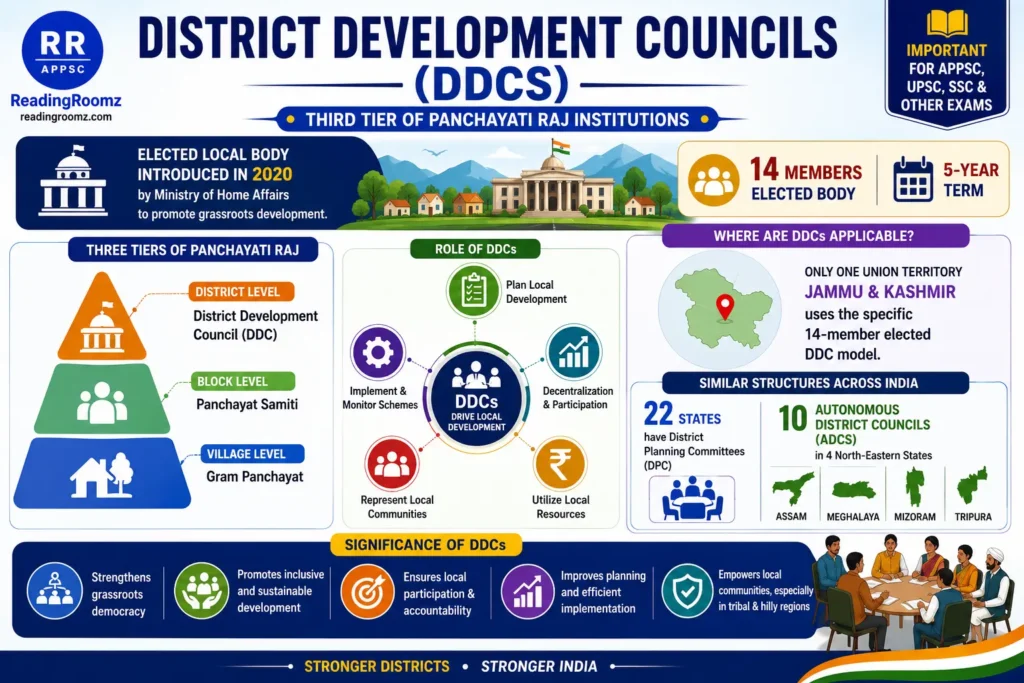
District Development Councils (DDCs) were introduced in Jammu and Kashmir in 2020 as the district-level tier of the Panchayati Raj system. Elections were held for 280 seats across 20 districts, with 14 directly elected members in each district. Their first five-year term concluded in February 2026, renewing debate over the future of grassroots democracy in the Union Territory.
DDCs were created through amendments to the Jammu and Kashmir Panchayati Raj Act, 1989, and related rules. They prepare and approve district development plans and supervise government-funded development works. They form the third tier above Halqa Panchayats and Block Development Councils.
A District Planning Committee (DPC), under Article 243ZD of the Constitution, has a different role. It consolidates plans prepared by rural panchayats and urban municipalities into an integrated district development plan. It is therefore intended as a coordinating planning institution rather than a parallel local executive authority.
Supporters argue that DDCs introduced direct district-level representation and strengthened the three-tier Panchayati Raj structure. Critics, however, raise concerns about limited financial autonomy, bureaucratic control, overlap with panchayats and municipalities, and unequal representation because every district has the same number of elected DDC seats despite major population differences.
The wider debate concerns whether local institutions in Jammu and Kashmir possess adequate funds, functions, and functionaries. Effective decentralisation requires regular elections, clear division of responsibilities, independent financial resources, and coordination among panchayats, municipalities, DDCs, and the elected Union Territory legislature.
Key Points for Exams:
- DDC stands for District Development Council.
- DDCs were introduced in Jammu and Kashmir in 2020.
- The first DDC elections were conducted in 2020.
- Jammu and Kashmir has 20 DDCs, one for each district.
- DDCs constitute the district-level tier of the Panchayati Raj system in J&K.
- The rural structure includes Halqa Panchayats, Block Development Councils and DDCs.
- District Planning Committees are provided under Article 243ZD.
- DPCs consolidate plans prepared by panchayats and municipalities.
- The main issue is whether DDCs advance decentralisation or increase administrative control.
Science and Technology
Helium Emerges as a Strategic Resource for Advanced Technologies
Helium is becoming a strategic resource because it is essential for healthcare, semiconductor manufacturing, space missions, scientific research, and quantum technologies. Recent concerns over export restrictions and geopolitical tensions have highlighted the vulnerability of the global helium supply chain.
Helium is the second-lightest element and a chemically inert noble gas. It is not commercially manufactured. Most terrestrial helium is formed through the radioactive decay of uranium and thorium and becomes trapped in natural-gas reservoirs.
Helium has the lowest boiling point of any element, at about –269°C. Liquid helium is used to cool superconducting magnets in Magnetic Resonance Imaging machines, research facilities and some quantum-computing systems.
It is also used in semiconductor manufacturing, optical-fibre production, leak detection and rocket fuel-tank pressurisation. Its small atomic size allows it to pass through tiny openings, making it highly useful for detecting leaks.
Helium is difficult to replace because it is chemically inert, non-flammable, extremely light and effective at ultra-low temperatures. Storage and transport are costly because liquid helium requires specialised vacuum-insulated cryogenic vessels and gradually evaporates during transit.
Key Points for Exams:
- Helium has the chemical symbol He and atomic number 2.
- It is the second-lightest element after hydrogen.
- Helium belongs to the noble gas group.
- Its boiling point is approximately –269°C.
- Grade-A helium generally has a purity of at least 99.997%.
- Helium is mainly recovered from natural gas deposits.
- Major producers include the United States, Qatar, Algeria, Russia, and Canada.
- It is used in MRI scanners, semiconductors, quantum computers, and rockets.
- Helium cools superconducting magnets.
- Its small atomic size makes it useful for leak detection.
- Helium is considered non-renewable on human timescales.
- Liquid helium requires specialised cryogenic containers.
- Supply concentration makes the global market vulnerable to shocks.
Miscellaneous
NIDAR 2.0 Programme
The Ministry of Electronics and Information Technology (MeitY), in collaboration with the Drone Federation India (DFI), launched NIDAR 2.0 for 2026–27 on 13 July 2026 in New Delhi. It was introduced under the SwaYaan initiative to promote student innovation in indigenous drone technologies.
NIDAR stands for National Innovation Challenge for Drone Application and Research. The programme encourages students to develop autonomous drones, indigenous avionics, and core drone components using Indian technology.
Key Points for Exams:
- NIDAR stands for National Innovation Challenge for Drone Application and Research.
- VEGA is an indigenous microprocessor developed by C-DAC.
- SwaYaan: The SwaYaan initiative, approved by MeitY in July 2022 with an outlay of about Rs 89.87 crore over five years, builds the skilled workforce needed for India’s drone sector.
Daily Current Affairs Quiz
Q1. Which property makes helium particularly important for cooling superconducting magnets in MRI machines and quantum-computing systems?
A. Its high electrical conductivity
B. Its extremely low boiling point
C. Its high chemical reactivity
D. Its ability to form solid compounds easily
Show Answer
Answer: B. Its extremely low boiling point
Explanation: Helium has an extremely low boiling point of approximately –269°C. This allows liquid helium to cool superconducting magnets used in MRI scanners, scientific instruments and certain quantum-computing systems to temperatures close to absolute zero.
Q2. Which Article of the Constitution provides for the constitution of District Planning Committees?
A. Article 243ZF
B. Article 243ZD
C. Article 243Z
D. Article 243Y
Show Answer
Answer: B. Article 243ZD
Explanation: Article 243ZD provides for a District Planning Committee in every State at the district level. Its function is to consolidate development plans prepared by panchayats and municipalities and prepare a draft development plan for the district as a whole.
Q3. Which military offensive led to the fall of Bashar al-Assad’s government in Syria in December 2024?
A. Operation Olive Branch
B. Operation Deterrence of Aggression
C. Operation Euphrates Shield
D. Operation Inherent Resolve
Show Answer
Answer: B. Operation Deterrence of Aggression
Explanation: Operation Deterrence of Aggression was launched by Hayat Tahrir al-Sham and allied opposition groups on 27 November 2024. The rapid offensive culminated in the capture of Damascus and the fall of Bashar al-Assad’s government on 8 December 2024.
Q4. Sheikh Hamad bin Khalifa Al Thani, who passed away on July 12, 2026, was the former ruler of which country?
A. Oman
B. Qatar
C. Bahrain
D. Kuwait
Show Answer
Answer: B. Qatar
Explanation: Sheikh Hamad bin Khalifa Al Thani was the former Emir of Qatar. He ruled the country from 1995 to 2013 and played a major role in transforming Qatar into a leading global exporter of liquefied natural gas.
Q5. Which of the following countries has launched the ‘Third Child Plus Programme’ to address its declining birth rate?
A. Nepal
B. Bhutan
C. Sri Lanka
D. Maldives
Show Answer
Answer: B. Bhutan
Explanation: Bhutan launched the Third Child Plus Programme to encourage families to have three or more children. Under the scheme, eligible families receive monthly financial assistance for every third and subsequent child until the child turns three.
Q6. SwaYaan is an initiative launched by which of the following Ministries?
A. Ministry of Civil Aviation
B. Ministry of Defence
C. Ministry of Electronics and Information Technology
D. Ministry of Education
Show Answer
Answer: C. Ministry of Electronics and Information Technology
Explanation: SwaYaan is a capacity-building initiative of the Ministry of Electronics and Information Technology (MeitY) for human-resource development in unmanned aircraft systems, drones and allied technologies.
Best Value — APPSC Current Affairs 2026
Cover 6 or 9 Months in One Purchase
Monthly current affairs PDF with 150–200 APPSC-pattern MCQs — available in Telugu and English medium. One purchase, all editions delivered instantly.
Last 6 Months Current Affairs Bundle
Last 9 Months Current Affairs Bundle
Frequently Asked Questions
Who is the new leader of Syria now?
Ahmed al-Sharaa is the new leader of Syria. Syria’s transitional People’s Assembly held its first session in Damascus on 12 July 2026, marking the restoration of a national legislature after the fall of Bashar al-Assad’s government.
What is the main currency of Bhutan?
The main currency of Bhutan is the Ngultrum. The Indian currency, the rupee, is also widely accepted.
What is the District Development Council?
District Development Councils (DDCs) are elected local government bodies introduced in 2020 by the Ministry of Home Affairs. DDCs serve as the third tier of Panchayati Raj Institutions (local village and district councils) to promote grassroots development. Only one union territory, Jammu and Kashmir, currently uses the specific 14-member elected District Development Council (DDC) model.
However, across India, 22 states have similar District Planning Committees (DPC).
Additionally, four northeastern states (Assam, Meghalaya, Mizoram, and Tripura) have 10 Autonomous District Councils (ADCs) to manage tribal areas.
Disclaimer: This article is prepared for competitive exam preparation using publicly available information.
Join Our Community
Study with the ReadingRoomz Community
Join thousands of APPSC aspirants. Get daily current affairs, MCQs, PDFs, and preparation guidance — all in one place.