National Blockchain Framework
విషయ సూచిక
Introduction
Blockchain technology, once known mainly for cryptocurrencies, has evolved into one of the most transformative digital innovations of the 21st century. Unlike centralized databases, Blockchain provides tamper-proof, transparent, and decentralized record-keeping, making it ideal for governance and public trust.
To harness this potential, the ఎలక్ట్రానిక్స్ మరియు సమాచార సాంకేతిక మంత్రిత్వ శాఖ (MeitY) launched the National Blockchain Framework (NBF) — a unified system to integrate blockchain solutions in government services.
What is the National Blockchain Framework (NBF)?
The National Blockchain Framework is India’s indigenous platform for secure and scalable digital governance.
It provides the infrastructure, standards, and tools to deploy blockchain technology across government departments and industries.
| వివరాలు | Information |
|---|---|
| Launched by | Ministry of Electronics & Information Technology (MeitY) |
| Initiated in | March 2021 |
| Official Launch | 4 September 2024 |
| బడ్జెట్ | ₹64.76 crore |
| ప్రయోజనం | To enable transparent, accountable, and efficient governance using blockchain technology |
Core Components of the National Blockchain Framework
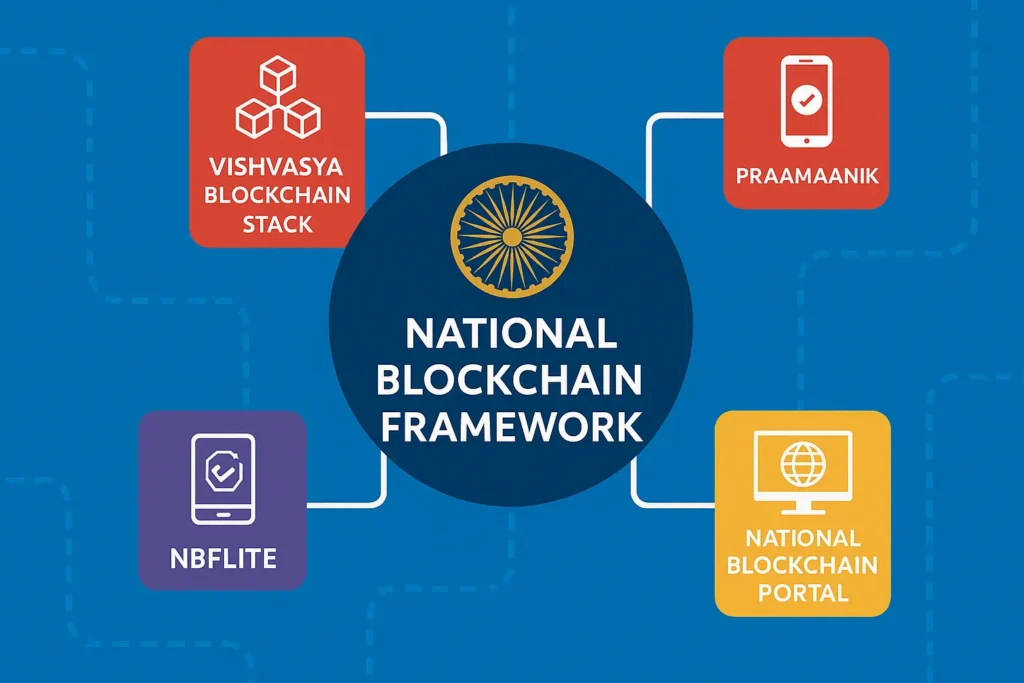
The National Blockchain Framework (NBF) consists of four major components:
1. Vishvasya Blockchain Stack
- India’s indigenous blockchain platform for developing governance applications.
- Provides Blockchain-as-a-Service (BaaS) for government entities.
- Deployed across NIC data centres in Bhubaneswar, Pune, and Hyderabad.
- Built on a permissioned blockchain layer ensuring secure, verified access.
- Offers open APIs for easy integration with e-Governance platforms.
2. NBFLite – Blockchain Sandbox
- A sandbox version of the Vishvasya stack.
- Designed for startups, academia, and research institutions to test blockchain-based applications.
- Includes ready-to-use smart contract templates for governance areas like supply chains and digital certificates.
3. Praamaanik – App Verification System
- An innovative blockchain solution for verifying mobile applications.
- Protects users from fake apps and fraudulent support systems.
- Ensures trust and authenticity in the digital ecosystem by matching app data with blockchain records.
4. National Blockchain Portal
- Serves as a central hub for India’s blockchain strategy.
- Promotes standardization, interoperability, and innovation.
- Encourages cross-sector blockchain adoption in governance and industry.
Blockchain Basics: Types and Features
What is Blockchain?
A blockchain is a distributed and immutable digital ledger that stores data securely across multiple computers.
It ensures transparency, trust, and tamper-resistance in digital transactions.
Types of Blockchain
| రకం | వివరణ |
|---|---|
| Public Blockchain | Open to all users (e.g., Bitcoin network). |
| Private Blockchain | Restricted to selected users; used in government applications. |
| Consortium Blockchain | Managed jointly by multiple organizations. |
| Hybrid Blockchain | Combines features of both public and private blockchains. |
Applications of the National Blockchain Framework
The National Blockchain Framework is being used across several sectors for document verification, logistics, judiciary, and property management.
1. Certificate and Document Chain
- Developed by NIC to store and verify documents securely.
- Over 34 crore documents verified via blockchain (as of Oct 2025).
- Used for CBSE academic certificates, caste, income, and driving licenses.
2. Logistics Chain
- Tracks movement of goods across stakeholders.
- Example: Aushada (Karnataka’s online medicine supply system) integrated with blockchain to ensure drug traceability and authenticity.
2. Judiciary Chain
- Provides a secure, time-stamped record of court data and orders.
- Enables e-delivery of summons and bail orders, reducing manual delays.
- Over 665 judiciary documents verified on blockchain (as of Oct 2025).
3. Inter-Operable Criminal Justice System (ICJS)
- Integrates police, courts, and prisons through blockchain.
- Ensures unified digital case management.
- 39,000+ ICJS documents verified (as of Oct 2025).
4. Property Chain
- Digitally records all property transactions and land records.
- Prevents fraudulent ownership transfers and reduces litigation.
- Over 34 crore property documents verified as of October 2025.
Strategic Roadmap for Blockchain Adoption in India
The National Strategy on Blockchain by MeitY lays the foundation for blockchain integration across governance.
It focuses on policy formulation, regulatory frameworks, and institutional capacity-building.
Institutions Driving Blockchain in India
Centre of Excellence (CoE) in Blockchain Technology
- Set up by NIC for pilot projects, training, and consultancy.
- Works with Hyperledger Sawtooth, Hyperledger Fabric, and Ethereum platforms.
TRAI’s Role
- Integrated Distributed Ledger Technology (DLT) in telecom for spam prevention.
- Enabled end-to-end tracking of over 1.13 lakh entities (SMS origin to delivery).
RBI Initiatives
- Using blockchain for Digital Rupee (e₹) pilot since December 2022.
- Enhances payment transparency and inclusion.
NSDL’s DLT Platform
- Introduced for Debenture Covenant Monitoring.
- Ensures secure tracking of asset charges and investor protection in capital markets.
Capacity Building and Skill Development
Skill Development Programmes
- Over 214 training programmes conducted by MeitY’s Digital India Corporation.
- Trained 21,000+ government officials in emerging technologies.
PG Diploma in FinTech & Blockchain (PG-DFBD)
- 900-hour course covering Blockchain, FinTech, AI/ML, and Cybersecurity.
BLEND by C-DAC
- Online course for engineering students to learn blockchain architecture and applications.
FutureSkills PRIME
- MeitY-supported re-skilling programme to upskill India’s IT workforce in 10 emerging technologies, including blockchain.
Future Blockchain Use Cases
India is exploring several blockchain-based Proof of Concepts (POCs):
- Land Records: Secure ownership verification.
- Blood Bank: Transparent donation tracking.
- GST Chain: Real-time tax monitoring.
- Public Distribution System (PDS): Ensuring authenticity in supply chains.
The National Blockchain Framework marks India’s transition to a trusted digital economy.
By integrating transparency, accountability, and security, it strengthens Digital India and Aatmanirbhar Bharatinitiatives.
With continued innovation, India is set to become a global leader in blockchain-powered governance.
Quick Revision Notes
| Topic | ముఖ్య వాస్తవాలు: |
|---|---|
| ప్రారంభ తేదీ | 4 September 2024 |
| మంత్రిత్వ శాఖ | MeitY |
| బడ్జెట్ | ₹64.76 crore |
| Core Stack | Vishvasya Blockchain Stack |
| Key Tools | NBFLite, Praamaanik, National Blockchain Portal |
| Verified Docs | Over 34 crore (as of Oct 2025) |
| డేటా కేంద్రాలు | Bhubaneswar, Pune, Hyderabad |
| ఫోకస్ | Transparent, scalable, and secure e-Governance |
తరచుగా అడిగే ప్రశ్నలు (FAQs)
What is the National Blockchain Framework (NBF)?
The National Blockchain Framework (NBF) is an initiative by the Ministry of Electronics and Information Technology (MeitY) to build a secure, transparent, and scalable digital governance ecosystem using blockchain technology.
It provides a unified architecture for integrating blockchain into public services.
When was the National Blockchain Framework launched?
The National Blockchain Framework was officially launched on 4 September 2024 with a budget of ₹64.76 crore. The project was initiated in March 2021 under the Digital India programme.
What is the purpose of the National Blockchain Framework?
he main aim of the NBF is to enhance trust, transparency, and efficiency in governance by using blockchain technology to securely store and verify government records, certificates, and transactions.
Who developed the National Blockchain Framework?
The Ministry of Electronics and Information Technology (MeitY) developed the NBF, in collaboration with the National Informatics Centre (NIC) and other government partners like C-DAC and TRAI.
What are the four main components of the National Blockchain Framework?
The four key components of the NBF are:
Vishvasya Blockchain Stack – Core infrastructure for blockchain applications.
NBFLite – Sandbox environment for startups and researchers.
Praamaanik – App verification system to detect fake apps.
National Blockchain Portal – Central platform for blockchain adoption and innovation.
What is Vishvasya Blockchain Stack?
It is an indigenous blockchain technology stack developed under NBF to provide Blockchain-as-a-Service (BaaS).
It is hosted across NIC data centres in Bhubaneswar, Pune, and Hyderabad to ensure scalability and fault tolerance.
What is NBFLite in the National Blockchain Framework?
NBFLite is a sandbox version of the blockchain stack that allows startups, academic institutions, and developers to test blockchain-based applications in a safe environment before live deployment.
What is Praamaanik?
Praamaanik is a blockchain-based app verification system that validates mobile apps and their sources, helping users identify authentic and non-malicious applications.
Which cities host the National Blockchain Framework data centres?
The NBF data centres are located in Bhubaneswar, Pune, and Hyderabad, operated by the National Informatics Centre (NIC).
What is the National Blockchain Portal?
The National Blockchain Portal is a central online platform that provides resources, standards, and guidance for blockchain projects. It encourages cross-sector innovation and standardized adoption of blockchain across industries.
మూలం: పి ఐ బి