Current Affairs 28 April 2026
Add as a preferred Source on GoogleTable of Contents
International Current Affairs
India–New Zealand Free Trade Agreement (FTA) 2026
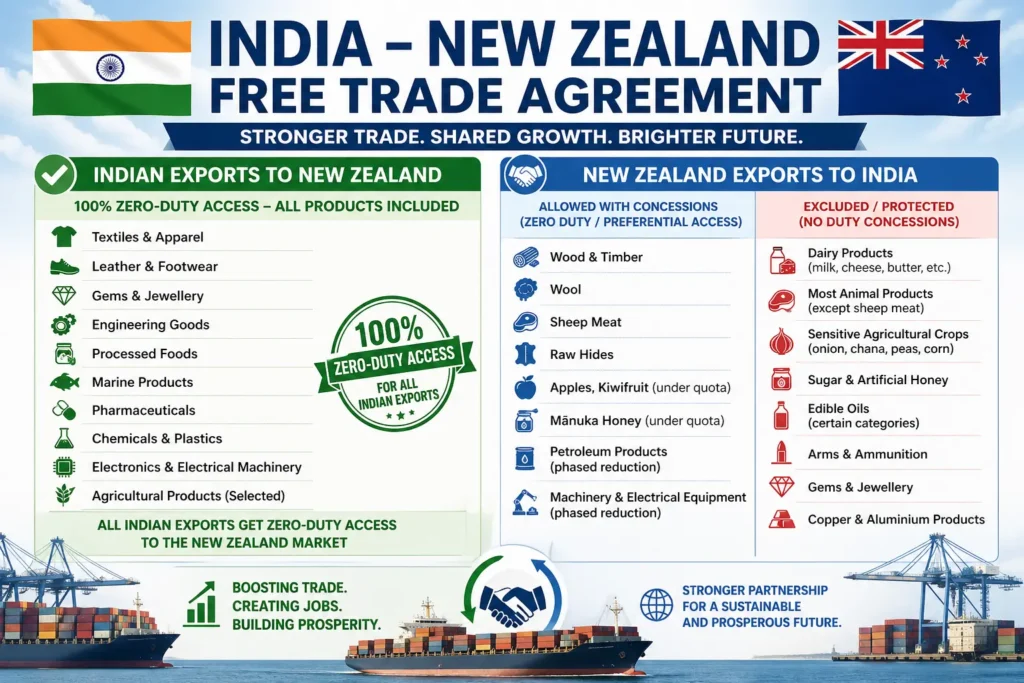
India and New Zealand signed a landmark Free Trade Agreement (FTA) in April 2026, marking a significant milestone in bilateral economic relations. The agreement was concluded in a record 9 months, making it one of the fastest FTAs negotiated by India.
A key highlight of the FTA is that it provides zero-duty access to 100% of Indian exports to New Zealand, boosting sectors such as textiles, leather, engineering goods, and processed foods. At the same time, India has protected sensitive sectors like dairy and certain agricultural products by keeping them in the exclusion list.
The agreement includes a major USD 20 billion investment commitment from New Zealand over 15 years, strengthening long-term economic cooperation. It also focuses on MSMEs, women-led enterprises, and job creation, especially in labour-intensive industries.
In the services sector, the FTA opens new opportunities by allowing access to 118 services sectors and promoting India’s traditional systems like AYUSH (Ayurveda, Yoga, etc.) globally. For the first time, provisions for student mobility and post-study work visas have been included, enabling Indian students and professionals to work and gain international exposure.
Additionally, the agreement facilitates a Temporary Employment Entry (TEE) visa pathway for 5,000 skilled Indian professionals annually and introduces a Working Holiday Visa scheme.
| Category | Products Included (Zero-Duty / Preferential Access) | Products Excluded / Protected (No Duty Concessions) |
|---|---|---|
| Indian Exports to New Zealand | – Textiles & Apparel – Leather & Footwear – Gems & Jewellery – Engineering Goods – Processed Foods – Marine Products – Pharmaceuticals – Chemicals & Plastics – Electronics & Electrical Machinery – Agricultural products (selected) | None (100% tariff elimination) – All Indian exports get zero-duty access |
| New Zealand Exports to India (Allowed with Concessions) | – Wood & Timber – Wool – Sheep Meat – Raw Hides – Apples, Kiwifruit (under quota) – Mānuka Honey (under quota) – Petroleum Products (phased reduction) – Machinery & Electrical Equipment (phased reduction) | – Dairy Products (milk, cheese, butter, etc.) – Most Animal Products (except sheep meat) – Sensitive Agricultural Crops (onion, chana, peas, corn) – Sugar & Artificial Honey – Edible Oils (certain categories) – Arms & Ammunition – Gems & Jewellery – Copper & Aluminium Products |
National Current Affairs
AI for Community-Led Water Management in Rajasthan
A pilot project named AI4WaterPolicy demonstrated how Artificial Intelligence (AI) can strengthen community-led development in the water-stressed districts of Sirohi and Pali in Rajasthan.
This initiative used AI to listen to communities. An AI chatbot conducted over 350 interviews via WhatsApp with local stakeholders such as ‘Pani Mitras’ (water volunteers), Panchayat leaders, and field staff. Conversations were held in Hindi and local dialects using voice and text.
The AI analysed responses and identified key issues such as women’s workload, delays in government approvals, and gaps in understanding Panchayati Raj systems. Based on these insights, training programmes were redesigned mid-cycle, leading to improved community participation and better engagement with government officials.
Energy Capital of India
Three AI-powered e-checkposts have been installed in Singrauli to curb illegal transportation of minerals. The initiative aims to enhance revenue collection and improve transparency in mining operations.
Singrauli, located in northeastern Madhya Pradesh near Uttar Pradesh, is popularly known as the “Energy Capital of India” due to its vast coal reserves and concentration of thermal power plants.
These AI-enabled checkposts use advanced monitoring and surveillance systems to track mineral transport vehicles in real-time, helping authorities detect irregularities, prevent illegal mining activities, and ensure better compliance with regulations.
Science and Technology
Anthropic’s ‘Mythos’ AI Model
Anthropic recently introduced an advanced AI model named Mythos, designed to identify hidden vulnerabilities in software systems. The model was shared selectively with partners under an alliance (Project Glasswing) to strengthen cybersecurity and help organisations detect flaws that traditional tools often miss.
In simple terms, Mythos works like a highly skilled cybersecurity expert. Instead of just scanning for known issues, it actively tests software, tries different inputs, and learns from how the system responds. This helps it find deep, hidden problems that normal tools might miss.
But there’s a risk. Some unauthorised users managed to access this powerful tool using stolen or misused credentials. This is dangerous because if such advanced technology falls into the wrong hands, it could be used to find weaknesses in critical systems like banks, hospitals, or power grids and exploit them quickly.
Person in News
Renowned Photographer Raghu Rai
Renowned Indian photojournalist Raghu Rai passed away in 2026 at the age of 83 after battling cancer. He was one of India’s most celebrated photographers, known for capturing powerful moments of the nation’s social, political, and cultural life.
Raghu Rai’s work documented key historical events, including the Bhopal Gas Tragedy, and iconic personalities such as Indira Gandhi, Dalai Lama, and Mother Teresa.
Daily Current Affairs Quiz
Test your knowledge with exam-oriented multiple choice questions based on today’s current affairs.
Disclaimer: This article is prepared for competitive exam preparation using publicly available information.