Andhra Pradesh Space Policy 4.0 (2025–2030)
Modified: 30 May 2025
Table of Contents
On July 13, 2025, the Government of Andhra Pradesh issued the Andhra Pradesh Space Policy 4.0 (2025–2030) through G.O.Ms. No.122 — just 16 days after the companion Aerospace and Defence Policy. Together, these twin policies represent the most ambitious industrial roadmap for Andhra Pradesh.
The Space Policy is significant because Andhra Pradesh has a natural advantage in India’s space ecosystem: it is home to Sriharikota, India’s only operational spaceport. The policy converts that geographic asset into an economic one, creating two Space Cities, a dedicated implementing corporation, and a comprehensive incentive framework targeting ₹25,000 crore in investment and 35,000 jobs over ten years.
At a Glance
| Parameter | Detail |
|---|---|
| Policy Name | AP Space Policy 4.0 |
| Government Order | G.O.Ms.No.122 |
| Date of Issue | July 13, 2025 |
| Policy Period | 2025–2030 (5 years; valid until new policy announced) |
| Investment Target | ₹25,000 crore (over 10 years) |
| Direct Jobs Target | 5,000 |
| Indirect Jobs Target | 30,000 |
| Implementing SPV | Andhra Pradesh Space City Corporation |
| Nodal Agency (Land) | APIIC |
| Honorary Advisor (Space) | Sri Sreedhara Panicker Somanath |
Space Policy Vision
“The Government of Andhra Pradesh envisions positioning the State as a globally competitive and innovation-driven hub for space research, technology development, manufacturing, and launch services.”
Five Mission Objectives
- Develop a comprehensive and inclusive industrial ecosystem for startups, large enterprises, academic institutions, and global investors
- Attract domestic and foreign investment in upstream, midstream, and downstream segments of the space value chain
- Facilitate space-based innovations in governance, education, agriculture, disaster management, and environmental monitoring
- Support national space programmes through industrial supply base development, proximity advantages, and targeted manufacturing clusters near Sriharikota
- Promote public-private partnerships and encourage technology transfer through regulatory frameworks and funding mechanisms
The Two Space Cities
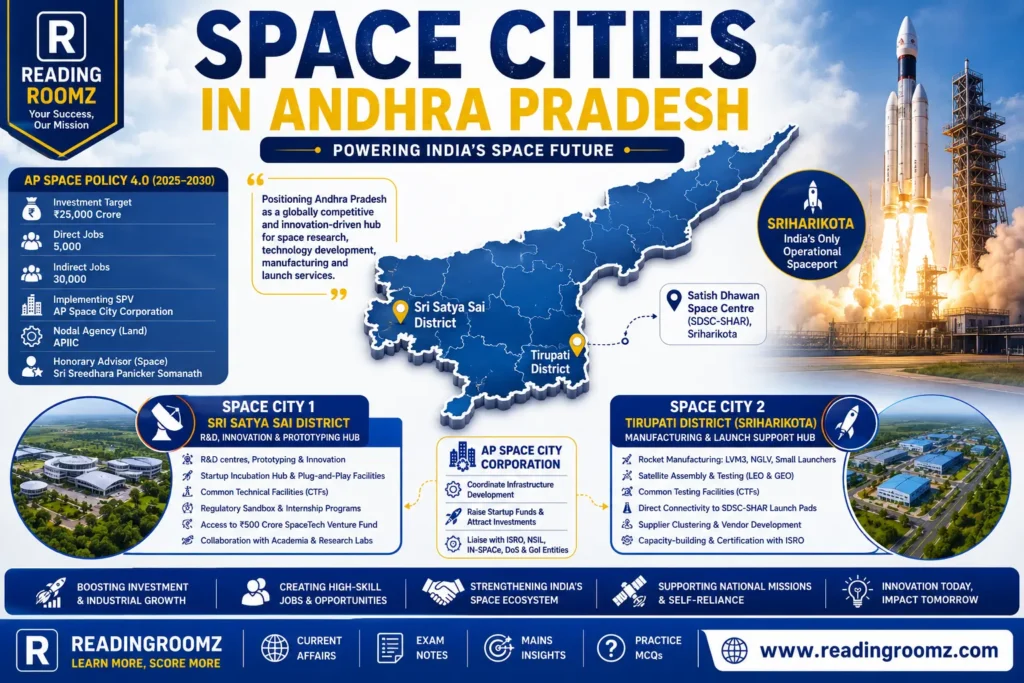
The policy establishes two dedicated Space Cities, each with a distinct industrial focus:
Space City 1 — Sri Satya Sai District
| Feature | Detail |
|---|---|
| Location | Sri Satya Sai District, along Hyderabad–Bengaluru Industrial Corridor (HBIC) |
| Focus | Design, R&D, Innovation, and Prototyping (upstream activities) |
| Proximity | Close to Bengaluru — ISRO R&D hub, prominent aerospace clusters |
What it will offer:
- R&D centre for space systems, subsystems, and payloads
- Dedicated Space Startup Incubation Hub with plug-and-play R&D facilities
- Common Technical Facilities (CTFs): cleanrooms, vacuum chambers, EMI/EMC labs, simulation labs
- Regulatory sandbox for experimental design and prototyping
- Access to ₹500 crore SpaceTech Venture Fund
- Internship programme connecting graduates to design, engineering, and innovation roles
- Collaboration with academic institutions and research laboratories
Space City 2 — Tirupati District
| Feature | Detail |
|---|---|
| Location | Tirupati District, near Kalahasti (Routhasuramala) |
| Focus | Manufacturing, Integration, and Launch Support Services (midstream/downstream) |
| Proximity | Near Satish Dhawan Space Centre (SDSC-SHAR), Sriharikota |
| Land earmarked | ~1,000 acres (long-term leases) |
What it will offer:
- Rocket manufacturing ecosystem: LVM3, NGLV, small launchers
- High-volume satellite assembly and testing lines (LEO and GEO satellites)
- Common Testing Facilities (CTFs): thermal vacuum chambers, vibration and structural testing, environmental simulation labs
- Dedicated logistics corridor (6-lane road) with direct access to SDSC-SHAR launch pads
- PPP-driven expansion in co-development with ISRO/NSIL and private industry
- Clustering of suppliers, satellite integrators, and launch logistics service providers
- Vendor development programme for Tier-II and Tier-III suppliers
- Capacity-building and certification in collaboration with ISRO
The policy envisions Space City Tirupati (Sriharikota) as India’s foremost integrated rocket and satellite production and launch ecosystem.
Andhra Pradesh Space City Corporation (New SPV)
A dedicated Special Purpose Vehicle — the AP Space City Corporation — will:
- Coordinate infrastructure development across both Space Cities
- Raise startup funds and attract investments
- Liaise with ISRO, NSIL, IN-SPACe, DoS, and other GoI entities for domestic demand
India’s Space Ecosystem
| Indicator | Data |
|---|---|
| Global space economy size | Over USD 500 billion |
| India’s current share | ~2% (USD 8–10 billion) |
| India’s 2030 target | USD 44 billion |
| Private firms supporting ISRO | 700+ |
| Space-focused startups in India | 200–250 |
| GoI Space VC Fund | ₹1,000 crore |
| Technology Adoption Fund (IN-SPACe) | ₹500 crore |
| FDI in the Indian space (last 5 years) | USD 354 million |
India’s space ecosystem has three key pillars under the Department of Space:
- ISRO: Principal agency for space missions, launch vehicles, satellites, deep space exploration (Chandrayaan, Mangalyaan, Gaganyaan)
- IN-SPACe: Single-window facilitator and regulator for private sector participation; manages Technology Adoption Fund (₹500 crore) and VC Fund (₹1,000 crore)
- NSIL (NewSpace India Limited): Commercial arm of DoS; handles PPP production of PSLV, SSLV, NGLV
Key Government of India Space Projects: AP Can Supply
| Project | Significance for AP |
|---|---|
| Satellite Constellations (LEO/GEO) | Manufacturing demand for satellite platforms, subsystems |
| Chandrayaan-4 (lunar, by 2027) | Advanced payload and composite material manufacturing |
| Venus Orbiter Mission (VOM) | Deep-space tech manufacturing |
| Mars Lander Mission (MLM) | High-precision components |
| Bharatiya Antariksh Station (BAS) — 50 tonnes by 2035 | Human spaceflight infrastructure |
| First Indian on the Moon — by 2040 | Habitation modules, astronaut infrastructure |
| NGLV (Next Generation Launch Vehicle) | Rocket manufacturing at Space City Tirupati |
| 3rd Launch Pad — Sriharikota | Ancillary services, logistics, and AP directly benefit |
| New spaceport — Kulasekarapattinam | AP Space City Tirupati as a manufacturing feeder |
Frequently Asked Questions
What is the AP Space Policy 4.0?
It is the Andhra Pradesh government’s five-year industrial and investment policy (2025–2030) aimed at making the state a globally competitive hub for space research, manufacturing, and launch services. It targets ₹25,000 crore in investment over 10 years and 5,000 direct and 30,000 indirect jobs. Issued on July 13, 2025, through G.O.Ms. No.122.
What is the investment target of AP Space Policy 4.0?
The policy aims to attract ₹25,000 crore investment over 10 years.
What are the two Space Cities proposed under AP Space Policy 4.0?
Space City 1: Sri Satya Sai District (R&D, Design, Innovation, Prototyping)
Space City 2: Tirupati District (near Sriharikota) Manufacturing, Integration & Launch Support
Who is the honorary advisor under AP Space Policy 4.0?
Former ISRO Chairman Sri Sreedhara Panicker Somanath is the honorary advisor for the policy.
Which organisation is the nodal agency for land allocation under AP Space Policy?
APIIC (Andhra Pradesh Industrial Infrastructure Corporation) is the nodal agency for land allotment and infrastructure development.
Join Our Community
Study with the ReadingRoomz Community
Join thousands of APPSC aspirants. Get daily current affairs, MCQs, PDFs, and preparation guidance — all in one place.