AP Aerospace and Defence Policy 4.0 (2025–2030)
Modified: 29 May 2026
Table of Contents
On June 27, 2025, the Government of Andhra Pradesh issued the Andhra Pradesh Aerospace and Defence Policy 4.0 (2025–2030) through G.O.Ms.No.111, marking a defining moment in the state’s industrial transformation. The policy positions AP as a future-ready hub for defence manufacturing, aerospace R&D, naval production, drones, and missile systems — sectors that are reshaping India’s strategic and economic landscape alike.
For APPSC aspirants, this is not just a current affairs topic. It is an MCQ, Mains essay source that connects industrial policy, geography, defence strategy, and fiscal incentives.
At a Glance
| Parameter | Detail |
|---|---|
| Government Order | G.O.Ms.No.111 |
| Date of Issue | June 27, 2025 |
| Policy Period | 2025–2030 (5 years) |
| Investment Target | ₹1 lakh crore |
| Employment Target | 1 lakh jobs |
| Land Identified | 23,000 acres across the state |
| Nodal Agency | APIIC (AP Industrial Infrastructure Corporation) |
| Approval System | Single Desk Approval via AP Single Desk Portal |
Vision and Strategic Objectives
The policy aims to establish Andhra Pradesh as a global hub for research, development, and manufacturing in aerospace and defence. Its core focus areas are:
- Missile systems and precision-guided munitions
- Aircraft manufacturing and MRO (Maintenance, Repair & Overhaul)
- Naval and shipbuilding
- Unmanned systems — drones and robotics
- Space-tech manufacturing
- Specialised materials: tungsten, copper, composite fibres, technical textiles, advanced resins
AP’s geographic strengths — a 975 km coastline for naval industries, proximity to ISRO’s Satish Dhawan Space Centre at Sriharikota, and location between Bengaluru and Chennai aerospace corridors — make this vision credible.
The Hub-and-Spoke Cluster Model
One of the most structurally distinctive features of Policy 4.0 is its hub-and-spoke development model:
- Hubs: Large, technologically advanced anchor enterprises
- Spokes: Sub-sector-focused MSME parks radiating around each hub
- Common Facility Centres (CFCs): Shared infrastructure within MSME parks, reducing capital barriers for smaller players
- Nodal Agency: APIIC handles land allotment and cluster development
Both public and private lands are used for setting up clusters. Each cluster is equipped with approach roads, uninterrupted power supply, water facilities, and common testing infrastructure.
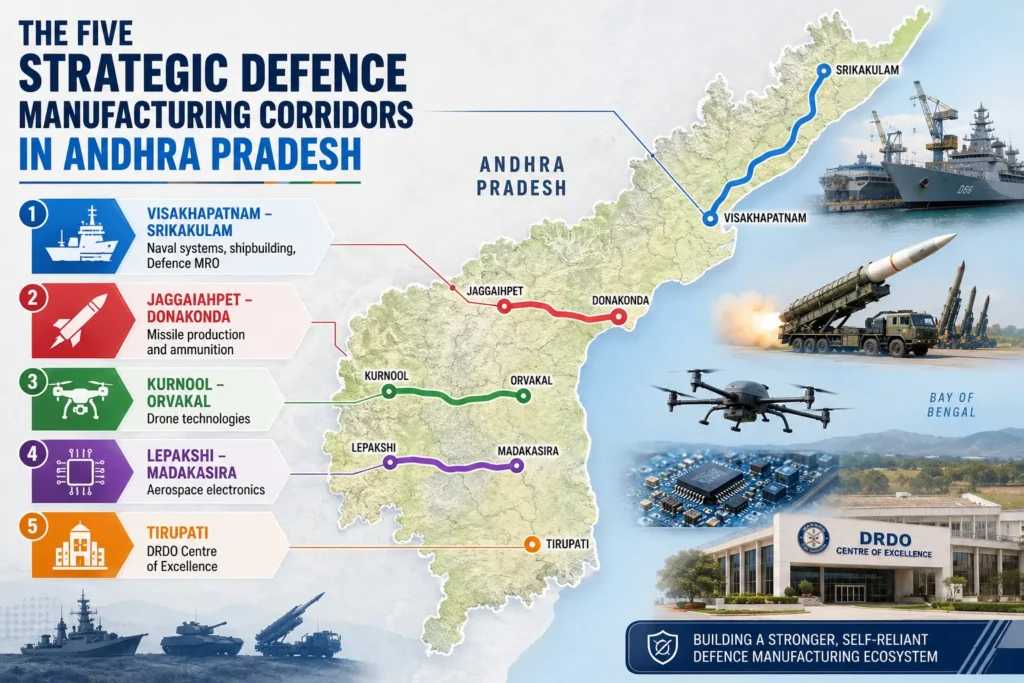
The Five Strategic Defence Manufacturing Corridors
| Corridor | Focus Sector |
|---|---|
| Visakhapatnam – Srikakulam | Naval systems, shipbuilding, Defence MRO |
| Jaggaiahpet – Donakonda | Missile production and ammunition |
| Kurnool – Orvakal | Drone technologies |
| Lepakshi – Madakasira | Aerospace electronics |
| Tirupati | DRDO Centre of Excellence |
DRDO-ADA AMCA Complex at Puttaparthi — The Recent Development
The Government of Andhra Pradesh has formally committed to hosting a world-class Aircraft Integration and Flight Testing Complex at Puttaparthi, Sri Sathya Sai district, to be built by the Aeronautical Development Agency (ADA) under DRDO.
Key facts:
- 350 acres proposed — 150 acres adjoining the Puttaparthi runway + 200 acres for satellite office complex and residential township
- An additional 300 acres are planned for the surrounding aerospace manufacturing ecosystem
- The project has received in-principle approval from the Ministry of Defence
- Linked to India’s Advanced Medium Combat Aircraft (AMCA) programme — India’s planned fifth-generation stealth fighter aircraft
- AMCA prototype targeted: late 2026 – early 2027; first flight expected: 2028
- The runway at Puttaparthi will be extended to 10,000 feet
- Puttaparthi selected for: proximity to Bengaluru and dedicated airspace (reduces interference from commercial air traffic)
- Foundation stone laid by Union Defence Minister Rajnath Singh and CM Chandrababu Naidu on May 15, 2025
The investment expected from the DRDO ecosystem alone is close to ₹1 lakh crore.
Incentive Structure
For Startups
| Incentive | Amount |
|---|---|
| Equity-based support | Up to ₹50 lakh |
| Go-to-market assistance | Up to ₹50 lakh |
| Deeptech/Advanced startup funding | Up to ₹1 crore |
| Rental subsidy (co-working/MSME parks) | 100% for 30 employees for 1 year |
| Facilitated through | AP Innovation & Startup Policy 4.0 + Ratan Tata Innovation Hub |
For MSMEs
Overall incentive cap: 75% of Fixed Capital Investment (FCI)
| Incentive Type | Rate |
|---|---|
| Investment Subsidy (General) | 25% of FCI (Micro, Small); 25% of FCI (Medium) |
| Investment Subsidy (Special Category) | 45% of FCI (Micro, Small); 35% of FCI (Medium) |
| Power Subsidy | ₹1/unit for 5 years (general); ₹1.5/unit for 5 years (special category) |
| Stamp Duty & Transfer Duty | 100% reimbursement |
| MSME Startup Corpus | Dedicated ₹100 crore corpus |
Special Category applies to enterprises owned by Women / BC / SC / ST / Minority / Specially-abled / Transgender entrepreneurs with AP domicile.
For Large Enterprises (FCI: ₹125 crore – ₹500 crore)
Overall incentive cap: 100% of FCI
| Incentive Type | Detail |
|---|---|
| Investment Subsidy | 15% of eligible FCI, capped at ₹75 crore (over 3 years) |
| Technology Transfer Subsidy | 50% of the cost, up to ₹1 crore (over 4 years) |
| Land Rebate — First 5 Anchor Investors | 25% rebate on the APIIC gross selling price of land |
| Land Rebate — Other Large Enterprises | 10% rebate on the APIIC gross selling price of land |
| PLI Top-up (GoI scheme projects) | 10% of the GoI incentive amount, capped at 5% of FCI |
| SGST Reimbursement | 100% for 5 years |
| Stamp Duty | 100% reimbursement |
| Land Conversion Charges | 100% reimbursement |
| Decarbonization Subsidy | 20% (non-red)/25% (red category), capped at 6% of FCI |
Investment Categories Defined
| Category | FCI Range | Investment Period |
|---|---|---|
| MSME | As per GoI definition | 2 years |
| Large Enterprise | ₹125 crore – ₹500 crore | 3 years |
| Mega Enterprise | Above ₹500 crore | 4 years |
National Context: Why This Policy Matters Now
| National Indicator | Data |
|---|---|
| India’s Defence Budget FY 2025–26 | ₹6.81 lakh crore (USD 77.4 billion) |
| Defence Exports FY 2024–25 | ₹23,622 crore |
| Defence Export Target | ₹50,000 crore by FY 2028–29 |
| MSME Supply Chain | 12,000+ MSMEs in the defence sector |
| Export growth (last decade) | 34x increase |
AP wants to be a decisive contributor to this national story. The policy aligns directly with Atmanirbhar Bharat, India’s Positive Indigenisation List (restricting defence imports that can be made domestically), and liberalised FDI norms for the defence sector.
Eligible Activities Under the Policy
The policy covers:
- Manufacturing activities as per the Defence Acquisition Procedure (DAP) of the Government of India
- MRO services for aircraft, defence and naval equipment
- Defence Technology and Test Centres (DTTCs)
- Specialised testing ranges, simulation centres, and training academies for the Army, Navy, Air Force
- Centres of Excellence for R&D and innovation
Challenges to Watch (For Mains)
- Land acquisition delays: 23,000 acres “identified”, but revenue, environmental, and regulatory clearances can take years
- Skilled workforce: Defence manufacturing needs specialised engineers, technicians, and researchers
- Long gestation periods: Defence projects have complex testing, certification, and regulatory requirements
- State competition: Tamil Nadu, Karnataka, Uttar Pradesh (Defence Industrial Corridor), and Telangana all have competing ambitions
Frequently Asked Questions
What is the AP Aerospace and Defence Policy 4.0?
It is the Andhra Pradesh government’s five-year industrial framework (2025–2030) to attract ₹1 lakh crore in investments, create 1 lakh jobs, and position the state as a national and global leader in defence manufacturing, aerospace R&D, drone technology, naval production, and missile systems. It was issued on June 27, 2025, through G.O.Ms. No.111.
What are the investment and employment targets of AP Aerospace and Defence Policy 4.0?
The policy targets ₹1 lakh crore in new investments and 1 lakh new jobs over the five-year period 2025–2030.
What are the five strategic manufacturing corridors under AP Aerospace and Defence Policy 4.0?
1. Visakhapatnam–Srikakulam: Naval systems, shipbuilding, MRO
2. Jaggaiahpet–Donakonda: Missile production and ammunition
3. Kurnool–Orvakal: Drone technologies
4. Lepakshi–Madakasira: Aerospace electronics
5. Tirupati: DRDO Centre of Excellence
Which corridor in AP is dedicated to drone manufacturing?
The Kurnool–Orvakal corridor is dedicated to drone technologies under AP Aerospace and Defence Policy 4.0.
Which corridor is focused on missile production in Andhra Pradesh?
The Jaggaiahpet–Donakonda corridor is focused on missile production and ammunition.
How many acres has AP allocated for the DRDO facility at Puttaparthi?
350 acres — 150 acres adjoining the Puttaparthi runway and 200 acres for a satellite office complex and residential township. An additional 300 acres is planned for the broader aerospace manufacturing ecosystem.
What is the AMCA programme and why is Puttaparthi significant?
AMCA (Advanced Medium Combat Aircraft) is India’s indigenous fifth-generation stealth fighter aircraft programme managed by ADA/DRDO. Puttaparthi was selected for the integration and flight testing complex because of its proximity to Bengaluru (where ADA and ISRO R&D hubs are located) and its dedicated airspace that minimises interference from commercial aviation. The runway will be extended to 10,000 feet to support test flights.
Who is the nodal agency for land allotment under AP Aerospace and Defence Policy 4.0?
APIIC — the Andhra Pradesh Industrial Infrastructure Corporation — is the nodal agency for land allotment and cluster development.
What are the priority materials under AP Aerospace and Defence Policy 4.0?
Specialised metals, including tungsten and copper, and composite materials, including fibres, technical textiles, and advanced resins used for lightweight yet resilient aerospace components.
Join Our Community
Study with the ReadingRoomz Community
Join thousands of APPSC aspirants. Get daily current affairs, MCQs, PDFs, and preparation guidance — all in one place.