Minor Minerals and Major Minerals in India
విషయ సూచిక
Minerals are the backbone of India’s industrial growth. Understanding major minerals and minor minerals in India is essential for UPSC, APPSC, SSC, and other competitive exams.
What Are Minerals?
Minerals are natural substances found in the Earth’s crust with definite physical and chemical properties. In India, mining and mineral regulation come under the Mines and Minerals (Development and Regulation) Act, 1957 (MMDR Act).
Classification: Major and Minor Minerals in India
India’s minerals are divided into two broad categories major minerals and minor minerals for governance, taxation, and management.
This classification helps determine:
- Which government (Central or State) regulates a mineral.
- The royalty and lease period.
- Environmental and policy regulations.
What Are Major Minerals?
There is no explicit definition of major minerals in the MMDR Act, but all minerals that are not minor minerals are officially designated as major minerals in India. They include metallic, non-metallic, and energy minerals vital for industries and national development.
List of Major Minerals in India
Here is a list of major minerals in India, often asked in UPSC, APPSC and State PSC exams:
| కేటగిరీ | Major Minerals Examples |
|---|---|
| Metallic Minerals | Iron Ore, Bauxite, Manganese, Copper, Lead, Zinc, Chromite, Gold |
| Non-Metallic Minerals | Limestone, Gypsum, Mica, Dolomite, Phosphate, Graphite |
| Energy Minerals | Coal, Lignite, Uranium, Petroleum, Natural Gas |
These major minerals in India UPSC questions are frequently asked to test knowledge of mineral belts, industries, and resource distribution.
What Are Minor Minerals?
According to Section 3(e) of the MMDR Act, minor minerals mean:
“Building stones, gravel, ordinary clay, ordinary sand, and any other mineral declared as a minor mineral by the Central Government.”
In short minor minerals are mainly used for construction and local industries, while major minerals are essential for heavy industries like steel, power, and cement.
Legal Framework: MMDR Act 1957
- Major minerals – Regulated by the Central Government.
- Minor minerals – Regulated by the State Governments under Section 15 of the MMDR Act.
- Rules like the Mineral Concession Rules, 1960 and Mineral Conservation and Development Rules, 1988apply primarily to major minerals.
The classification between minor and major minerals is crucial for understanding governance and economic policies.
Distribution of Major Minerals in India
For UPSC and State PSC exams, knowing where major minerals are found in India is vital.
| ఖనిజం | ప్రధాన ఉత్పత్తి రాష్ట్రాలు |
|---|---|
| Iron Ore | Odisha, Jharkhand, Chhattisgarh, Karnataka |
| Coal | Jharkhand, Odisha, Chhattisgarh, West Bengal |
| Bauxite | Odisha, Gujarat, Jharkhand, Maharashtra |
| Mica | Andhra Pradesh, Jharkhand, Bihar |
| Copper | Rajasthan, Madhya Pradesh, Jharkhand |
| Zinc & Lead | Rajasthan (Zawar mines) |
| Limestone | Madhya Pradesh, Andhra Pradesh, Chhattisgarh |
Exam Tip:
Questions like “Which state leads in production of iron ore in India?” or “List of major minerals in India and their locations” are common in UPSC Prelims and State PSC exams.
Importance of Major and Minor Minerals
ఆర్థిక ప్రాముఖ్యత
- Major minerals power industries like steel, cement, aluminium, and electricity.
- Minor minerals like sand and gravel support housing, roads, and infrastructure.
Social Importance
- Provide employment to millions.
- Drive local economies in mineral-rich districts.
Environmental Aspect
- Both types of mining can impact ecosystems, requiring sustainable management.
Recent Update (2025)
Feb 2025: Ministry of Mines notified that barytes, felspar, mica and quartz will be treated as major minerals (instead of minor). This has implications for leases (50 yrs) and regulation.
October 2025: The గనుల మంత్రిత్వ శాఖ classified Limestone as a major mineral completely, removing the earlier dual classification (it was partly treated as a minor mineral when used for lime kilns).
This makes it a trending topic for major minerals and minor minerals UPSC 2025 questions.
Difference Between Major and Minor Minerals
| కోణం | Major Minerals | Minor Minerals |
|---|---|---|
| నిర్వచనం | All minerals not declared as minor | As per Sec 3(e) MMDR Act |
| Regulated by | Central Government | State Government |
| ఉదాహరణలు | Iron ore, Coal, Bauxite, Copper, Limestone | Building stones, Gravel, Ordinary sand |
| Use | Heavy industries, power, export | Construction, local economy |
| Lease Period | Up to 50 years | Usually 5–10 years |
Key Government Reforms
- 2021 Amendment – Introduced mineral auction transparency.
- 2023–24 – Increased royalty for certain major minerals.
- 2025 – Limestone, barytes, felspar, mica and quartz fully reclassified as major mineral; new policy for sustainable mining introduced.
Quick Recap
- Major minerals: Iron, Coal, Bauxite, Mica, Limestone, Copper, etc.
- Minor minerals: Building stones, Gravel, Sand, Clay.
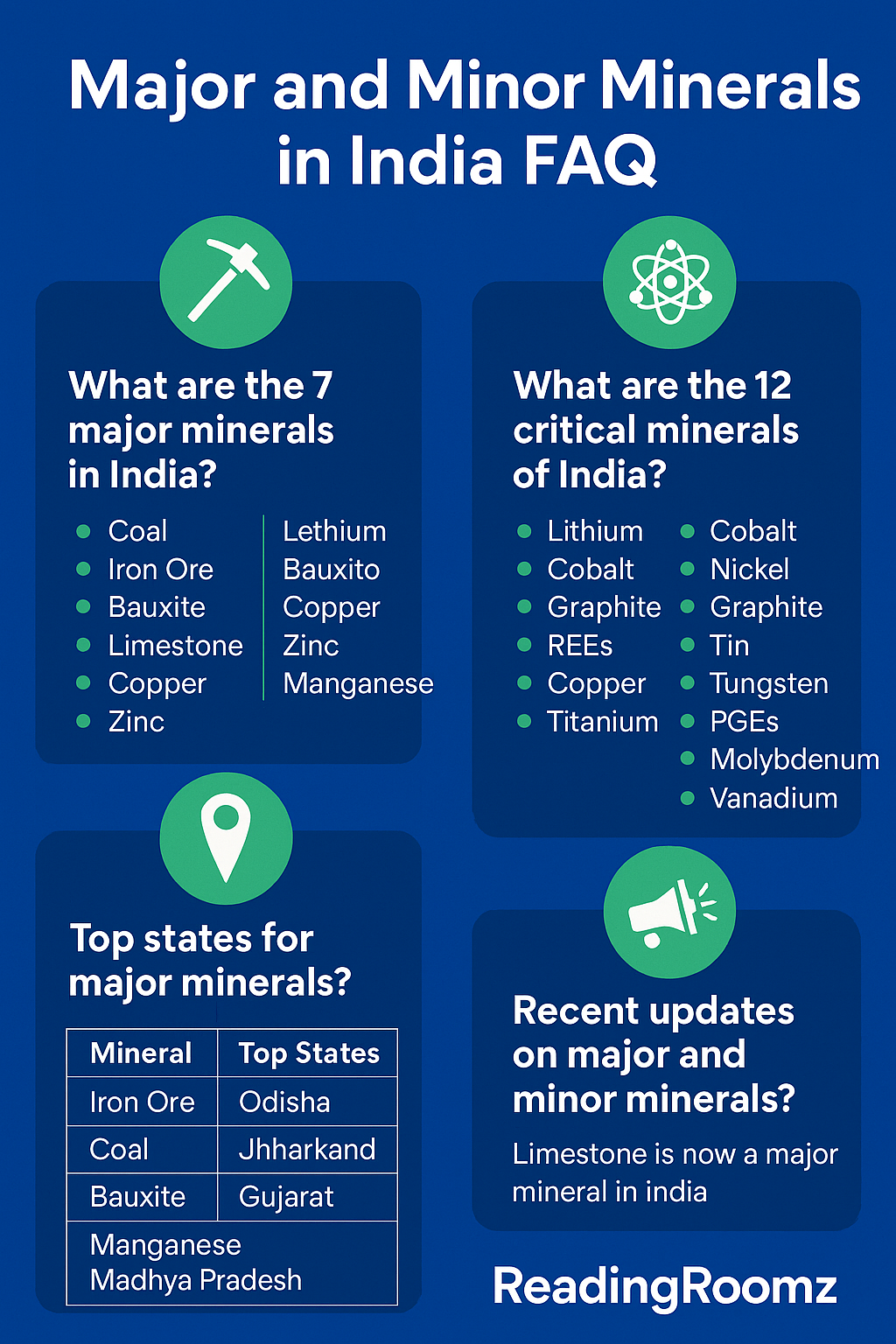
- Recent update: Limestone now classified as a major mineral (2025).
- Exam tip: Prepare the list of major minerals in India + their producing states.
తరచుగా అడిగే ప్రశ్నలు (FAQs)
-
What are the 7 major minerals in India?
The seven major minerals in India are coal, iron ore, bauxite, limestone, copper, zinc, and manganese.
These minerals form the foundation of India’s core industries like power, steel, cement, and construction.
They are officially designated as major minerals under the Mines and Minerals (Development and Regulation) Act, 1957. -
What are the 7 main types of minerals?
Minerals are broadly categorized into seven main types based on their chemical composition:
Native Elements (e.g., gold, silver)
Silicates (e.g., quartz, feldspar)
Oxides (e.g., hematite, bauxite)
Sulfides (e.g., galena, pyrite)
Sulfates (e.g., gypsum)
Carbonates (e.g., limestone, calcite)
Halides & Phosphates (e.g., fluorite, apatite)
These categories help classify both major and minor minerals found in India for academic and industrial reference. -
What are the 12 critical minerals of India?
The 12 critical minerals of India, identified by the Ministry of Mines (2023) for national security and clean energy needs, are:
Lithium
Cobalt
Nickel
గ్రాఫైట్
Rare Earth Elements (REEs)
Copper
Tin
Tungsten
Titanium
Platinum Group Elements (PGEs)
Molybdenum
Vanadium
These minerals are crucial for electric vehicles (EVs), renewable energy, defense manufacturing, and semiconductor production. -
What is the largest mineral found in India?
The largest mineral resource in India by volume is coal, accounting for nearly 55% of the country’s total mineral output.
India ranks among the top five global producers of coal, with major deposits in Jharkhand, Odisha, Chhattisgarh, and West Bengal.
In terms of metallic minerals, iron ore holds the second-largest reserve base. -
What are officially designated major minerals in India?
The officially designated major minerals in India are those not declared as minor minerals under Section 3(e) of the MMDR Act, 1957. These include key resources like coal, iron ore, bauxite, copper, zinc, lead, gold, silver, and limestone. As per the latest 2025 notification, limestone has now been classified completely as a major mineral by the Ministry of Mines.
-
What are major minerals and minor minerals aspirants should remember?
Major minerals → Iron ore, Coal, Bauxite, Mica, Copper, Zinc, Gold, Limestone.
Minor minerals → Building stones, Gravel, Sand, Ordinary clay, Marble (for construction).
The difference lies in their usage and the level of government regulation — Central Government regulates major minerals, while State Governments regulate minor minerals. -
What is the difference between major minerals and minor minerals in India?
Major minerals in India are used in heavy industries (steel, cement, energy) and regulated by the Central Government.
Minor minerals are used for construction (sand, stones, clay) and regulated by State Governments.
Example: Iron ore → major mineral; ordinary sand → minor mineral. -
Which state in India is richest in minerals?
Odisha is the richest Indian state in mineral resources, contributing around 35% of India’s total mineral production. It is abundant in iron ore, bauxite, chromite, coal, and manganese, making it the powerhouse of India’s mining sector.
-
Which department regulates major minerals in India?
The Ministry of Mines, under the Government of India, regulates exploration, development, and conservation of major minerals. The State Departments of Mines and Geology oversee minor minerals as per powers granted under Section 15 of the MMDR Act.
-
What are the top producing states of major minerals in India?
Iron Ore – Odisha, Jharkhand, Chhattisgarh
Coal – Jharkhand, Odisha, Chhattisgarh
Bauxite – Odisha, Gujarat, Maharashtra
Manganese – Odisha, Madhya Pradesh, Karnataka
Copper – Rajasthan, Jharkhand, Madhya Pradesh
Zinc – Rajasthan
Limestone – Madhya Pradesh, Andhra Pradesh, Chhattisgarh -
How many total major minerals are found in India?
India officially recognizes over 90 major minerals, including metallic, non-metallic, and fuel minerals. These are crucial for industries such as steel, cement, electricity, fertilizers, and automobiles.
మూలం: పి ఐ బి