Lok Adalats
Table of Contents
Lok Adalats and the Idea of People-Centric Justice
Lok Adalats represent India’s unique model of justice delivery where disputes are resolved through consensus, cooperation, and compassion, rather than prolonged courtroom battles. Rooted in the constitutional vision of access to justice for all, Lok Adalats provide an informal, speedy, and cost-free mechanism for dispute resolution.
For competitive exam aspirants (APPSC, UPSC, SSC), Lok Adalats is very important topic under Polity, Governance, Judiciary, and Social Justice, frequently asked in both Prelims and Mains.
What are Lok Adalat?
Lok Adalat is a statutory forum where disputes are settled amicably through conciliation, without following strict procedural laws.
- They function under the Legal Services Authorities Act, 1987
- Awards passed are final, binding, and equivalent to a civil court decree
- No appeal lies against a Lok Adalat award
In simple terms, Lok Adalat focus on settlement, not litigation.
Legal Basis of Lok Adalat
Legal Services Authorities Act, 1987
The Legal Services Authorities Act, 1987 gives statutory recognition to Lok Adalat and establishes a nationwide legal aid framework.
Key Legal Provisions
- Establishment of Lok Adalats at National, State, District, Taluk levels
- Referral of pending and pre-litigation cases
- No court fee; already paid fee is refunded
- Final and binding award, treated as a civil court decree
- Provision for Permanent Lok Adalats for public utility services
Lok Adalat awards are enforceable like court judgments but no appeal is allowed.
Institutional Structure of Lok Adalat (4-Tier System)
| Level | Authority | Key Role |
|---|---|---|
| National | NALSA (under CJI) | Policy, National Lok Adalat calendar |
| State | SLSA | State-level Lok Adalats & legal aid |
| District | DLSA | District & Taluk coordination |
| Taluk | TLSC | Grassroots dispute resolution |
This structure ensures justice reaches the last mile, including rural and remote areas.
Types of Lok Adalat in India
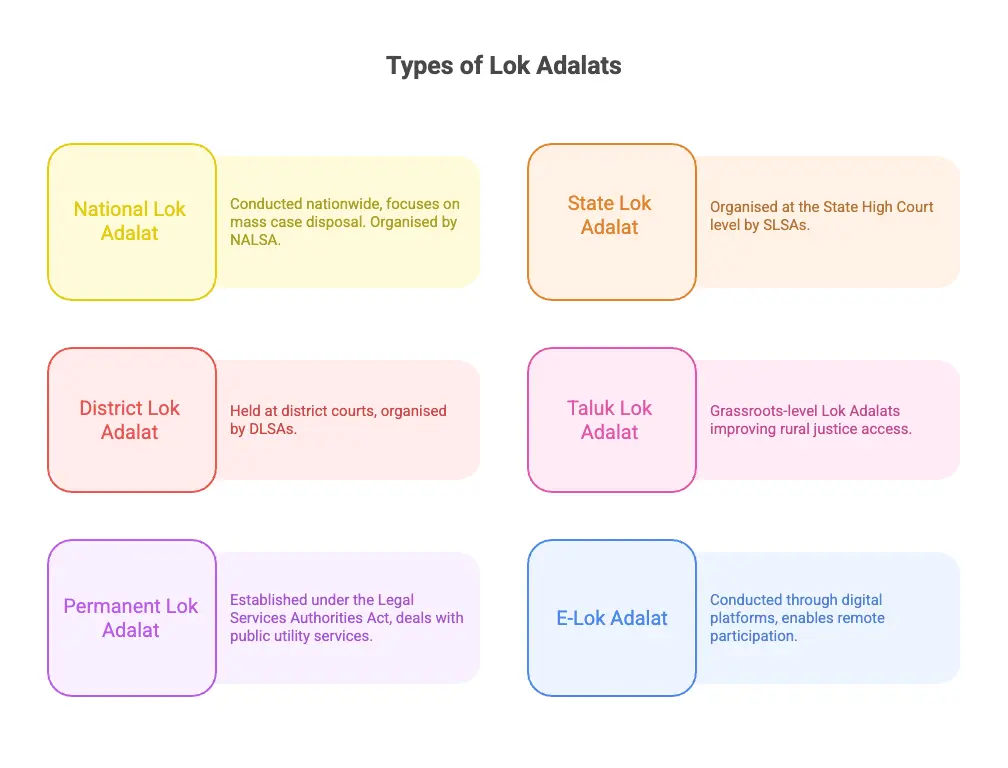
1. National Lok Adalat
- Conducted simultaneously across India
- Organised as mission-mode campaigns
- Handle lakhs of cases in a single day
- Cases updated on National Judicial Data Grid (NJDG)
2. E-Lok Adalat
- Virtual Lok Adalats using digital platforms
- Gained momentum during COVID-19
- Enable participation from home
- Strengthen digital justice delivery
3. Permanent Lok Adalat (PLAs)
| Feature | Details |
|---|---|
| Legal Provision | Sections 22B–22E, LSA Act |
| Jurisdiction | Up to ₹1 crore |
| Coverage | Public Utility Services |
| Nature | Conciliation + Adjudication |
Public Utility Services include:
- Transport
- Electricity
- Water supply
- Postal services
- Telecom
If conciliation fails, PLAs can decide the case, unlike regular Lok Adalat.
Key Advantages
- Speedy justice
- Zero litigation cost
- Mutual settlement
- Reduction in court backlog
- Accessible at local level
Lok Adalat embody the constitutional principle of Article 39A – Equal Justice and Free Legal Aid.
👉 Go to Daily Current Affairs Section
Frequently Asked Questions (FAQs)
What is meant by Lok Adalat?
Lok Adalat literally means “People’s Court.”
It is an alternative dispute resolution (ADR) mechanism where disputes are settled amicably through compromise and conciliation, instead of formal court trials.
Lok Adalats are organised under the Legal Services Authorities Act, 1987 and aim to provide speedy, cost-free, and people-friendly justice.
Are Lok Adalat awards legally binding?
Yes. Lok Adalat awards are final, binding, and treated as civil court decrees.
Can Lok Adalat decisions be appealed?
No. There is no appeal against a Lok Adalat award.
Which disputes are handled by Permanent Lok Adalat?
Disputes related to public utility services such as electricity, transport, water, telecom, and postal services.
Who organises National Lok Adalat?
The National Legal Services Authority (NALSA) organises National Lok Adalat across India.
What are the 6 types of Lok Adalat?
For exam clarity, Lok Adalats can be broadly classified into the following six types:
National Lok Adalat
Conducted simultaneously across the country on pre-notified dates
Organised by NALSA
Focuses on mass disposal of cases
State Lok Adalat
Organised at the State High Court level
Conducted by State Legal Services Authorities (SLSA)
District Lok Adalat
Held at district courts
Organised by District Legal Services Authorities (DLSA)
Taluk / Mandal Lok Adalat
Grassroots-level Lok Adalats
Improves access to justice in rural and semi-urban areas
Permanent Lok Adalat (PLA)
Established under Sections 22B–22E of the Legal Services Authorities Act
Deals with public utility services
Has power to decide cases if conciliation fails
E-Lok Adalat
Conducted through digital/virtual platforms
Introduced especially during COVID-19
Enables remote participation by parties
Permanent Lok Adalat is the only Lok Adalat with adjudicatory powers.
Which cases are taken in Lok Adalat?
Lok Adalats handle both pre-litigation and pending court cases, provided both parties agree for settlement.
Common types of cases taken up:
Motor accident compensation cases
Bank loan recovery disputes
Cheque bounce cases (Section 138, NI Act)
Family disputes (maintenance, matrimonial issues)
Land and property disputes (compoundable)
Labour and service matters
Insurance claim disputes
Public utility service disputes (in Permanent Lok Adalats)
Cases NOT taken up:
Non-compoundable criminal offences
Serious crimes like murder, rape, terrorism
Consent of parties is mandatory for settlement in Lok Adalats.
Source: Lok Adalats