Legal Services Authorities Act, 1987
Table of Contents
The Legal Services Authorities Act 1987 is a milestone in our government commitment to equality before the law. It ensures that no citizen is denied justice because of poverty, illiteracy, or social disadvantage. Every year, November 9 is celebrated as National Legal Services Day to commemorate the enactment of this law, which came into effect on 9th November 1995.
📸 Image Courtesy: Press Information Bureau (PIB), Government of India
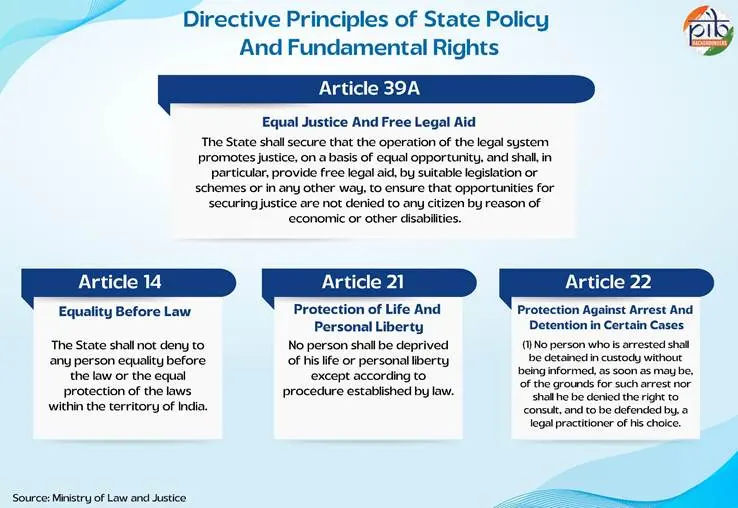
The Legal Services Authorities Act created a nationwide framework to provide free and competent legal services to the poor, marginalized, and disadvantaged guaranteeing that justice is not a privilege but a fundamental right. It means government implementing Article 39A, one of the most important Directive Principles of State Policy that ensures “Equal Justice and Free Legal Aid”
Objectives of the Legal Services Authorities Act 1987
The Act aims to:
- Provide free and competent legal aid to those who cannot afford it.
- Ensure equal access to justice for all citizens.
- Promote legal awareness across all sections of society.
- Establish Lok Adalats and Permanent Lok Adalats for quick and amicable resolution of disputes.
- Encourage alternative dispute resolution (ADR) to reduce the burden on courts.
Three-Tier Legal Aid Structure in India
To make legal aid accessible at all levels, the Act established a three-tier structure:
| Level | Institution | Headed By | Function |
|---|---|---|---|
| National | National Legal Services Authority (NALSA) | Chief Justice of India | Oversees and coordinates all legal aid activities nationwide |
| State | State Legal Services Authorities (SLSA) | Chief Justice of the High Court | Implements schemes and organizes legal awareness programmes |
| District | District Legal Services Authorities (DLSA) | District Judge | Provides local-level legal assistance and conducts Lok Adalats |
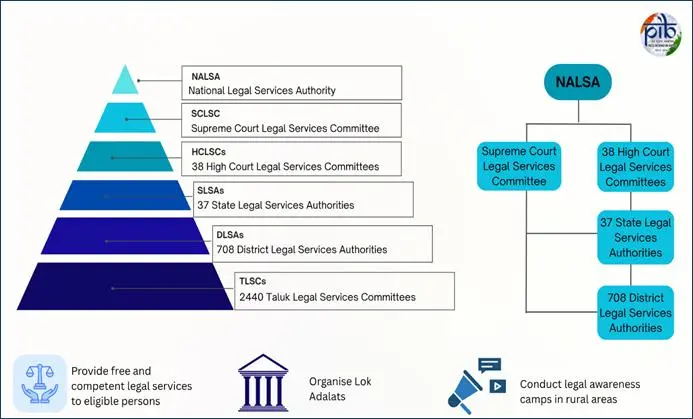
📸 Image Courtesy: Press Information Bureau (PIB), Government of India
Key Achievements (2022–2025)
| Initiative | Beneficiaries / Cases Resolved |
|---|---|
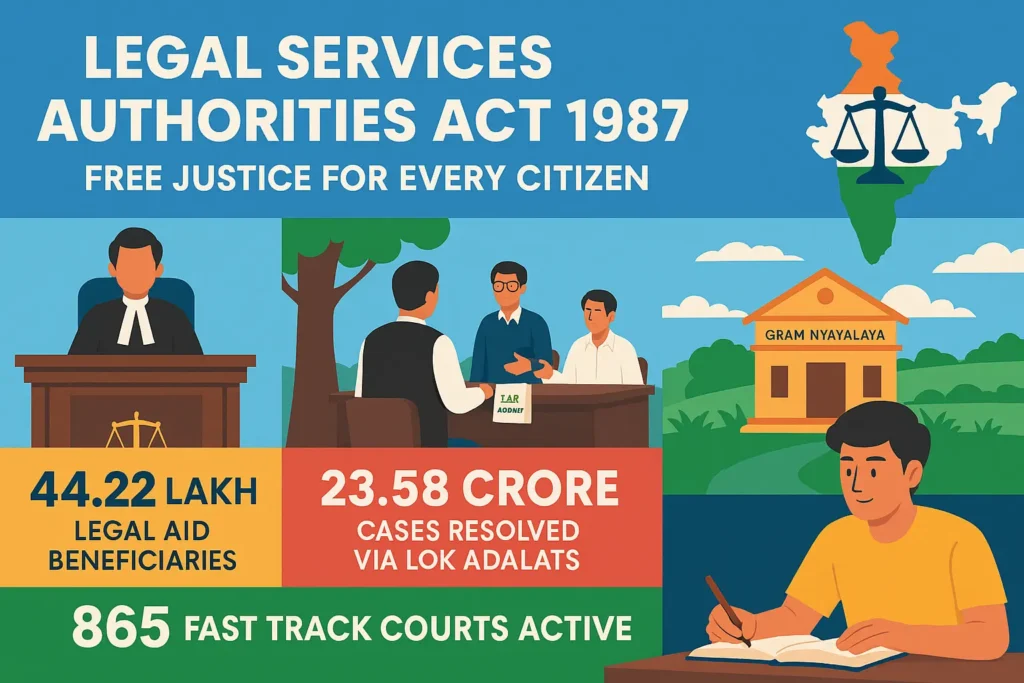
| Free Legal Aid & Advice | 44.22 lakh people |
| Cases Resolved via Lok Adalats | 23.58 crore cases |
| People Benefited through DISHA Scheme | 2.10 crore individuals |
| Legal Awareness Programmes Conducted | 13.83 lakh sessions |
| Total Participants in Awareness Drives | 14.96 crore citizens |
How to Apply for Free Legal Aid
Eligible individuals can apply through multiple methods:
- Offline Application: Submit a written request or oral application (assisted by a paralegal volunteer).
- Online Application: Visit nalsa.gov.in or the respective State Legal Services Authority website.
- Tracking Applications: Applicants receive updates via postal mail, email, or online application number.
Applications are processed within seven days as per Regulation 7(2) of the NALSA (Free and Competent Legal Services) Regulations, 2010.
Lok Adalats – Justice Through Conciliation
The Act also institutionalized Lok Adalats as alternative forums for quick, affordable dispute resolution.
Between 2022–2025, Lok Adalats (State, Permanent, and National) settled 23.58 crore cases, demonstrating India’s growing preference for amicable settlement over lengthy litigation.
Legal Aid Defense Counsel System (LADCS)
To provide criminal defense support to those who cannot afford lawyers, the LADCS Scheme was launched under NALSA.
- Active in 668 districts (as of September 2025)
- 7.86 lakh cases disposed between 2023–25
- Total Outlay: ₹998.43 crore (FY 2023–26)
This system ensures that every accused, irrespective of financial status, receives fair representation in court.
DISHA: Digital Legal Empowerment (2021–2026)
The Designing Innovative Solutions for Holistic Access to Justice (DISHA) scheme uses technology to make justice accessible to remote and marginalized populations.
- Outlay: ₹250 crore
- People Benefited: 2.10 crore
- Services: Pre-litigation advice, pro bono representation, and legal awareness
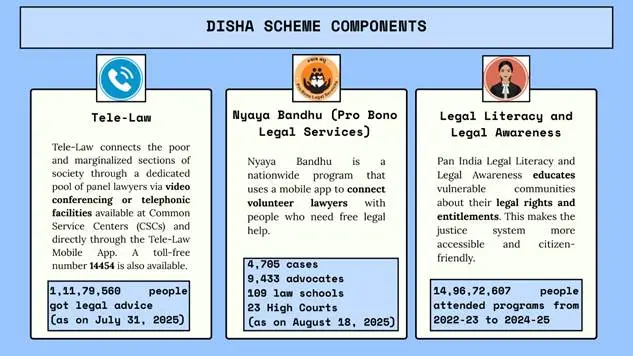
📸 Image Courtesy: Press Information Bureau (PIB), Government of India
This program strengthens India’s “Digital Justice” movement by bringing legal help to every mobile screen.
Gender and Caste Representation in Tele-Law (as of June 2025)
| Category | Cases Registered | % Share |
|---|---|---|
| Female | 44.81 lakh | 39.6% |
| Male | 68.39 lakh | 60.4% |
| General | 26.89 lakh | 23.8% |
| OBC | 35.64 lakh | 31.5% |
| SC | 35.27 lakh | 31.2% |
| ST | 15.39 lakh | 13.6% |
This data reflects the inclusive nature of India’s legal services system.
Legal Awareness and Training Initiatives
- 13.83 lakh awareness programmes held across India (2022–25)
- 14.96 crore participants educated on legal rights
- Doordarshan aired 56 legal awareness TV episodes in 6 languages
- NALSA and State Legal Services Authorities trained thousands of paralegal volunteers (PLVs) and panel lawyers
These initiatives bridge the gap between law and citizens, making justice accessible in regional languages and rural areas.
Fast Track & Special Courts
India has strengthened judicial delivery through specialized courts:
- 865 Fast Track Courts (FTCs) operational as of June 2025
- 725 Fast Track Special Courts (FTSCs) including 392 exclusive POCSO courts
- 3.34 lakh sexual offence cases disposed since inception
- Funded under the Nirbhaya Fund with a total outlay of ₹1,952.23 crore (extended till March 2026)
These courts ensure speedy justice, especially for women and children.
Grassroots Justice: Gram Nyayalayas and Nari Adalats
- 488 Gram Nyayalayas are active across India (as of March 2025), resolving local disputes efficiently.
- Nari Adalats, operating under Mission Shakti, empower women to seek justice at the Gram Panchayat level through mediation and negotiation.
They symbolize India’s vision of justice from village to courtroom.
For Aspirants
The Legal Services Authorities Act 1987 stands as a cornerstone of India’s inclusive justice system. It ensures that every citizen regardless of caste, gender, or economic status — has the right to free legal aid and quick justice.
For aspirants preparing for APPSC, UPSC, SSC, or judicial exams, understanding this Act is vital, as it reflects:
- The evolution of India’s judicial reforms,
- The structure of legal aid institutions, and
- The principle of access to justice for all, a key constitutional value.
By studying this Act, aspirants grasp how law translates into action — strengthening democracy at its roots.
Frequently Asked Questions (FAQs)
-
What is the Legal Services Authorities Act 1987?
The Legal Services Authorities Act, 1987 was enacted to provide free and competent legal services to the weaker sections of society. It established a nationwide system of Legal Services Authorities to ensure that justice is not denied to anyone because of financial or social barriers.
-
When did the Legal Services Authorities Act come into force?
The Act came into effect on 9th November 1995. This date is celebrated every year as National Legal Services Day in India.
-
What is the main objective of the Legal Services Authorities Act 1987?
The main aim is to ensure equal access to justice for all by providing free legal aid, promoting legal literacy, and resolving disputes through Lok Adalats and other alternate dispute resolution mechanisms.
-
What are the three levels of Legal Services Authorities?
National Legal Services Authority (NALSA) – Headed by the Chief Justice of India.
State Legal Services Authorities (SLSA) – Headed by the Chief Justice of the High Court.
District Legal Services Authorities (DLSA) – Headed by the District Judge. -
Who is eligible for free legal aid in India?
Citizens belonging to SC/ST, women, children, victims of natural disasters, persons with disabilities, and those earning below the prescribed income limit are eligible for free legal aid under the Act.
-
How can one apply for free legal aid under the Legal Services Authorities Act?
Applications can be submitted offline or online:
Through NALSA or State/District Legal Services Authority websites.
In person by filling out a prescribed form or even orally, with the help of a paralegal volunteer. -
What is a Lok Adalat?
A Lok Adalat is an alternative dispute resolution forum set up under the Legal Services Authorities Act to settle disputes amicably at the pre-litigation or pending stage. Over 23.58 crore cases have been resolved through Lok Adalats between 2022–25.
-
What is the LADCS Scheme under NALSA?
The Legal Aid Defense Counsel System (LADCS) provides free legal defense to eligible individuals in criminal cases. As of September 2025, 668 districts have functional LADCS offices.
-
What is the DISHA Scheme?
The DISHA (Designing Innovative Solutions for Holistic Access to Justice) Scheme, implemented from 2021–2026, uses technology to provide pre-litigation advice, pro bono services, and awareness. It has helped over 2.10 crore people so far.
-
What is the significance of National Legal Services Day?
Celebrated on November 9 every year, it marks the implementation of the Legal Services Authorities Act, 1987 and aims to raise awareness about citizens’ right to free legal aid and access to justice.
Source: PIB