Kharif Crops in India
Table of Contents
Kharif crops are among the most important agricultural topics for competitive examinations such as APPSC, UPSC, SSC, DSC, and TET. Questions are frequently asked about the sowing season, harvesting period, major crops, climatic conditions, and differences between Kharif and Rabi crops.
India is primarily an agricultural country, and the cropping pattern depends heavily on the monsoon. Kharif crops are known as monsoon crops because they are cultivated during the southwest monsoon season.
What are Kharif Crops?
Kharif crops are the crops sown at the beginning of the monsoon season and harvested at the end of the rainy season.
These crops generally require:
- High temperature
- Heavy rainfall
- Humid climatic conditions
The word “Kharif” is derived from an Arabic word meaning “autumn”.
Kharif Crop Season in India
| Activity | Time Period |
|---|---|
| Sowing Season | June – July |
| Harvesting Season | September – October |
| Main Dependency | Southwest Monsoon |
| Temperature Requirement | 25°C – 35°C |
| Rainfall Requirement | Moderate to High |
Kharif cultivation begins with the arrival of the southwest monsoon winds in India.
Major Kharif Crops in India
| The most important Kharif food crop | Major Producing States | Important Notes |
|---|---|---|
| Rice | West Bengal, Uttar Pradesh, Punjab, Andhra Pradesh | Most important Kharif food crop |
| Maize | Karnataka, Madhya Pradesh, Bihar | Used as food and fodder |
| Cotton | Gujarat, Maharashtra, Telangana | Requires black soil |
| Jowar | Maharashtra, Karnataka | Coarse cereal crop |
| Bajra | Rajasthan, Gujarat | Drought-resistant crop |
| Soybean | Madhya Pradesh, Maharashtra | Major oilseed crop |
| Groundnut | Gujarat, Andhra Pradesh | Oilseed crop |
| Sugarcane | Uttar Pradesh, Maharashtra | Long-duration crop |
| Tur (Arhar) | Maharashtra, Karnataka | Pulse crop |
| Millets | Rajasthan, Karnataka | Nutri-cereals |
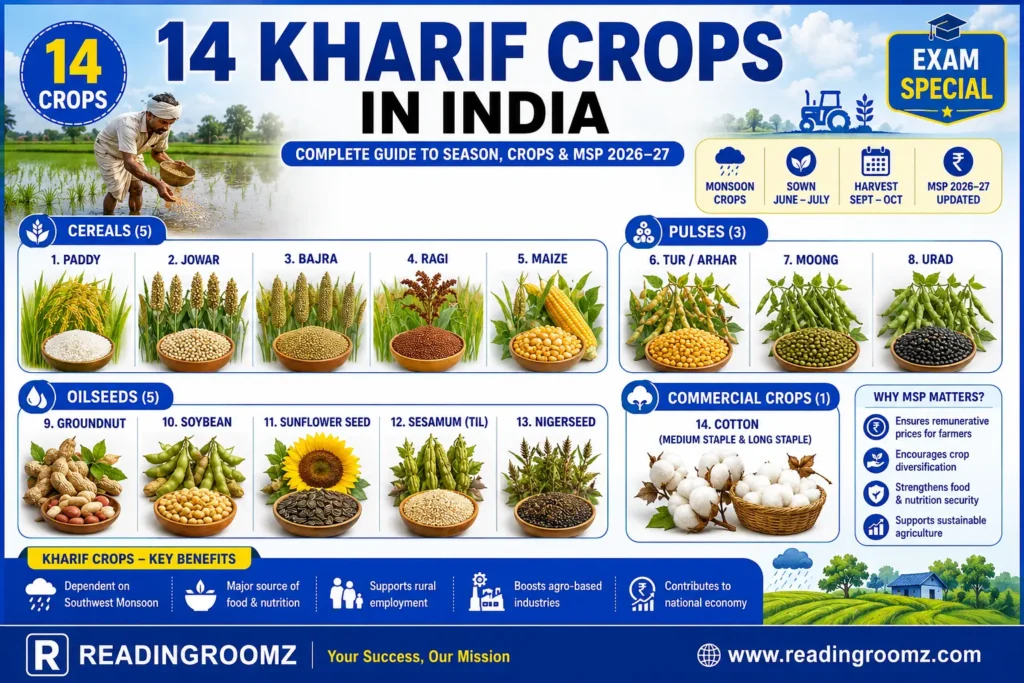
Climatic Conditions Required for Kharif Crops
- Temperature: Most kharif crops require temperatures between 25°C and 35°C during their growth stage.
- Rainfall: Heavy rainfall is essential because these crops are dependent on the monsoon.
- Humidity: Humid weather conditions support better crop development.
Types of Kharif Crops
- Food Crops: Rice, maize, jowar, and bajra are important food crops.
- Cash Crops: Cotton, jute, and sugarcane are major cash crops.
- Oilseed Crops: Groundnut and soybean are important oilseed crops grown during the kharif season.
- Pulse Crops: Tur (Arhar), moong, and urad are major pulse crops.
Important Features of Kharif Crops
| Northern, Eastern, and Peninsular India | Description |
|---|---|
| Season | Monsoon season |
| Water Requirement | High |
| Main Source of Irrigation | Rainfall |
| Soil Types | Alluvial, black and red soils |
| Major Regions | Northern, Eastern and Peninsular India |
| Risk Factor | Monsoon failure affects production |
Difference Between Kharif and Rabi Crops
| Feature | Kharif Crops | Rabi Crops |
|---|---|---|
| Season | Monsoon | Winter |
| Sowing Time | June–July | October–November |
| Harvesting Time | Sept–Oct | March–April |
| Climate | Hot and wet | Cool and dry |
| Rainfall Need | High | Low |
| Examples | Rice, Cotton | Wheat, Gram |
Importance of Kharif Crops in India
These crops play a major role in India’s agricultural economy. Rice cultivation supports food security for millions of people. Cotton supports the textile industry, while oilseed crops help in edible oil production.
These crops also:
- Generate rural employment
- Support agro-based industries
- Contribute to exports
- Strengthen food security
Green Revolution
The Green Revolution mainly focused on wheat production; later phases also improved rice productivity through:
- HYV seeds
- Irrigation facilities
- Fertilizers
- Mechanization
Punjab, Haryana, and Andhra Pradesh became important rice-producing regions.
Millets as a Kharif Crop
Millets are gaining importance due to:
- Climate resilience
- Low water requirement
- High nutritional value
India celebrated the International Year of Millets in 2023 after a proposal by the Government of India was accepted by the United Nations.
Minimum Support Price for Kharif Crops
The Cabinet Committee on Economic Affairs approved increased MSPs for 14 crops for Marketing Season 2026–27. The Government stated that MSPs are fixed at at least 1.5 times the all-India weighted average cost of production, following the Union Budget 2018–19 policy.
| Crop | MSP 2026–27 |
|---|---|
| Paddy (Common) | ₹2441/quintal |
| Bajra | ₹2900/quintal |
| Ragi | ₹5205/quintal |
| Tur/Arhar | ₹8450/quintal |
| Moong | ₹8780/quintal |
| Groundnut | ₹7517/quintal |
| Sunflower Seed | ₹8343/quintal |
| Cotton (Medium Staple) | ₹8267/quintal |
Sunflower Seed received the highest MSP increase of ₹622 per quintal.
Important Exam Facts to Remember
| Topic | Important Fact |
|---|---|
| Monsoon Crops | Kharif crops |
| Most Important Kharif Crop | Rice |
| Cotton Soil | Black soil |
| Largest Rice Producer | West Bengal |
| Millet State | Rajasthan |
| The largest soybean producing state | Madhya Pradesh |
| The largest oilseed-producing state | Rajasthan (major crop mustard) |
| The largest groundnut-producing state | Gujarat |
Frequently Asked Questions (FAQs)
What is a kharif crop?
Kharif crop is cultivated during the monsoon season in India. They are sown in June–July and harvested in September–October.
Which crop is the major kharif crop in India?
Rice is the most important kharif crop in India.
Why are kharif crops called monsoon crops?
These crops depend heavily on the southwest monsoon for water supply and cultivation.
What is the difference between kharif and rabi crops?
Kharif crop is grown during the rainy season, whereas rabi crop is grown during the winter season.
Which soil is best for cotton cultivation?
Black soil is ideal for cotton cultivation.
Are millets a kharif crop?
Yes. Bajra and jowar are important millet crops grown during the kharif season.
Kharif crop is the backbone of Indian agriculture and is closely linked with the monsoon system. Rice, cotton, soybeans, and millets are among the most important kharif crops grown across the country. Understanding their climatic requirements, crop season, and economic importance is essential for competitive examinations like APPSC, UPSC, and SSC.
Study with the ReadingRoomz Community
Join thousands of APPSC aspirants. Get daily current affairs, MCQs, PDFs, and preparation guidance — all in one place.