
Current Affairs 29 December 2025
Add as a preferred Source on GoogleTable of Contents
Gandikota — The “Grand Canyon of India”
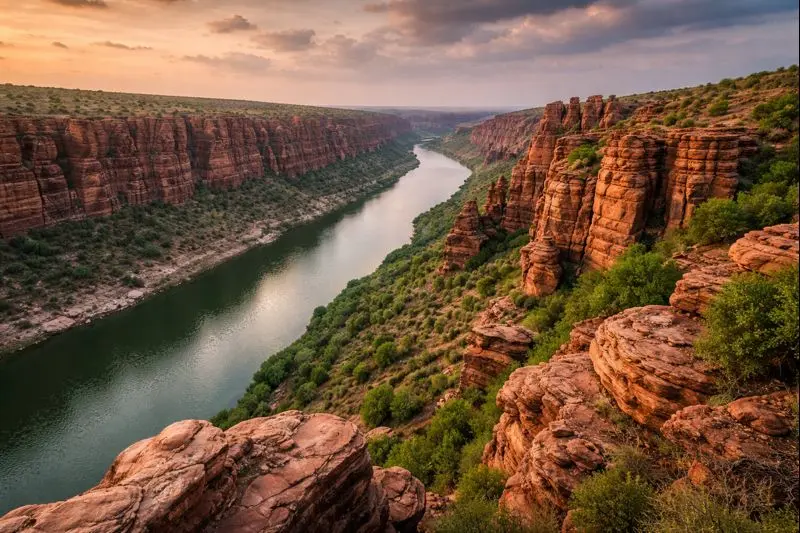
Gandikota, a spectacular gorge carved by the Penna River in Kadapa district, Andhra Pradesh, is often referred to as the “Grand Canyon of India” due to its steep red sandstone cliffs and dramatic landscapes. Despite its natural beauty, historical significance, and leisure potential, Gandikota has remained underdeveloped as a tourist destination because of decades of neglect.
The 12th-century Gandikota Fort, built by the Pemmasani Nayaks (feudatories of the Kakatiya dynasty), later came under the Vijayanagara Empire, Qutb Shahi rulers, Mughals, Kadapa Nawabs, and finally the British. The fort complex includes the Madhavaraya Temple, Sri Ranganatha Temple, Jama Masjid, granary, jail, step wells, and palaces, and is currently maintained by the Archaeological Survey of India (ASI).
To unlock Gandikota’s tourism potential, the Andhra Pradesh government has prepared a Gandikota Master Plan under the Special Assistance to States for Capital Investment (SASCI) scheme. Proposed developments include star hotels, gorge illumination, sound-and-light shows, heritage trails, viewing points, a tent city, solar power systems, boating facilities, and even helicopter rides.
Dulhasti Stage–II Hydropower Project Approved
A panel under the Ministry of Environment, Forest and Climate Change has approved the 260-MW Dulhasti Stage–II Hydropower Project on the Chenab River in Kishtwar, Jammu and Kashmir. The approval was granted by the Expert Appraisal Committee (EAC) on hydel projects during its 45th meeting.
The clearance comes in the backdrop of India suspending the Indus Waters Treaty with Pakistan after the Pahalgam terror attack (April 2025). With the treaty currently in abeyance, the Centre is accelerating hydropower development in the Indus basin, including projects like Sawalkote, Ratle, Bursar, Pakal Dul, Kiru, Kwar, and Kirthai I & II.
Next-Generation Antivenom for Snakebite Treatment
Snakebite remains a major public health challenge in India, causing nearly 58,000 deaths every year, particularly among agricultural workers and rural populations. Despite advances in medical science, snakebite envenoming continues to disproportionately affect low-income regions and has been classified as a neglected tropical disease by the World Health Organization.
Traditional Antivenom Production in India
- Antivenom in India is made using venom from the ‘Big Four’ snakes — spectacled cobra, common krait, Russell’s viper and saw-scaled viper.
- Venom is collected from these snakes, mainly by trained tribal communities such as the Irula Snake Catcher’s Industrial Co-operative Society in Tamil Nadu.
- A mixture of venoms is injected into horses in small, safe doses over time.
- The horse’s body produces antibodies to fight the venom.
- Blood is taken from the horse, and the antibody-rich plasma is separated and purified.
- These antibodies are processed, tested, freeze-dried, and supplied as antivenom vials.
Limitation: This method covers only four snake species, while India has more than 60 venomous snakes, and venom varies by region, reducing effectiveness in some cases.
New Research and Technological Advances
Recent international research published in Nature (2025) represents a significant breakthrough in snakebite treatment. Scientists from a Danish laboratory, along with global collaborators, developed a broad-spectrum antivenom using nanobody technology derived from alpacas and llamas. These animals belong to the camelid family and produce unique, small, and highly stable antibodies known as nanobodies. Using genetic engineering, researchers cloned nanobody-producing genes into bacteria, enabling cost-effective, large-scale production without relying on horses.
REPM Manufacturing Scheme
The Government of India has approved a ₹7,280 crore scheme to promote the domestic manufacturing of Sintered Rare Earth Permanent Magnets (REPMs). The scheme aims to establish 6,000 metric tonnes per annum (MTPA) of integrated manufacturing capacity, covering the entire value chain from rare-earth oxides to finished magnets.
This initiative is crucial for strengthening self-reliance (Atmanirbhar Bharat) in critical sectors such as electric mobility, renewable energy, electronics, aerospace and defence, while reducing heavy import dependence, particularly on China. The scheme aligns with India’s Net Zero 2070 vision and the National Critical Minerals Mission (NCMM), enhancing India’s role in global advanced-materials value chains.
1) They are used in the manufacture of high-technology devices.
2) China has near monopoly over their production.
3) They are radioactive elements.
Which of the statements given above is/are correct?
Answer: 1 and 2 only
Explanation: Rare Earth Elements are critical inputs for high-technology products such as permanent magnets, electric vehicle motors, wind turbines, electronics and defence systems, making Statement 1 correct. China dominates global rare earth mining and processing, giving it near monopoly control, which makes Statement 2 correct. However, rare earth elements are not inherently radioactive; radioactivity may occur due to associated minerals like thorium, hence Statement 3 is incorrect.
President’s Sortie on INS Vaghsheer
The President of India, Droupadi Murmu, undertook a dived sortie onboard INS Vaghsheer, an indigenous Kalvari-class submarine of the Indian Navy, on the Western Seaboard on 28 December 2025. She embarked the submarine from Karwar Naval Harbour, Karnataka, and spent over two hours interacting with the crew and witnessing operational demonstrations. President Murmu became the second President of India to take a submarine sortie, after A. P. J. Abdul Kalam.
Daily Current Affairs Quiz
Test your knowledge with exam-oriented multiple choice questions based on today’s current affairs.
Disclaimer: This article is prepared for competitive exam preparation using publicly available information.