Atal Innovation Mission
Table of Contents
1. What is Atal Innovation Mission?
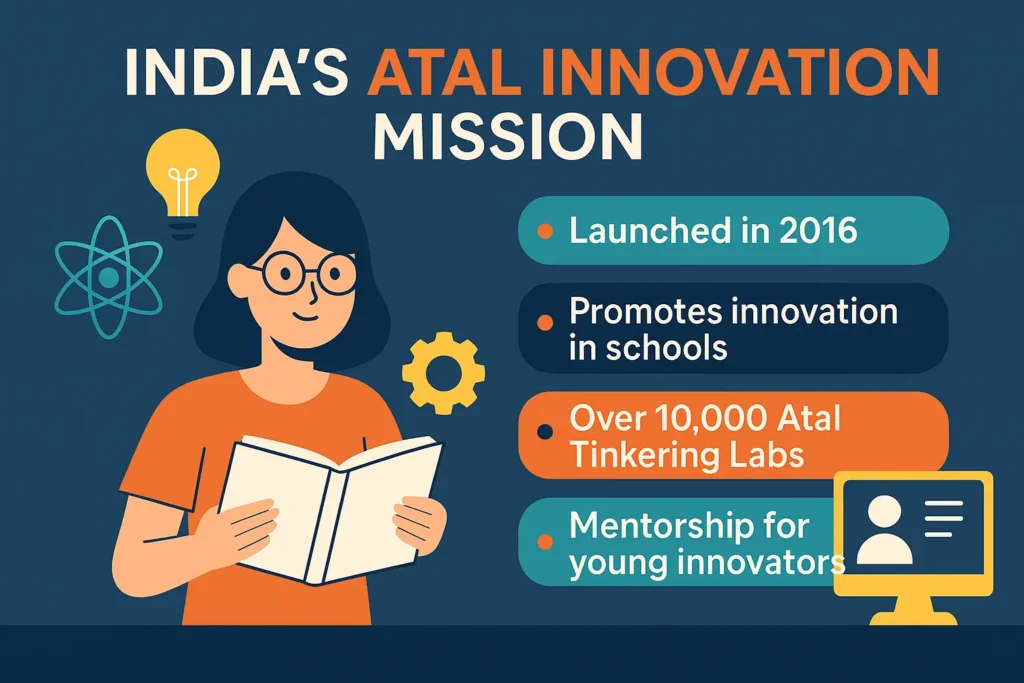
Atal Innovation Mission (AIM) is the Government of India’s flagship initiative to build a nationwide culture of innovation, design thinking and entrepreneurship.
- Nodal agency: NITI Aayog
- Launch year: 2016
- Core idea: Take a child from student tinkerer → student innovator → student entrepreneur
- Coverage: Schools, colleges, universities, research institutions, startups, MSMEs and communities
Atal Innovation Mission is not a single scheme, but an umbrella mission that runs multiple programmes: ATLs, AICs, ACICs, ANIC, Mentors of Change etc.
2. Objectives of Atal Innovation Mission
- Build a culture of innovation & entrepreneurship across India
- Promote design thinking, critical thinking and problem-solving skills among students
- Create world-class incubation support for startups
- Take innovation beyond metros to Tier-2/3, aspirational districts, tribal and rural regions
- Link school-level tinkering → incubation → startup → market in one continuous pipeline
- Align India’s innovation ecosystem with NEP 2020 and Viksit Bharat 2047 vision
3. Major Components of Atal Innovation Mission
3.1 Atal Tinkering Labs (ATLs)
- Atal Tinkering Labs (ATLs) Small makerspaces in schools with tools like robotics kits, 3D printers, sensors, DIY electronics etc.
- Target group: Classes 6–12
- Skills: Design mindset, computational thinking, physical computing, adaptive learning
- Tagline: “Cultivate one million children in India as neoteric innovators”
- Scale (as per article):
- 10,000+ ATLs established (since 2016)
- Coverage in 35 States/UTs, 722 districts
- 1.1 crore+ students engaging with ATLs (Nov 2025)
- Focus on aspirational districts and rural areas
Key ATL activities:
- Tinkering projects integrated with STEM education
- ATL Marathon – annual nationwide innovation challenge
- ATL Student Innovator Programme (SIP) – connects top students to Atal Incubation Centres
- Events like hackathons, Tinkerpreneur, theme-based challenges (climate, health, agriculture, etc.)
3.2 Atal Incubation Centres (AICs)
- Atal Incubation Centres are World-class startup incubators in universities, institutions and corporates
- Atal Incubation Centres Support:
- Co-working space & labs
- Mentorship and business support
- Seed funding and investor connect
- Access to industry and markets
- As of now 72 Atal Incubation Centres are operational
- 3,500+ startups incubated
- 32,000+ jobs created
- 1,000+ women-led ventures supported
- Sectors: HealthTech, FinTech, EdTech, Space & Drone, AR/VR, Food Processing, Tourism etc.
3.3 Atal Community Innovation Centres (ACICs)
- Aim: Take innovation to unserved & underserved regions:
- Tier-2 & Tier-3 cities
- Aspirational districts
- Tribal, hilly and rural areas
- Model: Co-funding (up to ₹2.5 crore grant from AIM, matched by partner)
- As of now 14 Atal Community Innovation Centres set up
3.4 Atal New India Challenge (ANIC)
- Purpose: Fund and support technology-based solutions for national & sectoral problems
- Grant-in-aid: Up to ₹1 crore per startup (prototype stage)
- Support duration: ~12–18 months
3.5 Mentor of Change Network
- Mentor of Change Network is the Large volunteer network of professionals who mentor students & startups
- Mentors: 6,200+ across industry, academia, NGOs, public & private sectors
- Role:
- Guide ATL students
- Mentor startup teams at AICs/ACICs
- Help with product development, IP, business models
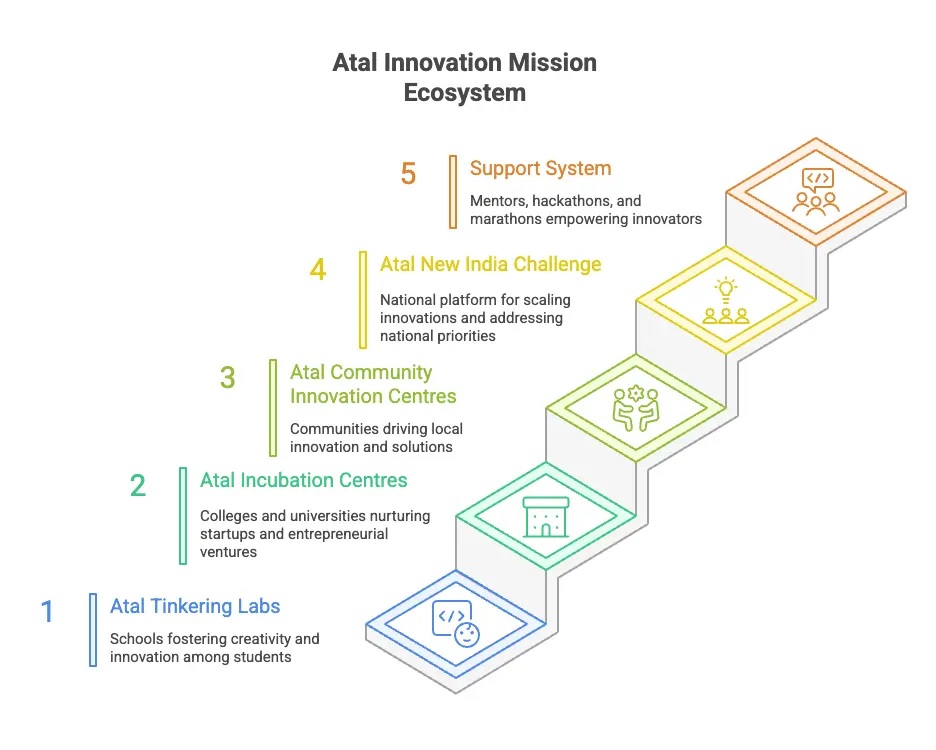
4. AIM Ecosystem – One Continuous Pipeline
- School Level: Atal Tinkering Labs (ATLs)
- College/University Level: Atal Incubation Centres (AICs)
- Community Level: Atal Community Innovation Centres (ACICs)
- Scaling & National Priorities: Atal New India Challenge (ANIC)
- Support System: Mentors of Change + Hackathons + Innovation Marathons
5. Atal Innovation Mission & NEP 2020
- NEP 2020 shifts from rote learning → experiential, inquiry-based learning
- AIM operationalises this shift through:
- ATLs for hands-on STEM and tinkering
- Hackathons, marathons, buildathons (e.g., School Innovation Marathon, Viksit Bharat Buildathon 2025)
- Teacher training via Innovation Ambassadors, SIATP, School Innovation Councils (SICs)
- Supports NEP’s goals:
- Critical thinking, creativity, scientific temper
- Vocational exposure & entrepreneurship
- Preparing students for AI, robotics, IoT, space tech etc.
6. AIM At a Glance
| Component / Indicator | Key Facts (as per given article) |
|---|---|
| Nodal body | NITI Aayog |
| Launch year | 2016 |
| Atal Tinkering Labs (schools) | 10,000+ labs across 35 States/UTs, 722 districts |
| Students in ATLs | 1.1 crore+ |
| Target (new ATLs in govt schools) | 50,000 ATLs over next 5 years (from 2025) |
| Atal Incubation Centres (AICs) | 72 |
| Startups incubated | 3,500+ |
| Jobs created | 32,000+ |
| Women-led startups supported | 1,000+ |
| ACICs | 14 |
| Mentors of Change | 6,200+ mentors |
👉 Go to Daily Current Affairs Section
Frequently Asked Questions
What is Atal Innovation Mission?
AIM is the Government of India’s flagship mission under NITI Aayog to promote innovation and entrepreneurship through programmes like Atal Tinkering Labs, Atal Incubation Centres, Atal Community Innovation Centres, Atal New India Challenge and the Mentor of Change network.
Atal Innovation Mission is set up under which body?
AIM is set up under NITI Aayog, the Government of India’s premier policy think-tank.
What is the launch date of Atal Innovation Mission?
AIM was launched in 2016 (approval and operationalisation as a flagship innovation mission under NITI Aayog).
What is the motto of Atal Innovation Mission?
There is no single official “one-line motto” notified for the entire mission. However:
Its core vision is: “to promote a culture of innovation and entrepreneurship across India.”
At school level, its ATL programme uses the tagline:
“Cultivating one million children in India as neoteric innovators.”
What is the budget of AIM for 2025?
The Union Budget does not always show a separate, standalone line item exclusively labelled “Atal Innovation Mission Budget 2025”. Allocations usually appear under NITI Aayog’s demand for grants and related innovation heads.
How is AIM linked to Atal Tinkering Labs?
Atal Tinkering Labs are one of the flagship school-level components of Atal Innovation Mission. They:
Provide makerspaces in schools
Promote STEM, design thinking, robotics, AI, IoT
Act as the entry point into AIM’s innovation pipeline, which later connects students to AICs, ACICs, ANIC etc.
How does Atal Innovation Mission support women and rural innovators?
1,000+ women-led startups supported via AICs (as per article)
ATLs and ACICs are being set up in rural, tribal, aspirational districts
Programmes like hackathons, marathons, buildathons give rural students national-level platforms
ATLs (school tinkering) → AICs & ACICs (incubation) → ANIC (scaling) → Startups & jobs (New India)
Source: Atal Innovation Mission