
Current Affairs 23 June 2026
Add as a preferred Source on GoogleTable of Contents
International Current Affairs
Project Nimbus: Google and Amazon’s Cloud Contract with Israel
Project Nimbus is a cloud computing contract worth over $1 billion between the Government of Israel and tech giants Google and Amazon Web Services (AWS). The project was signed in 2021 to provide cloud infrastructure and digital services to Israeli government ministries, authorities, and public sector organisations.
Highlights
- Project Nimbus was launched in 2021.
- The contract is valued at more than $1 billion.
- It provides cloud computing services to Israeli government agencies.
- The initial duration of the project is 7 years, with provisions for extension.
- AWS was selected as the primary cloud service provider, alongside Google Cloud.
Why is Project Nimbus Controversial?
- Pro-Palestinian activists and some employees of Google and Amazon have opposed the project.
- Critics argue that cloud infrastructure and AI services could potentially be used for:
- Surveillance activities.
- Data storage related to military operations.
- Monitoring of Palestinian populations.
- Employee protests have taken place at Google, Amazon, and other technology companies.
- Student groups in the United States have also organised demonstrations against the project.
Google’s Position
- Google has stated that Project Nimbus is intended for civilian government cloud services.
- The company has maintained that the contract is not related to military weapons systems or classified intelligence operations.
Science and Technology
Biochar Emerges as a Sustainable Solution for Agricultural Waste and Soil Health
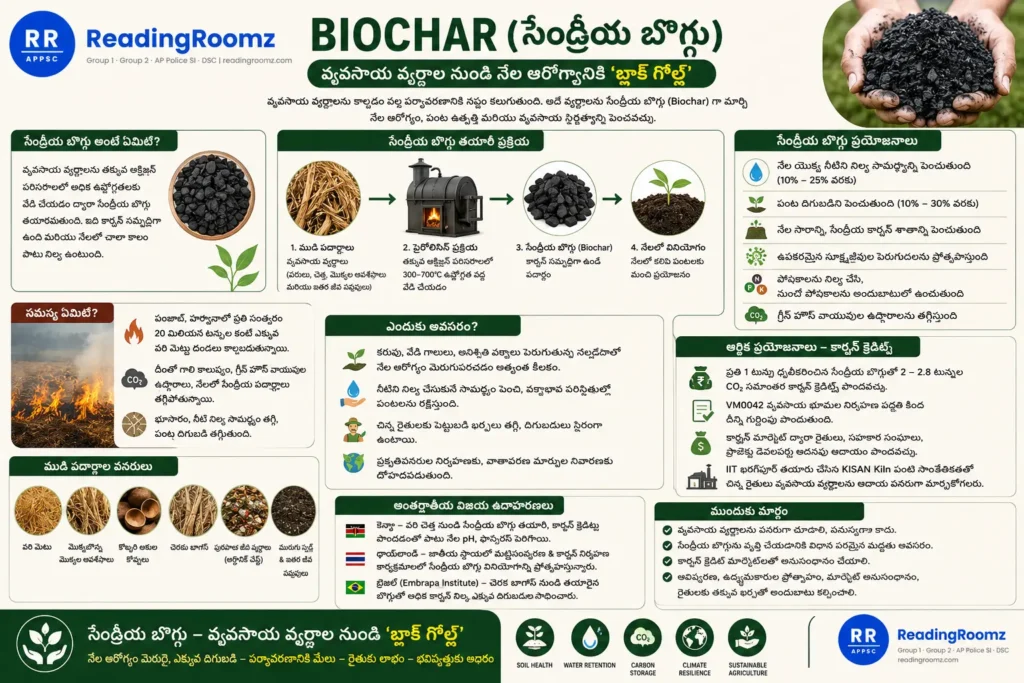
Biochar has gained attention as a carbon-negative agricultural technology that can help address crop residue burning, improve soil fertility, and enhance climate resilience. It is produced by heating agricultural waste under low-oxygen conditions, resulting in a carbon-rich material that decomposes very slowly in soil.
Highlights
- Biochar is made from agricultural residues such as paddy straw, maize stalks, coconut leaf stalks, and other biomass.
- It helps:
- Improve soil organic carbon content.
- Increase water-holding capacity.
- Enhance nutrient retention.
- Promote beneficial microbial activity.
- Studies have shown that biochar can:
- Increase crop productivity by 10–30%.
- Improve water-holding capacity by 10–25%, especially in nutrient-poor soils.
- Biochar can also help reduce greenhouse gas emissions by preventing open-field burning of crop residues.
Climate and Economic Significance
- Biochar supports:
- Natural farming
- Soil health management
- Carbon farming initiatives
- Each tonne of certified biochar can generate approximately 2–2.8 tonnes of CO₂-equivalent carbon credits under internationally accepted carbon accounting standards.
- It is considered a persistent carbon dioxide removal technology because it stores carbon in soil for long periods.
Ranks and Reports
India Becomes World’s Largest Ship Recycling Nation in 2025
India emerged as the world’s leading ship recycling nation in 2025, achieving the target set under Maritime India Vision (MIV) 2030 well ahead of schedule. According to the latest report of the United Nations Conference on Trade and Development, India’s share of global ship recycling increased from 30.1% in 2024 to 35.4% in 2025.
Highlights
- India ranked 1st globally in ship recycling in 2025.
- Ship recycling volume increased from 1.86 million Gross Tons (GT) in 2024 to 2.99 million GT in 2025.
- India’s global market share rose to 35.4%.
- The achievement fulfilled the target of Maritime India Vision 2030 ahead of schedule.
Key Government Initiatives
Recycling of Ships Act, 2019
- Enacted to align India’s ship recycling industry with the Hong Kong International Convention for the Safe and Environmentally Sound Recycling of Ships.
- India ratified the convention in 2019.
Ship-Breaking Credit Note Scheme
- Ship owners receive a credit note equal to 40% of the scrap value of a recycled vessel.
- The credit note can be used towards the purchase of a new ship built in India.
Modernisation of Ship Recycling Yards
- Financial assistance of ₹53.5 crore provided.
- 115 recycling facilities upgraded to HKC standards.
Expansion of Alang Ship Recycling Yard
- India plans to increase ship recycling capacity to approximately 9 million Light Displacement Tons (LDT).
- The expansion will strengthen India’s position in the global circular economy.
- Alang is one of the world’s largest ship recycling yards. It is located in Gujarat on the Gulf of Khambhat coast.
Daily Current Affairs Quiz
Q1. Biochar is produced by heating agricultural biomass under which of the following conditions?
A. High oxygen conditions
B. Low oxygen conditions
C. High-pressure steam conditions
D. Direct sunlight exposure
Show Answer
Answer: B. Low oxygen conditions
Explanation: Biochar is produced through a process called pyrolysis, where agricultural biomass is heated under low-oxygen conditions, resulting in a carbon-rich material that improves soil health and stores carbon.
Q2. Project Nimbus, recently seen in the news, is a cloud computing contract between Israel and which two technology companies?
A. Microsoft and IBM
B. Google and Amazon
C. Apple and Meta
D. Oracle and Intel
Show Answer
Answer: B. Google and Amazon
Explanation: Project Nimbus is a cloud computing agreement worth over $1 billion between the Government of Israel and Google Cloud and Amazon Web Services (AWS).
Q3. According to the latest UNCTAD report, which country became the world’s largest ship recycling nation in 2025?
A. USA
B. China
C. India
D. Russia
Show Answer
Answer: C. India
Explanation: India emerged as the world’s leading ship recycling nation in 2025 with a global market share of 35.4%, according to the UNCTAD report.
Frequently Asked Questions
What is Project Nimbus?
Project Nimbus is a cloud computing contract worth over $1 billion between the Government of Israel and tech giants Google and Amazon Web Services (AWS).
What is Biochar?
Biochar is a stable, carbon-rich form of charcoal produced by heating organic waste such as wood chips, crop residues, and manure in a low-oxygen environment (pyrolysis).
Which country became the largest ship recycling nation in 2025?
India emerged as the largest ship recycling nation in 2025.
Which is the biggest ship-breaking yard in the world?
The largest ship-breaking yard in the world is the Alang-Sosiya Ship Recycling Yard in Gujarat, India.
Disclaimer: This article is prepared for competitive exam preparation using publicly available information.
Join Our Community
Study with the ReadingRoomz Community
Join thousands of APPSC aspirants. Get daily current affairs, MCQs, PDFs, and preparation guidance — all in one place.