
Current Affairs 12 March 2026
Add as a preferred Source on GoogleTable of Contents
India Diversifies Natural Gas Imports to Address Supply Shortage
Our country is facing a temporary shortage of natural gas, but government officials have indicated that the situation is likely to improve as imports from new sources such as the United States and Norway become economically viable.
Key Highlights
- our country earlier relied heavily on Qatar (US second) for LNG (Liquefied Natural Gas) imports.
- Rising global prices have made gas imports from the U.S. and Norway feasible.
- However, shipments from these distant sources may take around two months due to longer shipping routes.
LPG Production Increased
- The government has increased domestic LPG (Liquefied Petroleum Gas) production by about 10%.
- Oil refineries were directed by the Ministry of Petroleum and Natural Gas to maximise LPG output.
- Propane and butane available in refineries are being prioritised for LPG production.
Price Changes
- Earlier LNG imports from Qatar cost $6–8 per MMBtu.
- Prices have now increased to around $15 per MMBtu, making imports from distant countries economically viable.
Difference Between Natural Gas and LPG
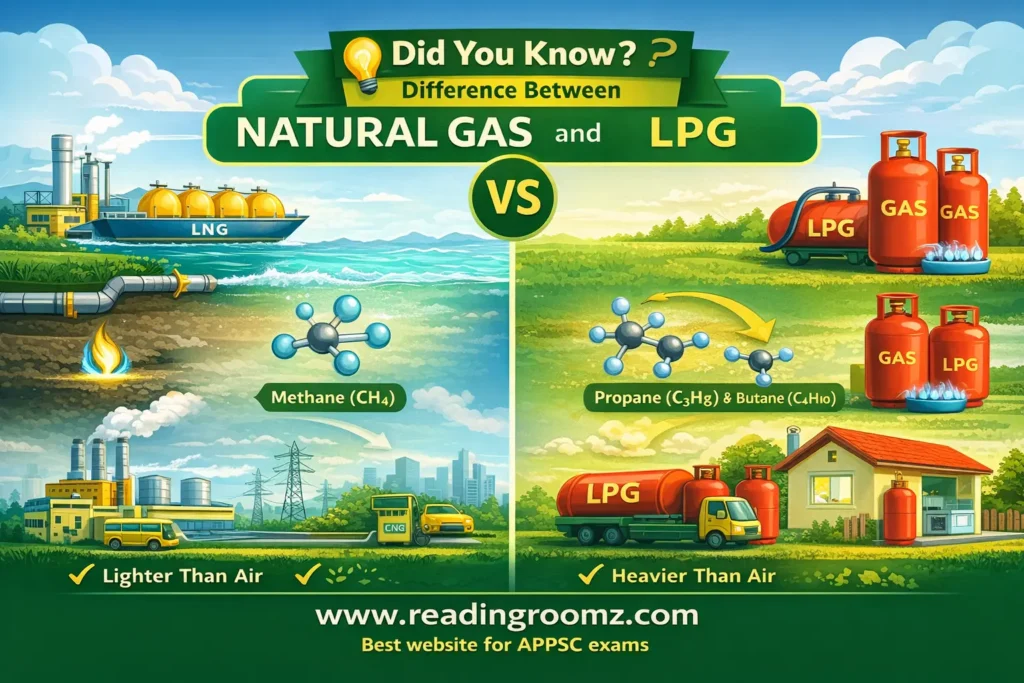
| Feature | Natural Gas | LPG (Liquefied Petroleum Gas) |
|---|---|---|
| Main Composition | Mainly Methane (CH₄) | Mixture of Propane (C₃H₈) and Butane (C₄H₁₀) |
| Storage Method | Transported through pipelines or as LNG (Liquefied Natural Gas) | Stored in pressurised cylinders or tanks |
| Common Uses | Electricity generation, industries, city gas distribution, CNG vehicles | Household cooking fuel, heating, small industries |
| Density Compared to Air | Lighter than air (disperses quickly when leaked) | Heavier than air (can accumulate near ground) |
| Transportation | Pipelines, LNG tankers | Cylinders, LPG tankers |
| Energy Source Type | Fossil fuel mainly extracted from natural gas fields | By-product of petroleum refining and natural gas processing |
| Safety Aspect | Safer in open areas as it disperses quickly | Requires careful handling due to accumulation risk |
Chandigarh Achieves ‘Fully Literate’ Status
Chandigarh has achieved a 99.93% literacy rate, becoming a fully literate Union Territory in India. The announcement was made by Gulab Chand Kataria.
Key Highlights
- Literacy Rate Achieved: 99.93%
- Programme: Understanding Lifelong Learning for All in Society (ULLAS)
- Benchmark: 95% literacy target set under National Education Policy 2020
- Chandigarh is now the 6th State/Union Territory in India and the 2nd Union Territory to achieve fully literate status.
Major Achievements
- Literacy rate increased from 93.7% to 99.93%.
- 15,556 citizens participated in the literacy programme.
- Women’s literacy rose significantly from 90.7% to 99.89%, marking a major step toward women’s empowerment and inclusive education.
100% literate States in India
| State / Union Territory | Year Achieved | Notes |
|---|---|---|
| Kerala | 1991 | First state in India declared fully literate under the Total Literacy Campaign |
| Mizoram | 2014 | Declared fully literate after crossing 95% literacy |
| Tripura | 2015 | Third state declared fully literate |
| Goa | 2018 | Achieved full literacy under adult education programmes |
| Ladakh (UT) | 2024 | Declared fully literate under the ULLAS programme |
| Chandigarh (UT) | 2026 | Achieved 99.93% literacy under ULLAS |
Important Note for Exams
- In literacy missions, 95% literacy is considered the benchmark for declaring an area “fully literate.”
- Recent recognitions are mostly under the ULLAS – Understanding Lifelong Learning for All in Society programme aligned with NEP 2020.
Proton Accelerator Facility to be Established in Visakhapatnam
Union Government is planning to establish a high-energy proton accelerator facility in Visakhapatnam, Andhra Pradesh, as part of its long-term nuclear energy programme. The project will support India’s efforts to utilise its vast thorium reserves for sustainable nuclear power generation.
Key Highlights
- The proposed facility will be developed under India’s Accelerator-Driven Systems (ADS) programme.
- The accelerator will produce high-energy neutrons through spallation reactions.
- These neutrons will help convert thorium into uranium fuel for nuclear reactors.
- Visakhapatnam was selected due to its strong technological ecosystem and proximity to the sea, which provides cooling water for high-energy systems.
- The facility will take several decades to become fully operational due to the complexity and cost of the technology.
Role of RRCAT
The project is linked with research from the Raja Ramanna Centre for Advanced Technology (RRCAT) in Indore, which operates under the Department of Atomic Energy.
Importance for Our Country
India has one of the largest thorium reserves in the world, and the proton accelerator technology will play a crucial role in the third stage of India’s nuclear power programme, aimed at thorium-based energy production.
First Comprehensive Checklist of Fireflies in India Published
Researchers have compiled the first comprehensive checklist of fireflies in India, based on over 260 years of scattered scientific records (1881–2025). The study was published in the scientific journal Zootaxa on 10 March 2026.
Key Highlights
- The checklist documents 92 species of fireflies belonging to 27 genera in India.
- More than 60% of these species are endemic to the country.
- Firefly species were recorded across 22 States and 1 Union Territory.
- The study belongs to the insect family Lampyridae, commonly known as fireflies or lightning bugs.
Union Cabinet Amends Rules on Investments from Land Border Countries
The Union Cabinet, chaired by Narendra Modi, has approved amendments to the 2020 Foreign Direct Investment (FDI) rules that regulate investments from countries sharing a land border with India.
Background
In 2020, the Government issued Press Note 3 (2020), which required prior government approval for any investment from countries sharing a land border with India. This rule was introduced mainly to prevent opportunistic takeovers of Indian companies during the COVID-19 period.
Countries sharing land borders with India include China, Pakistan, Bangladesh, Nepal, Myanmar, Bhutan and Afghanistan.
Key Changes in the New Amendment
- The amendment introduces the concept of ‘beneficial ownership’.
- Investments where entities from land-border countries hold up to 10% non-controlling stake will now be allowed under the automatic route.
- Such investments must still be reported to the Department for Promotion of Industry and Internal Trade.
- Proposals in specific sectors like electronic capital goods, electronic components, polysilicon, and ingot-wafer manufacturing will be processed within 60 days.
Foreign Currency Non-Resident (Banks) [FCNR(B)] deposits
Context
Recently, The rupee has depreciated to ₹91.81 per dollar, compared to ₹85.49 per dollar at the end of March 2025. To attract foreign currency into India, RBI may encourage Non-Resident Indian (NRI) deposits through:
- Non-Resident External deposits
- Foreign Currency Non-Resident (Banks) deposits
Foreign Currency Non-Resident (Banks) deposits
Foreign Currency Non-Resident (Banks) [FCNR(B)] deposits are special bank deposits that Non-Resident Indians (NRIs) can maintain in foreign currencies such as US Dollar, Pound Sterling, Euro, or Yen with Indian banks.
Key Features
- Deposits are maintained in foreign currency, not in Indian rupees.
- The exchange rate risk is borne by the bank, not the depositor.
- These deposits generally have a maturity period of 1–5 years.
- Interest rates are linked to international benchmark rates.
How FCNR(B) Deposits Help Stabilise the Rupee depreciation?
When the Indian rupee depreciates, the Reserve Bank of India (RBI) may encourage banks to mobilise FCNR(B) deposits from NRIs.
- Foreign currency inflow increases by NRIs deposit dollars or other foreign currencies in Indian banks.
- India’s forex reserves increase strengthens the country’s external sector.
- Supply of dollars in the market improves, reducing pressure on the rupee.
- The RBI can intervene in the forex market more effectively.
Daily Current Affairs Quiz
Test your knowledge with exam-oriented multiple choice questions based on today’s current affairs.
Disclaimer: This article is prepared for competitive exam preparation using publicly available information.