Current Affairs 11 March 2026
Add as a preferred Source on GoogleTable of Contents
Rajasthan Scraps Two-Child Norm for Panchayati Raj Elections
The Rajasthan Legislative Assembly passed the Rajasthan Panchayati Raj (Amendment) Bill, 2026, removing the two-child norm for candidates contesting Panchayati Raj elections.
Key Highlights
- The amendment removes the disqualification rule for candidates having more than two children.
- The provision earlier existed under Section 19 of the Rajasthan Panchayati Raj Act, 1994.
- The two-child norm was originally introduced in 1995 during the government of Chief Minister Bhairon Singh Shekhawat.
Reason for the Amendment
- The rule was initially introduced as a population control measure when the fertility rate was around 3.6 during 1991–94.
- According to the State government, the Total Fertility Rate (TFR) has now dropped to around 2.0, making the restriction unnecessary.
- The government stated that the earlier rule prevented capable individuals with leadership qualities from contesting elections.
Political Debate
- The Bill was passed by voice vote after a heated debate.
- Opposition leaders questioned the need for removing the rule and also raised concerns about delayed Panchayat elections in the State.
Significance
The amendment means that individuals with more than two children can now contest Panchayati Raj elections and urban local body elections in Rajasthan, expanding political participation at the grassroots level.
Musi Riverfront Development Project in Telangana
The Telangana government has proposed the Musi Riverfront Development Project to rejuvenate the Musi River, which flows through Hyderabad and has become heavily polluted over the years.
Key Highlights
- River Length: About 260 km, with 55 km flowing through Hyderabad.
- The Musi River originates from the Ananthagiri hills in Vikarabad district through the confluence of two streams Musa and Esi.
Objective of the Project
The project aims to:
- Rejuvenate the polluted Musi River.
- Develop urban riverfront infrastructure such as:
- Leisure spaces
- Shopping areas
- Cultural and heritage structures.
Major Components of the Project
- Riverfront Development
- Development along both banks of the 55-km stretch of the river in Hyderabad.
- Ensuring Perennial Flow
- 2.5 TMC ft of water will be diverted from the Godavari River through the Mallanna Sagar Reservoir (about 72 km away) to maintain year-round flow.
- Sewage Treatment
- Construction of 39 new Sewage Treatment Plants (STPs) in addition to the existing 31 STPs to treat wastewater entering the river.
- Cultural Landmark
- A proposed ‘Gandhi Sarovar’ cultural precinct at the confluence of Musa and Esi rivers with a statue of Mahatma Gandhi.
- International Funding
- The Asian Development Bank (ADB) has given in-principle approval for funding for the first phase.
Controversy and Opposition
The project has faced protests because:
- Evictions of residents living in slums along the Musi riverbed began before the Detailed Project Report (DPR) was finalized.
- Activists and residents formed a coalition called “Musi Jan Andolan.”
- Concerns include:
- Displacement of long-time residents
- Lack of transparency
- Land acquisition affecting nearby residential communities.
Mojtaba Khamenei Appointed as Iran’s New Supreme Leader
Iran’s Assembly of Experts, an 88-member clerical body, has appointed Mojtaba Khamenei as the new Supreme Leader of Iran, following the death of his father Ali Khamenei.
Key Highlights
- New Supreme Leader: Mojtaba Khamenei
- Age: 57 years
- Appointed by: Assembly of Experts
- He becomes the third Supreme Leader of the Islamic Republic of Iran.
Previous Supreme Leaders of Iran
- Ruhollah Khomeini (1979–1989)
- Ali Khamenei (1989–2026)
- Mojtaba Khamenei (2026– )
Role of the Supreme Leader
In Iran’s political system, the Supreme Leader is the most powerful authority, serving as:
- Head of State
- Commander-in-Chief of the Armed Forces
- Ultimate authority over military, judiciary, and key national policies
India Wins ICC Men’s T20 World Cup 2026
India successfully retained the ICC Men’s T20 World Cup title, defeating New Zealand in the final held at the Narendra Modi Stadium, Ahmedabad. The Indian team was led by Suryakumar Yadav and delivered a dominant performance throughout the tournament.
Highlights of Men’s T20 World Cup 2026
- Player of the Tournament: Sanju Samson (321 runs).
- Final Match (Man of the Match): Jasprit Bumrah (4/15 in 4 overs).
- Most Runs: Sahibzada Farhan (383 runs).
- Most Wickets: Jasprit Bumrah and Varun Chakravarthy (14 wickets each).
Retaining Wall Project Along Krishna River in Andhra Pradesh
The Government of Andhra Pradesh has initiated the construction of a retaining wall along the right bank of the Krishna River near Seethanagaram in Tadepalli town, Guntur district to prevent flooding in nearby low-lying areas.
Key Highlights
- Project Cost: ₹294.20 crore
- Length of the Wall: 1.7 km
- Location: Downstream of Prakasam Barrage between the railway bridge and Varadhi.
Jal Jeevan Mission (JJM) is extended till December 2028
The Union Cabinet, chaired by Narendra Modi, has approved the extension and restructuring of the Jal Jeevan Mission up to December 2028 under JJM 2.0.
Key Highlights
- Total Outlay: ₹8.69 lakh crore
- Central Assistance: ₹3.59 lakh crore
- Additional central share: ₹1.51 lakh crore
Objective
The mission will shift from infrastructure creation to a citizen-centric service delivery model, ensuring sustainable piped drinking water supply to rural households.
Major Reforms under Jal Jeevan Mission 2.0
1. Sujalam Bharat Digital Framework
- A national digital platform to map the entire drinking water supply system from source to tap.
- Every village will receive a unique Sujal Gaon / Service Area ID.
2. Community Participation
- Gram Panchayats and Village Water & Sanitation Committees (VWSCs) will certify completion of water supply projects through “Jal Arpan”.
- Annual “Jal Utsav” will promote community-led maintenance of water infrastructure.
Achievements so far
- In 2019, only 3.23 crore (17%) rural households had tap water connections.
- As of 2026, around 15.80 crore households (81.61%) have tap water connections out of 19.36 crore rural households.
Credit Flow to Agriculture Sector in India
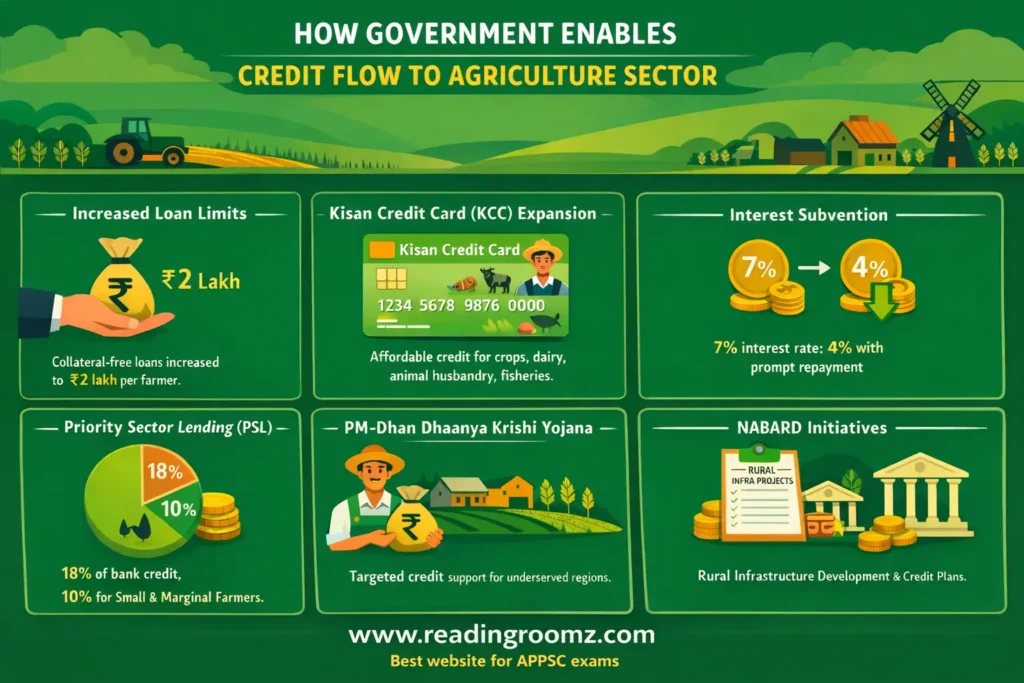
The Government of India has introduced targeted policy measures to increase institutional credit flow to the agriculture sector, particularly benefiting small and marginal farmers.
Key Measures Announced
1. Increase in Collateral-Free Loan Limit
- The limit for collateral-free short-term agricultural loans has been raised from ₹1.60 lakh to ₹2 lakh per borrower (effective from 1 January 2025).
- This move improves access to credit for small farmers who often lack assets for collateral.
2. Kisan Credit Card (KCC) Expansion
- The Kisan Credit Card scheme provides farmers with timely and affordable credit for:
- Seeds
- Fertilizers
- Pesticides
- Crop-related expenses
- Since 2019, the scheme has also been extended to animal husbandry, dairy, and fisheries sectors.
3. Interest Subvention Scheme
- Under the Modified Interest Subvention Scheme (MISS):
- Farmers get loans at 7% interest through KCC.
- Prompt repayment incentive of 3% reduces the effective interest rate to 4%.
4. Priority Sector Lending (PSL) Norms
- Banks must allocate 18% of Adjusted Net Bank Credit (ANBC) to agriculture.
- Within this, 10% is reserved for Small and Marginal Farmers (SMFs).
5. PM Dhan Dhaanya Krishi Yojana (PM-DDKY)
- Announced in Union Budget 2025–26.
- Aims to improve credit availability in districts with low agricultural credit flow.
6. Support through NABARD
- NABARD supports rural credit through:
- Rural Infrastructure Development Fund (RIDF)
- Potential Linked Credit Plan (PLP) for districts
- Financial assistance to banks and rural financial institutions.
Objective
These measures aim to:
- Improve credit access for small and marginal farmers (over 86% of farmers).
- Strengthen agriculture and allied sectors such as dairy, fisheries, and animal husbandry.
- Promote financial inclusion and rural economic growth.
Fisheries Research Institutes and Regional Research Centres
These Fisheries Research Institutes and Regional Research Centres Head Quarters and Regional Centres in Andhra Pradesh are important for APPSC exams. Make a note of it and read them often.
Daily Current Affairs Quiz
Test your knowledge with exam-oriented multiple choice questions based on today’s current affairs.
Disclaimer: This article is prepared for competitive exam preparation using publicly available information.
Frequently Asked Questions (FAQs)
Where does the Musi River start and end?
The Musi River starts at the foothills of Ananthagiri near Vikarabad, Telangana, formed by the Esi and Musa tributaries, flows eastward through Hyderabad, and ends by joining the Krishna River near Wazirabad in the Nalgonda district
Is Musi a tributary of Godavari?
No. Musi river flows through Hyderabad, and joins the Krishna River in the Nalgonda district.
Which country hosted the ICC Men’s T20 World Cup 2026?
India and Sri Lanka co-hosted the ICC Men’s T20 World Cup 2026.
What is the current status of the Jal Jeevan Mission?
The Union Cabinet, chaired by Narendra Modi, has approved the extension and restructuring of the Jal Jeevan Mission up to December 2028 under JJM 2.0. Total Outlay: ₹8.69 lakh crore.
What is the collateral-free agricultural loan limit for agricultural loans?
As on 10 March 2026, The limit for collateral-free short-term agricultural loans has been raised from ₹1.60 lakh to ₹2 lakh per borrower (effective from 1 January 2025).
Where is the Central Institute of Fisheries Education located?
The Central Institute of Fisheries Education is located in Mumbai, Maharashtra. One of the Regional Centres is located in Kakinada.