Current Affairs 06 March 2026
Add as a preferred Source on GoogleTable of Contents
Iranian Warship IRIS Dena Sinks Near Sri Lanka After U.S. Submarine Torpedo Attack
An Iranian naval frigate, IRIS Dena, sank in the Indian Ocean about 40 nautical miles off the coast of Galle, Sri Lanka, after being hit by a torpedo reportedly fired by a U.S. submarine. The incident has raised concerns about the escalation of the West Asian conflict near the Indian subcontinent.
The vessel had recently participated in the International Fleet Review 2026 held in Visakhapatnam, India, and was returning to Iran when the attack occurred.
As per US Statement, this is the first sinking of an enemy ship by a torpedo since World War II.
Andhra Pradesh Launches ‘Indra Dhanassu’ Initiative
The Government of Andhra Pradesh has introduced ‘Indra Dhanassu’, a new initiative aimed at promoting the welfare and social inclusion of Persons with Disabilities (PwDs).
As part of this initiative, the Andhra Pradesh State Road Transport Corporation (APSRTC) will provide free bus travel across the State to persons with disabilities. The scheme is intended to improve mobility, accessibility, and participation of PwDs in education, employment, and social activities.
India Ranks Second Globally in Childhood Obesity
According to the World Obesity Atlas 2026, released by the World Obesity Federation on World Obesity Day (March 4), India ranks second in the world in terms of the number of children living with obesity or high Body Mass Index (BMI).
Key Findings of the Report
In 2025, nearly 15 million children aged 5–9 years and 26 million children aged 10–19 years in India were overweight or obese.
📌 World Obesity Atlas 2026 Report
Inconsistent Website Blocking Practices in India
A recent study titled “Poisoned Wells: Examining the Scale of DNS Censorship in India” has revealed significant inconsistencies in how websites are blocked by Internet Service Providers (ISPs) across India.
The study highlights that DNS filtering is the primary method used for website blocking in India. However, this method is easily bypassed, and there is no uniform legal requirement specifying how ISPs should implement website blocking.
Website Blocking Methods (from Strongest to Weakest)
- Internet Shutdown
- Deep Packet Inspection (DPI)
- BGP Routing Manipulation
- IP Address Blocking
- SNI Filtering
- URL Filtering
- DNS Filtering
- Platform-Level Blocking
Jan Vishwas (Amendment of Provisions) Bill, 2026
The Andhra Pradesh Legislative Assembly has passed the A.P. Jan Vishwas (Amendment of Provisions) Bill, 2026, aiming to decriminalise minor offences and promote trust-based governance.
The Bill seeks to replace imprisonment with monetary penalties for minor procedural and regulatory violations under 12 State Acts. The initiative is intended to improve ease of living for citizens and enhance the Ease of Doing Business in the State.
Key Features of the Bill
- Decriminalisation of minor offences in various State laws.
- Replacement of imprisonment provisions with monetary penalties.
- Introduction of administrative adjudication mechanisms.
- Graded penalties based on the severity and duration of violations.
- Provision for compounding certain offences to reduce litigation.
Objective
The government observed that several existing laws imposed criminal penalties for minor procedural defaults, which led to:
- Unnecessary litigation
- Increased burden on courts
- Discouragement for investment and business activities
The reform aligns with the Jan Vishwas (Amendment of Provisions) Act, 2023 enacted by the Central Government, which aims to reduce compliance burden and improve the business environment.
Repeal of Obsolete Laws
The Bill also clears the way for the repeal of outdated laws such as:
- A.P. (Krishna, Godavari and Pennar Delta Area) Drainage Cess Act, 1985
- A.P. (Non-Delta Area) Drainage Act, 1986
This step reflects the State’s effort to modernise legal frameworks and remove obsolete regulations.
Telugu Inscriptions from Vijayanagara Period Identified in Annamayya District
Two Telugu inscriptions dating back to the Vijayanagara period have been identified on a monolithic pillar at the Sri Chennakesava Temple in Somapalayam village of Annamayya district, Andhra Pradesh.
Key Findings
- The inscriptions are engraved on the pedestal of a monolithic pillar located in front of the temple.
- The engravings include the phrases “Subhamastu Swasti Sri Jayabhyudaya” and “Jaya Samvatsaram”.
Based on the script style and the cyclic year ‘Jaya’, historians estimate that the inscriptions date back to 1534 CE, during the reign of Vijayanagara Emperor Achyuta Deva Raya, the successor of the famous ruler Krishnadevaraya.
Architectural Significance
The pillar is an over 50-foot-tall structure featuring intricate carvings such as:
- Keerthi Mukhas
- Garuda figures
- Musicians and dancers
- Yali motifs
- Floral patterns
India and Finland Elevate Bilateral Relations to Strategic Partnership
The President of Finland, Alexander Stubb, paid a State Visit to India from March 4–7, 2026, at the invitation of Prime Minister Narendra Modi. During the visit, India and Finland agreed to elevate their bilateral relationship to a “Strategic Partnership in Digitalization and Sustainability.”
Key Agreements (MoUs) Signed
- MoU on Migration and Mobility Partnership
- Renewal of MoU on Environmental Cooperation
- MoU on Cooperation in Official Statistics
Major Announcements
- Creation of a Joint Task Force on 6G research involving the University of Oulu (Finland) and Bharat 6G Alliance.
- Development of the Indo-Finland Startup Corridor to connect startup ecosystems.
- World Circular Economy Forum 2026 to be co-hosted in India.
Digital Tools and Mascots Unveiled for Census 2027
Union Home Minister Amit Shah soft-launched four digital tools and two mascots “Pragati” (female) and “Vikas” (male) for Census 2027. Census 2027 will be conducted as the world’s largest census exercise and will mark several technological innovations in India’s census process.
For the first time in India, the Census will be conducted digitally, and households will also have the option of Self-Enumeration, allowing citizens to submit their details online before the door-to-door survey.
Key Highlights of Census 2027
- Census 2027 will be conducted in two phases:
- Houselisting and Housing Census (Phase 1)
- Population Enumeration (Phase 2)
- The reference date for most parts of India will be 1 March 2027.
Four Digital Tools Launched
- Houselisting Block Creator (HLBC) Web Application – Uses satellite imagery to create houselisting blocks.
- HLO Mobile Application – Mobile app for enumerators to collect housing data digitally.
- Self-Enumeration (SE) Portal – Allows households to submit census details online in 16 languages.
- Census Management and Monitoring System (CMMS) Portal – Centralized system to manage and monitor census operations.
Korea District’s “5% Model” for Water Conservation in Chhattisgarh
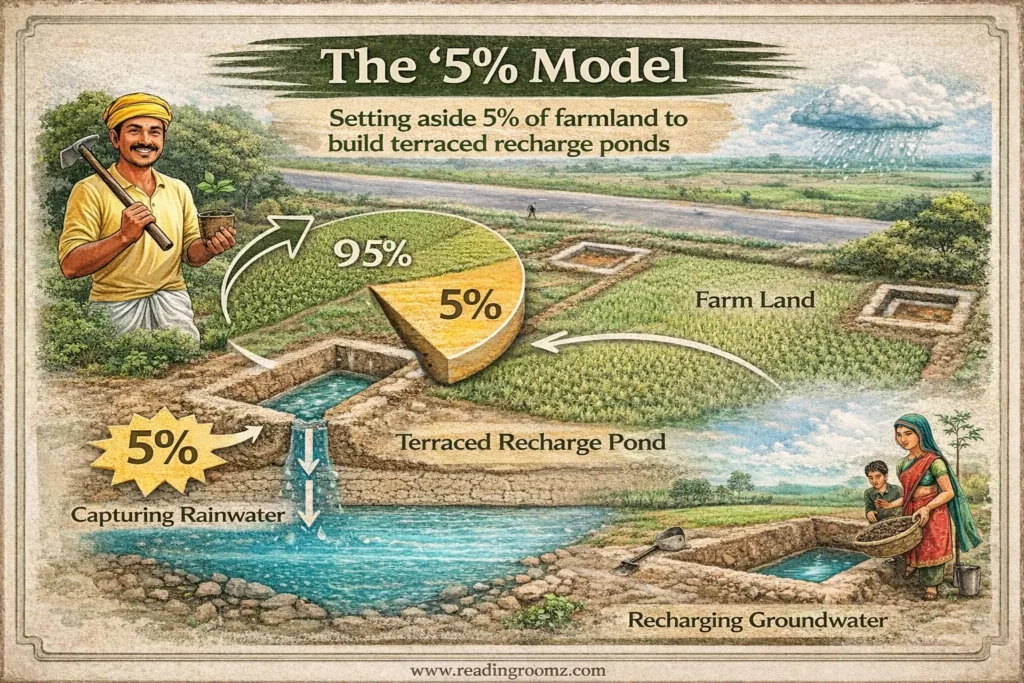
The Korea district of Chhattisgarh has emerged as a model of community-led water conservation through the initiative “Jal Sanchay Jan Bhagidari.” Under this initiative, farmers voluntarily dedicate 5% of their agricultural land to construct small recharge ponds and terraced pits to capture rainwater.
This innovative approach, known as the “5% Model,” was implemented under the Aawa Paani Jhoki movement and aims to improve groundwater recharge, soil moisture, and agricultural sustainability.
Key Features of the 5% Model
- Farmers allocate 5% of their farmland for rainwater harvesting structures such as recharge ponds and pits.
- Rainwater is retained within fields to recharge soil and groundwater aquifers.
- The initiative is based on community participation and Gram Sabha resolutions.
India’s First Riverine Lighthouses to be Built on Brahmaputra
India will establish its first riverine lighthouses on an inland waterway along the Brahmaputra River (National Waterway-2). The foundation stones for the project were laid by Union Minister for Ports, Shipping and Waterways, Sarbananda Sonowal at Lachit Ghat in Guwahati, Assam.
The project will be implemented by the Directorate General of Lighthouses and Lightships (DGLL) in collaboration with the Inland Waterways Authority of India (IWAI) with an investment of ₹84 crore.
NITI Aayog and UNICEF India Sign Statement of Intent for Nutrition Initiatives
NITI Aayog and UNICEF India signed a Statement of Intent (SoI) to strengthen collaborative efforts aimed at improving maternal and child nutrition outcomes in Aspirational Districts and Aspirational Blocks across India.
Daily Current Affairs Quiz
Test your knowledge with exam-oriented multiple choice questions based on today’s current affairs.
Disclaimer: This article is prepared for competitive exam preparation using publicly available information.