Current Affairs 27 February 2026 | APPSC
Add as a preferred Source on GoogleTable of Contents
U.S. Imposes 126% Countervailing Duty on Indian Solar Imports
- The United States has imposed a 126% countervailing duty (CVD) on solar cell imports from India after a preliminary investigation by the U.S. Department of Commerce.
- The probe concluded that subsidised Indian solar exports were hurting U.S. domestic manufacturers and violated WTO subsidy norms.
- Similar duties were also imposed on Indonesia and Laos.
Importance of U.S. Market
- The U.S. is the largest export destination for Indian solar components.
- India exported: $1 billion worth photovoltaics in FY 2022–23 and $1.94 billion in FY 2023–24
PMO Reviews Proposed CAFE-III Carbon Emission Norms 2027
- The Prime Minister’s Office (PMO) held a high-level meeting to review the Corporate Average Fuel Efficiency (CAFE-III) norms for passenger vehicles, proposed to be implemented from 2027.
- The meeting involved the Ministry of Power, Bureau of Energy Efficiency (BEE), and Ministry of Heavy Industries, but no final decision has been taken yet.
📌 What are CAFE 3 Norms?
CAFE (Corporate Average Fuel Efficiency) norms are fuel efficiency and CO₂ emission standards set by the Government of India for passenger vehicles. They require automobile manufacturers to ensure that the average emissions of all vehicles sold by them remain within a prescribed limit, thereby reducing fuel consumption and carbon emissions.
NSIC Upgraded to Schedule ‘A’ CPSE
- The National Small Industries Corporation Ltd. (NSIC), under the Ministry of MSME, has been upgraded from Schedule ‘B’ to Schedule ‘A’ category CPSE through a government notification dated 26 February 2026.
- NSIC has been working for over seven decades for the promotion and development of MSMEs in India.
PSU Classification Criteria in India
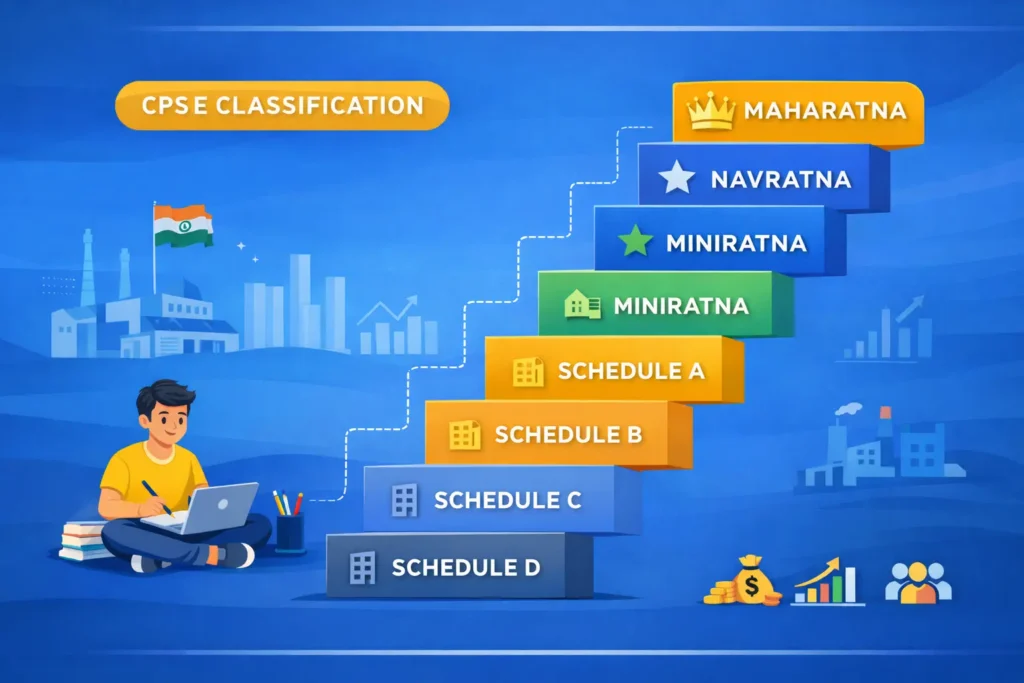
Central Public Sector Enterprises (CPSEs) are classified into Schedule A, B, C, D and Miniratna/Maharatna/Navratna categories based on their financial performance, size, operational scale, and strategic importance.
The Government (through the Department of Public Enterprises – DPE) grants these statuses to the Public Sector Companies.
Public Sector Enterprises are broadly classified into 8 categories.
- Maharatna Company
- Navaratna Company
- Miniratna Category – I
- Miniratna Category – II
- Schedule A
- Schedule B
- Schedule C
- Schedule D
PSU Classification Eligibility
| Category | Sub-Type | Eligibility / Basis | Key Financial Conditions | Main Benefit / Purpose |
|---|---|---|---|---|
| Maharatna | — | Must be a Navratna + listed on stock exchange | Turnover ≥ ₹25,000 CrNet worth ≥ ₹15,000 CrNet profit ≥ ₹5,000 Cr (avg last 3 yrs) | Invest up to 15% of net worth (max ₹5,000 Cr) without Govt approval |
| Navratna | — | Must be Miniratna Category-I + score ≥ 60/100 | Score based on 6 performance parameters (profitability, EPS, PBDIT, manpower cost, etc.) | High financial & operational autonomy |
| Miniratna | Category-I | Profit in last 3 consecutive years | Pre-tax profit ≥ ₹30 Cr in at least one year | Limited investment autonomy |
| Miniratna | Category-II | Profit in last 3 consecutive years | No minimum profit limit | Lesser autonomy than Category-I |
| Schedule A | — | Based on size, strategic importance & financial strength | High investment, large turnover, high manpower, national importance | Highest organisational & pay scale among CPSE schedules |
| Schedule B | — | Same parameters as above | Moderately large CPSE | Next level organisational status |
| Schedule C | — | Same parameters as above | Medium size CPSE | Lower than Schedule B |
| Schedule D | — | Same parameters as above | Small CPSE | Lowest organisational status |
India Israel Relations Elevated to Special Strategic Partnership
- India and Israel upgraded their bilateral ties to a Special Strategic Partnership.
- Both countries signed multiple MoUs covering key areas such as artificial intelligence, agriculture, geophysical exploration, fintech, cyber security, fisheries, education, labour mobility, and cultural exchange.
- An agreement to enable cross-border remittances through UPI.
- The establishment of an India–Israel Innovation Centre for Agriculture and a Cyber Centre of Excellence in India.
- The visit also led to the decision to allow up to 50,000 Indian workers to be employed in Israel over the next five years through regulated channels.
- India-Israel Academic Cooperation Forum.
- India- Israel Parliamentary Friendship Group.
Daily Current Affairs Quiz
Test your knowledge with exam-oriented multiple choice questions based on today’s current affairs.
Disclaimer: This article is prepared for competitive exam preparation using publicly available information.