India-EU FTA (Free Trade Agreement)
Table of Contents
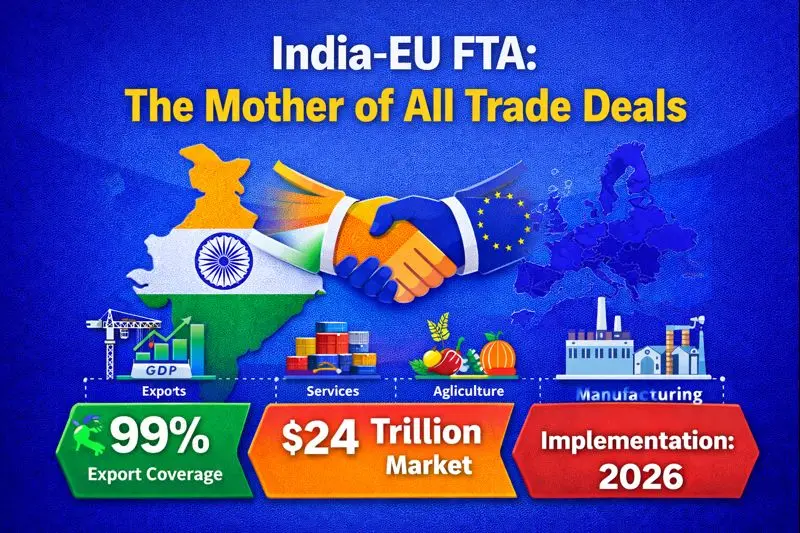
The India-EU FTA (Free Trade Agreement), often described as the “mother of all trade deals”, marks a historic milestone in India’s external trade and diplomacy. After nearly two decades of negotiations, the agreement brings together two world’s largest economies and is expected to reshape India-EU trade relations in the coming decade.
Why is the India-EU FTA Significant?
The India EU FTA is significant due to the scale of markets involved, depth of tariff concessions, and strategic diversification of India’s trade partners.
- The combined market size of India and the EU is estimated at ₹2,091.6 lakh crore (~$24 trillion).
- While India has signed 8 FTAs in the last four years, the EU alone accounts for nearly 12% of India’s total trade, making it India’s largest collective trading partner.
- In 2024-25, bilateral merchandise trade stood at ₹11.5 lakh crore ($136.5 billion).
- Trade in services touched ₹7.2 lakh crore ($83.1 billion).
What is India Gaining from the India-EU Trade Deal?
EU Tariff Concessions to India
| Category | Coverage |
|---|---|
| Immediate tariff elimination | 70.4% tariff lines |
| Export value covered immediately | 90.7% |
| Tariff elimination over 3–5 years | 20.3% tariff lines (2.9% export value) |
| Tariff reduction / quota-based | 6.1% tariff lines (6% export value) |
Overall, EU tariff concessions cover over 99% of India’s export value to the EU.
Services Sector Gains
The EU has offered broader and deeper commitments across 144 service sub-sectors, including:
- IT & ITeS
- Professional services
- Education
- Business services
- Indian traditional medicine (AYUSH)
In EU countries where regulations do not exist, AYUSH practitioners can offer services using Indian qualifications.
Which Sectors Will Benefit the Most?
According to the Commerce Minister, labour-intensive sectors will gain the maximum benefit.
Key Beneficiary Sectors
- Textiles & Apparel
- Leather & Footwear
- Marine products
- Chemicals, plastics & rubber
- Gems & jewellery
- Sports goods & toys
💡 These sectors currently face 4–26% tariffs, many of which will become 0% from Day One.
Additional beneficiaries:
- Agriculture exports: tea, coffee, spices, grapes, gherkins, onions, fruits & vegetables
- Processed food products
What Has India Offered to the EU?
| Parameter | India’s Offer |
|---|---|
| Immediate duty elimination | 49.6% tariff lines (30.6% trade value) |
| Phased elimination (5–10 years) | 39.5% tariff lines (63.1% trade value) |
| Total coverage | 92.1% tariff lines & 97.5% trade value |
Consumer-Facing Impacts in India
- European wine tariffs reduced from ~150% → 20–30% (quota-based)
- Luxury car tariffs reduced from 110% → 10% (quota-based)
- Cars below ₹25 lakh are excluded to protect domestic manufacturers
Which Sectors Are Kept Outside the Deal?
India
- Dairy, poultry, beef
- Rice, wheat, cereals
- Edible oils, tobacco
- Sensitive agricultural products
European Union
- Beef, sugar, rice
- Milk powder, honey
- Bananas, garlic, ethanol
Both sides protected politically sensitive sectors while liberalising competitive ones.
Key Challenges
1. Carbon Border Adjustment Mechanism (CBAM)
- No direct concession yet
- India secured a non-discrimination clause any future CBAM concession by EU to others applies to India
2. Investment Readiness
- India must accelerate ease-of-doing-business reforms to attract EU-bound investments
Implementation Timeline
- Text yet to undergo legal review
- Translation into 24 EU languages
- Approval by 27 EU member states
- Ratification by European Parliament
The India-EU FTA may be implemented by the end of the year 2026.
Why India-EU FTA important for APPSC
- Largest trade agreement India has ever signed
- Covers 99% of India’s export value
- Strategic shift amid US-China trade uncertainties
- Strengthens India-EU relations, supply chains, and services exports
👉 Latest Current Affairs for APPSC 2026
Frequently Asked Questions (FAQ)
Does India have an FTA with the EU?
Yes. The India-EU Free Trade Agreement negotiations concluded in January 2026 and are expected to be implemented in 2026.
Is the India-EU trade deal finalised?
Negotiations are concluded; legal and parliamentary approvals are pending.
What are the benefits of the India-EU FTA?
The India-EU FTA offers tariff-free or reduced-duty access for over 99% of India’s export value to the EU. Labour-intensive sectors like textiles, leather, gems, and marine products gain immediate 0% tariffs. Indian IT, AYUSH, and professional services gain wider market access across 144 EU sub-sectors, boosting both goods and services exports significantly.
Who is India’s largest trading partner in the EU?
The European Union as a bloc is India’s largest collective trading partner.
What does the EU import from India?
Textiles, apparel, chemicals, marine products, gems & jewellery, IT services, and agricultural products.
For Aspirants
The India-EU FTA is not just a trade deal, it is a strategic economic point. With 99% export coverage, services access, and labour-intensive sector gains, it has high relevance for APPSC exams prelims, mains, and interviews.
Source: PIB