Silver Economy
Table of Contents
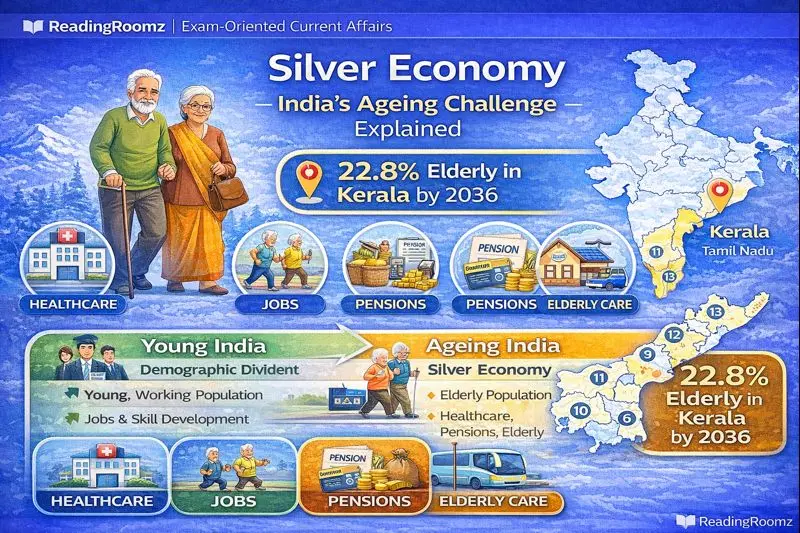
India is entering a new demographic phase where a rising elderly population is reshaping economic priorities. Policies, markets, and governance models are increasingly being designed around senior citizens (60+ years). This age-focused economic system is known as the Silver Economy.
Recent findings from the RBI Report on Demographic Transition in India (2025–26) have brought this concept into sharp focus, making it a high-probability exam topic for APPSC, UPSC, and SSC.
Definition & Meaning
Silver Economy refers to all economic activities, services, jobs, and policies that focus on the needs, welfare, and productivity of elderly people, usually aged 60 years and above.
In simple words:
When a large section of the population becomes old, the economy must adjust to support them through healthcare, pensions, elderly-friendly jobs, housing, transport, insurance, and care services. This adjusted system is called the Silver Economy.
Examples
- Hospitals, clinics, and geriatric healthcare services
- Pension schemes and retirement benefits
- Senior-friendly housing and assisted living facilities
- Elder-friendly transport and public infrastructure
- Part-time or flexible jobs suitable for older workers
- Health insurance and long-term care services
The importance of the Silver Economy is increasing due to long-term demographic changes.
Importance
- People are living longer due to medical advances
- The share of senior citizens is rising rapidly
- Fewer young workers means higher dependency ratio
- Governments must ensure income security, healthcare, and dignity in old age
RBI Report on Silver Economy in India (2025–26)
The Reserve Bank of India (RBI), in its report titled: “State Finances: A Study of Budgets 2025–26 – Demographic Transition in India” has highlighted rapid ageing trends in several Indian States.
Key Findings of RBI Report
| Indicator | RBI Observation |
|---|---|
| Most aged State by 2036 | Kerala (22.8% population aged 60+) |
| Ageing threshold | 15% population aged 60+ |
| Tamil Nadu | Enters ageing category by 2026 (15.8%) |
| Working-age population in Kerala | Declining steadily |
| Demographic dividend | Closing early in ageing States |
State Level Implications
Kerala – India’s First Silver Economy Challenge
Kerala is expected to face early closure of demographic dividend, forcing a shift in policy priorities.
RBI Recommendations for Ageing States:
- Shift focus from job creation to old-age support systems
- Increase healthcare financing
- Strengthen preventive healthcare
- Build elderly care infrastructure
- Enhance productivity of older workers
Silver Economy vs Demographic Dividend
| Aspect | Demographic Dividend | Silver Economy |
|---|---|---|
| Population | Young | Elderly |
| Policy focus | Jobs, skills, education | Health, pensions, care |
| Economic driver | Youth workforce | Elderly services |
| Risk if ignored | Unemployment | Fiscal stress & social insecurity |
Why Silver Economy is a Governance Issue?
The Silver Economy is not just a social concept it is a public finance and governance challenge.
- Rising pension burden
- Higher healthcare expenditure
- Pressure on State budgets
- Need for elderly-friendly urban planning
This makes it a core topic in Economics, Polity, Social Justice, and Current Affairs.
👉 Go to Daily Current Affairs Section
Frequently Asked Questions (FAQ)
What is Silver Economy meaning?
Silver Economy means the economic system designed to meet the needs of elderly people through healthcare, pensions, jobs, and care services.
What is Silver Economy in India?
Silver Economy in India focuses on supporting a rapidly growing elderly population, especially in ageing States like Kerala and Tamil Nadu.
Why is Silver Economy important for UPSC?
It is linked to demographic transition, public finance, healthcare, and social justice—key GS syllabus areas.
Which State needs Silver Economy the most?
Kerala, as per RBI, with over 22% elderly population by 2036.
What is RBI’s role in Silver Economy discussion?
RBI highlighted ageing risks and recommended building a strong Silver Economy framework.
For Aspirants
The Silver Economy is a future-defining concept for India’s governance and economic planning. As demographic dividend fades in some States, healthy ageing, elderly productivity, and social security will determine economic stability.
Reference: RBI Report