One District One Product
Table of Contents
India’s development story is often told through megacities and large industries. Yet, in districts like Moradabad, generations of artisans quietly shaped brassware with unmatched skill largely invisible to global markets.
This changed in 2018, when Uttar Pradesh launched an innovative experiment: One District One Product (ODOP). The idea was simple but transformational—identify one unique product per district and build an ecosystem around it.
What began as a state initiative is now a nationwide economic transformation model, covering 770+ districts and empowering millions of artisans, farmers, and MSMEs.
What is One District One Product (ODOP)?
One District One Product is a flagship initiative led by the Department for Promotion of Industry and Internal Trade (DPIIT) that aims to:
- Identify one unique product per district
- Provide branding, skill development, credit, and market access
- Convert districts into self-sustaining economic hubs
It aligns strongly with national missions like Vocal for Local, Make in India, and Aatmanirbhar Bharat.
Evolution of ODOP: From UP to All India
| Year | Milestone |
|---|---|
| 2018 | ODOP launched in Uttar Pradesh |
| 2020–22 | Expanded to multiple states |
| Dec 2025 | Implemented in 770+ districts nationwide |
Today, ODOP represents India’s most decentralised industrial policy.
Why ODOP Matters for India’s Economy
- Balanced Regional Development: ODOP reduces over-dependence on metros by unlocking district-level strengths, ensuring inclusive growth.
- Artisan & MSME Empowerment: Traditional skills often passed through generations are revived with modern tools, training, and finance.
- Job Creation & Rural Entrepreneurship: ODOP creates livelihoods within districts, reducing distress migration.
- Export Promotion: District products now reach international exhibitions, G20 gifting platforms, and overseas stores.
- Preservation of Cultural Heritage: ODOP safeguards India’s intangible cultural assets, from weaving to metal crafts.
Institutional Framework of ODOP
ODOP works through cooperative federalism:
- States/UTs identify district products
- Final lists are communicated to DPIIT
- District administrations implement skilling, credit, and marketing
Over 1,200 ODOP products are listed on the DPIIT digital portal.
Digital & Market Access Push
| Platform | Role |
|---|---|
| GeM–ODOP Bazaar | Direct government procurement |
| State e-commerce portals | Wider consumer reach |
| ODOP Exhibitions | National & global visibility |
This digital push ensures local producers access national demand.
UP remains the flagship example of ODOP success.
Key Highlights
- UP International Trade Show (UPITS) 2025
- 466 ODOP stalls
- ₹20.77 crore business generated
- Mahakumbh 2025, Prayagraj
- 6,000 sq. m ODOP zone
- 75 GI-tagged products showcased
Economic Impact in UP
| Indicator | Outcome |
|---|---|
| Exports | ↑ 76% (₹88,967 Cr → ₹1.71 lakh Cr) |
| Projects sanctioned | ₹6,000 crore |
| Artisans trained | 1.25 crore+ |
PM Ekta Malls: Physical Marketplaces for ODOP
PM Ekta Malls (Unity Malls) are iconic retail hubs showcasing ODOP, GI, and handicraft products.
- Dedicated space for every State & UT
- ₹5,000 crore interest-free support
- 29 malls approved across 27 states
- PPP model with professional management
These malls convert ODOP into national cultural and commercial destinations.
One District One Product Andhra Pradesh List
ODOP for 13 districts of Andhra Pradesh
| Sl. No. | District | ODOP Product(s) |
|---|---|---|
| 1 | Ananthapur | Groundnut Products |
| 2 | Chittoor | Tomato-based Products |
| 3 | East Godavari | Banana |
| 4 | Guntur | Spices (Chilli & Turmeric) |
| 5 | Kadapa | Banana-based Products |
| 6 | Krishna | Fish & Shrimp based products |
| 7 | Kurnool | Pulses based products |
| 8 | Nellore | Rice based products (eg. flaked & purified) |
| 9 | Prakasam | Pulses based products |
| 10 | Srikakulam | Cashewnut-based Products |
| 11 | Visakhapatnam | Traditional local snacks |
| 12 | Vizianagaram | Millets (ragi and korra) |
| 13 | West Godavari | Fish & Marine-based Products |
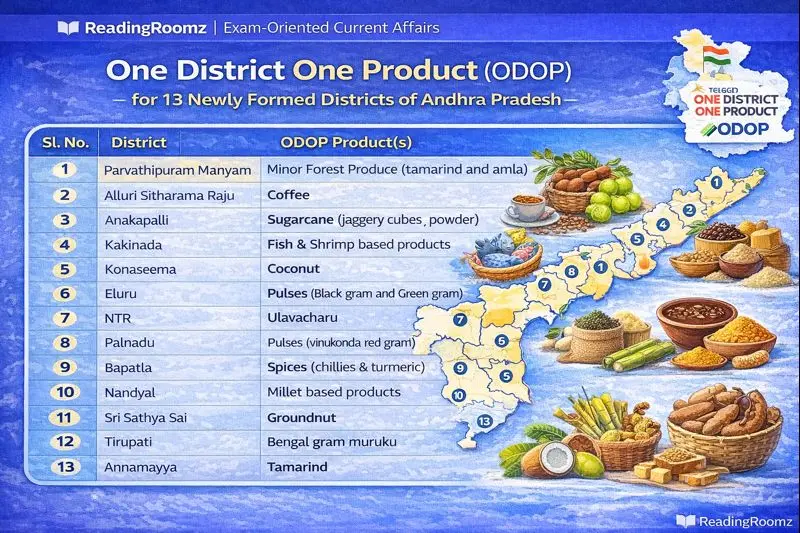
ODOP for 13 newly formed districts of Andhra Pradesh
| Sl. No. | District | ODOP Product(s) |
|---|---|---|
| 1 | Parvathipuram Manyam | Minor Forest Produce (tamarind and amla) |
| 2 | Alluri Sitharama Raju | Coffee |
| 3 | Anakapalli | Sugarcane (jaggaery cubes, powder) |
| 4 | Kakinada | Fish & Shrimp based products |
| 5 | Konaseema | Coconut |
| 6 | Eluru | Pulses (Black gram and Green gram) |
| 7 | NTR | Ulavacharu |
| 8 | Palnadu | Pulses (vinukonda red gram) |
| 9 | Bapatla | Spices (chillies & turmeric) |
| 10 | Nandyal | Millet based products |
| 11 | Sri Sathya Sai | Groundnut |
| 12 | Tirupati | Bengal gram muruku |
| 13 | Annamayya | Tamarind |
ODOP’s Global Outreach
ODOP is now part of India’s economic diplomacy.
Global Footprint
- 80+ Indian Missions promote ODOP abroad
- ODOP products used in G20 gifting
- Permanent ODOP stores:
- Singapore (2)
- Kuwait (1)
Why ODOP is Important for Competitive Exams
For APPSC aspirants, One District One Product is relevant to:
- Economy (inclusive growth, MSMEs)
- Governance (cooperative federalism)
- Current Affairs (industrial policy)
- Essay & GS answers (case study model)
👉 Go to Daily Current Affairs Section
Frequently Asked Questions (FAQ)
What is One District One Product (ODOP)?
It is a government initiative to promote one unique product per district through branding, skilling, finance, and market access.
Which ministry implements ODOP?
ODOP is coordinated by DPIIT with state and district governments.
When was ODOP launched?
It was first launched in Uttar Pradesh in 2018.
How many districts are covered under ODOP?
As of December 2025, 770+ districts are covered nationwide.
How is ODOP linked to Aatmanirbhar Bharat?
ODOP builds local manufacturing capacity, self-employment, and export competitiveness.
Reference: Ministry of Food Processing Industries