
Current Affairs 08 January 2026
Add as a preferred Source on GoogleTable of Contents
Election Commission’s Special Intensive Revision (SIR)
Background
- SIR began in Bihar and expanded to 12 more States and Union Territories.
- ECI clarified that issuing national identity cards or maintaining NRC lies with the Union Government, not the ECI.
The Election Commission of India (ECI) defended its Special Intensive Revision (SIR) of electoral rolls before the Supreme Court, rejecting allegations that it amounts to a “parallel National Register of Citizens (NRC)”.
- The ECI stated it has a constitutional duty, not merely power, to ensure that foreigners are excluded from electoral rolls.
- Even the presence of one foreigner on electoral rolls violates constitutional principles.
- The Constitution is described as “citizen-centric”, making citizenship the foundation of electoral participation.
Constitutional and legal basis cited
- Article 324: Grants ECI plenary powers over preparation and revision of electoral rolls.
- Article 326: Limits voting rights to adult citizens.
- Article 327: Parliament’s law-making power on elections is subject to Articles 324 and 326.
- Citizenship Act, 1955 (Section 9(2)): Central Government’s exclusive jurisdiction applies only to termination of citizenship due to voluntary acquisition of foreign citizenship.
• Includes all Indian citizens, irrespective of age.
• Prepared and maintained by the Central Government.
• Legal basis: Citizenship Act, 1955 (especially Section 14A).
• Objective: Identification of citizens and non-citizens for citizenship purposes.
• Covers the entire population, including minors.
• Not directly linked to voting rights.
Electoral Rolls / Special Intensive Revision (SIR):
• Includes only Indian citizens aged 18 years and above.
• Prepared and revised by the Election Commission of India (ECI).
• Constitutional basis: Article 324 read with Article 326.
• Objective: Ensuring the purity of electoral rolls for elections.
• Excludes minors, persons of unsound mind, and non-citizens.
• Directly linked to the right to vote.
NRC is concerned with determining citizenship status, whereas SIR focuses on verifying voter eligibility. Hence, SIR cannot be equated with NRC.
2026 Declared International Year for Rangelands and Pastoralists
The United Nations has declared 2026 as the “International Year for Rangelands and Pastoralists”, highlighting the urgent need to recognise and protect grasslands and rangelands as critical ecosystems for climate action, biodiversity conservation, and livelihoods. UNCCD COP16 formally recognised rangelands as complex socio-ecological systems.
Advantages of Grasslands:
- Grasslands and savannahs are major carbon sinks, often comparable to forests.
- They support pastoralist and indigenous communities and provide ecosystem services like:
- Water regulation
- Soil conservation
- Biodiversity support
Grasslands in India
Grasslands cover about 4–6% of India’s geographical area (often underestimated). Many Indian grasslands are misclassified as “wastelands” in official records.
Major Types of Grasslands in India
- Alpine Grasslands
- Location: Himalayas (above treeline)
- Examples: Bugyals (Uttarakhand), Himachal meadows
- Use: Summer grazing (Bhotiyas, Gujjars)
- Montane / Shola Grasslands
- Location: Western Ghats (Nilgiris, Anamalai, Palani, Hesaraghatta Grasslands)
- Feature: Shola–grassland mosaic
- Importance: Water regulation, endemism
- Semi-arid & Arid Grasslands
- Location: Rajasthan, Gujarat, Deccan Plateau
- Examples: Banni grasslands (Kutch), Maharashtra–Karnataka grasslands
- Communities: Maldharis, Raikas
- Floodplain Grasslands
- Location: Terai (Ganga–Brahmaputra plains)
- Examples: Kaziranga, Dudhwa
- Fauna: One-horned rhino, swamp deer
What are Biomaterials
Biomaterials are materials that are Derived wholly or partly from biological sources, or Engineered using biological processes. These are key alternative to fossil-based materials in sectors such as plastics, textiles, construction, and healthcare.
Types of biomaterials
- Drop-in biomaterials:
- Chemically identical to fossil-based materials
- Compatible with existing manufacturing systems
- Example: Bio-PET
- Drop-out biomaterials:
- Chemically different
- Require new processing or disposal systems
- Example: Polylactic Acid (PLA)
- Novel biomaterials:
- Offer new properties (self-healing, bioactive, advanced composites)
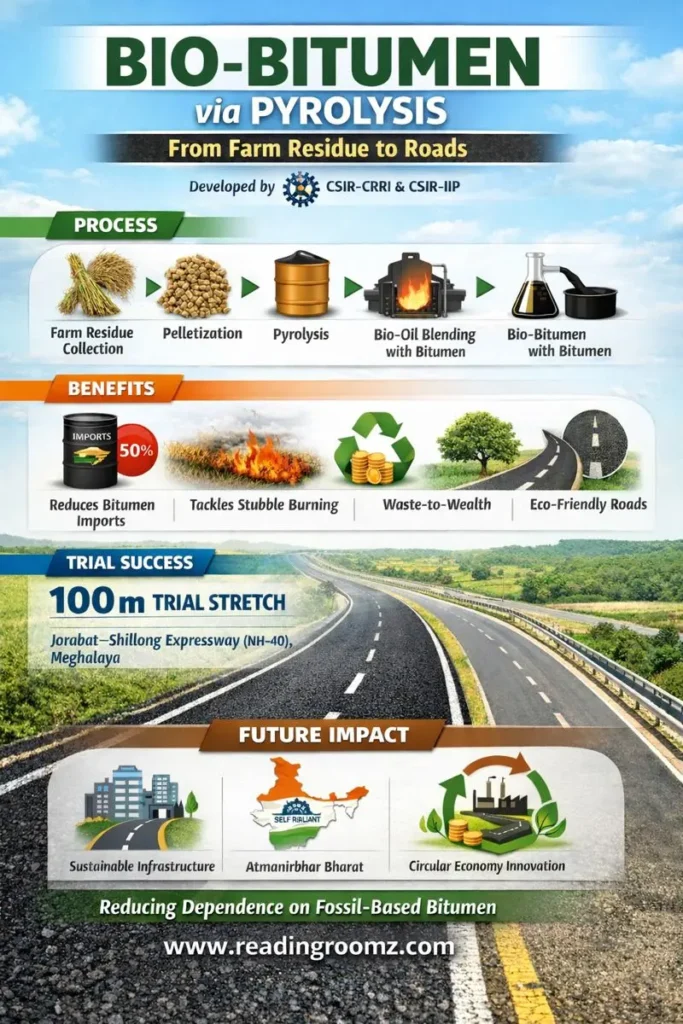
Bio-Bitumen via Pyrolysis: From Farm Residue to Roads
India has achieved a major milestone in sustainable infrastructure with the industrial-scale technology transfer of Bio-Bitumen via Pyrolysis, an indigenous innovation developed by CSIR-Central Road Research Institute (CSIR-CRRI), New Delhi and CSIR-Indian Institute of Petroleum (CSIR-IIP), Dehradun.
What is Bio-Bitumen?
- A bio-based alternative to fossil-derived bitumen.
- Produced by pyrolysis of farm residue, especially post-harvest rice straw.
- Bio-Bitumen Creating Process:
- Collection of rice straw
- Pelletisation
- Pyrolysis to produce bio-oil
- Blending with conventional bitumen
- First Plastic road of100-metre trial stretch successfully laid on Jorabat–Shillong Expressway (NH-40), Meghalaya.
Technical and economic significance
- 20–30% of conventional bitumen can be safely replaced without loss of performance.
- Tested for Rutting, Cracking, Moisture damage and resilient modulus.
- India currently imports around 50% of its bitumen; bio-bitumen can reduce imports worth ₹25,000–30,000 crore annually.
First Advance Estimates of GDP 2025–26 Released
The National Statistics Office (NSO) under the Ministry of Statistics & Programme Implementation (MoSPI) released the First Advance Estimates of India’s GDP for FY 2025–26 on 7 January 2026.
Key growth estimates
- Real GDP growth: 7.4% in FY 2025–26
- Nominal GDP growth: 8.0% in FY 2025–26
- Real GVA growth: 7.3%
- Nominal GVA growth: 7.7%
Sectoral performance (GVA at Constant Prices)
- Services sector: Main growth driver
- Financial, Real Estate & Professional Services + Public Administration, Defence & Other Services: 9.9%
- Trade, Hotels, Transport, Communication & Broadcasting: 7.5%
- Secondary sector: Manufacturing & Construction: 7.0%
- Primary sector: Agriculture & Allied Activities: 3.1% and Electricity, Gas, Water & Utilities: 2.1%
How is the GDP estimated?
- Advance Estimates are indicator-based and use the benchmark–indicator method.
- Key data sources include:
- Index of Industrial Production (IIP)
- GST collections
- Bank credit and deposits
- Agriculture & livestock production estimates
- Railway, aviation, port traffic data
• Real GDP vs Nominal GDP (UPSC 2018, SSC CGL 2022)
• Constant vs Current Prices (SSC CHSL 2020, APPSC Group 2 – 2019)
• GDP vs GVA (UPSC 2015, UPSC 2021)
• GDP Deflator formula (UPSC 2019, SSC CGL 2021)
• Base Year concept (SSC CGL 2017, TSPSC Group-1 2022)
👉 Direct GDP growth numbers are rarely asked.
A. Cost of Living Index
B. Wholesale Price Index
C. GDP Deflator
D. Consumer Price Index
Answer: C. GDP Deflator
Explanation: This question tests understanding of inflation measurement, not GDP numbers.
A. Current year
B. Base year
C. Financial year
D. Assessment year
Answer: B. Base year
Explanation: Repeated SSC concept: Constant prices = base year prices.
A. Real income growth
B. Inflation-adjusted income
C. Nominal income growth
D. Purchasing power parity
Answer: C. Nominal income growth
Explanation: APPSC frequently checks understanding of price types.
Daily Current Affairs Quiz
Test your knowledge with exam-oriented multiple choice questions based on today’s current affairs.
Disclaimer: This article is prepared for competitive exam preparation using publicly available information.