Current Affairs 25 December 2025
Add as a preferred Source on GoogleTable of Contents
RBI’s Handbook of Statistics on Indian States 2024–25
India’s export growth looks strong at the national level, but export activity is increasingly concentrated in a small set of States. Recent analysis of RBI’s Handbook of Statistics on Indian States 2024–25 shows that the top five exporting States Maharashtra, Gujarat, Tamil Nadu, Karnataka, and Uttar Pradesh account for nearly 70% of India’s exports, indicating a rising “core–periphery” pattern.
This concentration is linked to industrial clustering, better logistics, deeper credit availability, and stronger supply-chain ecosystems in coastal and industrial hubs, while many hinterland States remain weakly connected to global value chains. At the same time, production is becoming more capital-intensive: fixed capital is rising faster than employment, meaning exports are increasingly creating value without creating proportionate mass jobs.
RBI Liquidity Infusion via OMO and Dollar–Rupee Swap
RBI is recently announced that it will infuse liquidity through (i) OMO purchase of Government securities (G-Secs) worth ₹2,00,000 crore and (ii) a USD–INR swap auction of $10 billion (3-year tenor).
RBI had reportedly sold net $11.88 bn in Oct 2025 in the inter-bank forex market to manage rupee volatility—such interventions can reduce reserves, so liquidity tools + swaps are used to manage both rupee liquidity and dollar conditions.
Open Market Operation (OMO)
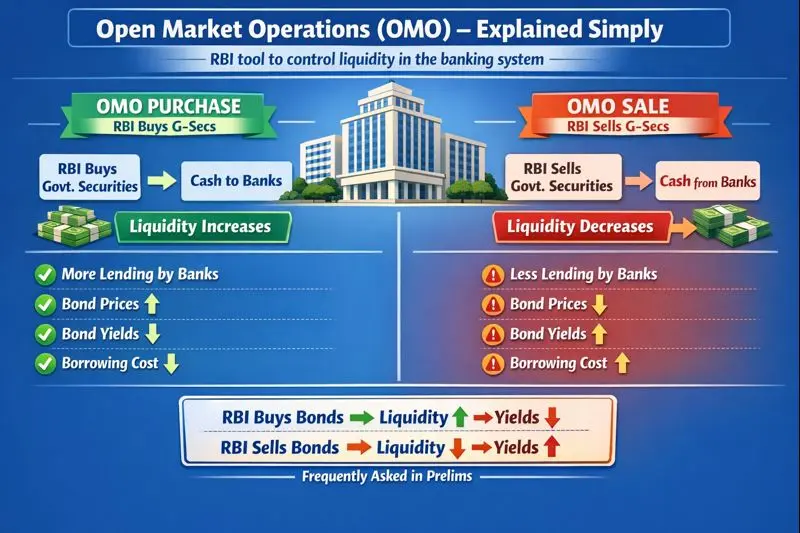
Open Market Operations (OMO) refer to the Reserve Bank of India’s action of buying or selling Government securities (G-Secs) in the open market to regulate liquidity in the banking system.
When RBI buys Government securities (OMO purchase), liquidity in the system increases. For example, if a bank holds ₹10,000 crore worth of G-Secs and RBI buys ₹1,000 crore of these securities, RBI pays the bank ₹1,000 crore in cash. As a result, the bank’s cash balance rises, allowing it to extend more loans. Overall liquidity improves, bond prices tend to rise, and bond yields usually fall, reducing the cost of borrowing.
When RBI sells Government securities (OMO sale), liquidity in the system decreases. For instance, if RBI sells ₹1,000 crore worth of bonds to banks, banks pay RBI using their available cash. This reduces banks’ cash balances, limits their lending capacity, tightens liquidity, and can lead to a rise in bond yields.
Dollar–Rupee Swap
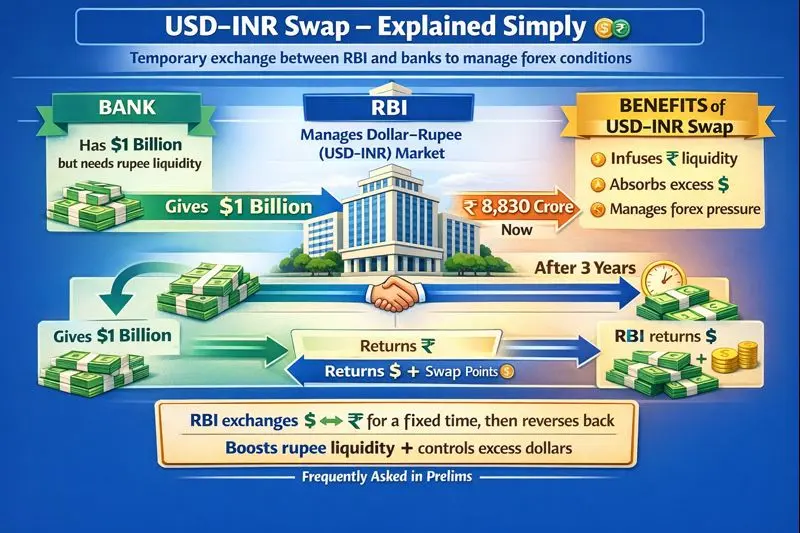
A USD–INR swap is a temporary arrangement between RBI and banks in which RBI exchanges rupees for dollars for a fixed period, and the transaction is reversed later.
Under this mechanism, RBI takes dollars from banks and gives them rupees immediately. After a predetermined period (such as three years), banks return the rupees to RBI, and RBI returns the dollars, adjusted by swap points decided through auction.
RBI uses USD–INR swaps to infuse rupee liquidity into the banking system, absorb excess dollars, and manage pressure on the dollar–rupee forward premium.
For example, if a bank has $1 billion but needs rupee liquidity, RBI may conduct a swap. RBI takes $1 billion from the bank and provides about ₹8,300 crore (assuming $1 = ₹83). The bank can immediately use this rupee liquidity for lending. After three years, the bank returns the rupees, and RBI returns the dollars. This process improves rupee liquidity while helping RBI manage foreign exchange conditions.
Open Market Operations refers to:
A) Borrowing by scheduled banks from the RBI
B) Lending by commercial banks to industry and trade
C) Purchase and sale of Government securities by the RBI
D) None of the above
Answer: C) Purchase and sale of Government securities by the RBI
Explanation: Open Market Operations (OMO) are conducted by the RBI through buying or selling government securities in the open market. When RBI buys G-Secs, it injects money (liquidity) into the banking system, making more funds available for lending. When RBI sells G-Secs, it absorbs liquidity from the system, helping control excess money supply and inflation. Hence, the correct option is C.
Which one of the following activities of the Reserve Bank of India is considered to be part of ‘sterilization’?
A) Conducting Open Market Operations
B) Oversight of settlement and payment systems
C) Debt and cash management for the Central and State Governments
D) Regulating the functions of Non-banking Financial Institutions
Answer: A) Conducting Open Market Operations
Explanation: Sterilization means neutralising the impact of forex market interventions on domestic liquidity. For example, when RBI buys dollars to support the rupee, it injects rupees into the system, increasing liquidity. To “sterilize” this excess liquidity, RBI can sell government securities via OMO to absorb rupees back. Hence, OMO is a key tool used in sterilization, making option A correct.
Which of the following can increase money supply in the economy?
A) Purchase of Government securities from the public by the Central Bank
B) Increase in Cash Reserve Ratio (CRR)
C) Increase in Repo Rate
D) Increase in Statutory Liquidity Ratio (SLR)
Answer: A) Purchase of Government securities from the public by the Central Bank
Explanation: When the Central Bank (RBI) purchases government securities, it pays money into the market, which increases bank reserves and overall liquidity. Higher reserves allow banks to lend more, expanding credit and raising money supply through the money multiplier effect. In contrast, higher CRR/SLR or higher repo rate typically reduces liquidity and credit creation. Therefore, option A is correct.
World’s Largest Nuclear Power Station by Output Capacity
Japan clears a key hurdle to restart Kashiwazaki–Kariwa nuclear plant after getting consent from local authority. After the 2011 Fukushima disaster (TEPCO-operated), Japan had moved away from nuclear energy, but later pushed for restarts amid energy-security and decarbonisation priorities. Kashiwazaki–Kariwa is widely described as the world’s largest nuclear power station by output capacity.
ISRO Launched Heaviest Ever Satellite
- ISRO successfully launched LVM3-M6 carrying the BlueBird Block-2 communication satellite.
- The mission achieved a record by placing the heaviest satellite ever carried by an Indian launch vehicle into its intended Low Earth Orbit (LEO).
- BlueBird Block-2 is part of a next-generation constellation designed to provide space-based cellular broadband directly to standard mobile smartphones (no special user equipment).
- The mission was executed under a commercial agreement between NewSpace India Limited (NSIL) and US-based AST SpaceMobile, and it was described as the third fully commercial mission of LVM3.
Pollution Control Vessel ‘Samudra Pratap’
- The Indian Coast Guard inducted ‘Samudra Pratap’ (Yard 1267), the first indigenously designed and built Pollution Control Vessel (PCV) in its fleet.
- Built by Goa Shipyard Limited (GSL) under the 02 PCV project, the vessel has 60%+ indigenous content, supporting Aatmanirbhar Bharat and Make in India.
- It is the largest ship in the ICG fleet, enhancing operational reach in marine pollution response.
- Key capabilities include firefighting notation, advanced oil-spill detection systems (e.g., oil fingerprinting machine, standoff chemical detector), and equipment to recover, analyse, and separate oil from contaminated water within the EEZ and beyond.
Good Governance Day
- Good Governance Day is observed on 25 December to commemorate the birth anniversary of former Prime Minister Atal Bihari Vajpayee and to promote accountability, transparency, and citizen-centric service delivery.
- The Good Governance Index (GGI) is a diagnostic tool developed by the Department of Administrative Reforms and Public Grievances (DARPG) to measure governance performance of States and Union Territories.
- GGI tracks governance across 10 sectors using multiple indicators, enabling benchmarking, evidence-based reforms, and improvement planning by States/UTs.
- Key 2025 Governance Platforms (DARPG-related):
- 28th National Conference on e-Governance (NCeG) held at Visakhapatnam (Sept 22–23, 2025) with the theme “Viksit Bharat: Civil Service and Digital Transformation”; it adopted the Visakhapatnam Declaration to strengthen digital governance aligned with Viksit Bharat 2047.
- IIAS–DARPG Conference held at New Delhi (Feb 10–14, 2025) with multiple plenary and breakout sessions and participation from several countries, focusing on governance transformation.
Andhra Pradesh Launched Unified Family Survey (UFS)
- Andhra Pradesh launched the Unified Family Survey (UFS) to ensure every household is accurately recorded in government databases.
- The survey started in mid-December and is being conducted door-to-door by Village Secretariats (rural) and Ward Secretariats (urban) staff.
- Officials will verify and update family details so welfare delivery and public services reach all eligible beneficiaries without exclusion.
Daily Current Affairs Quiz
Test your knowledge with exam-oriented multiple choice questions based on today’s current affairs.
Disclaimer: This article is prepared for competitive exam preparation using publicly available information.