Panchayats (Extension to Scheduled Areas) Act, 1996
Table of Contents
Why the PESA Act Matters for Tribal Self-Rule
Our Country’s tribal communities constitute about 8.6% of the population and inhabit regions rich in forests, minerals, water resources, and indigenous knowledge systems. To protect their rights and ensure community-led governance, the Constitution provides for Scheduled Areas under Article 244 (Fifth Schedule).
However, the 73rd Constitutional Amendment (1993), which institutionalised Panchayati Raj, did not automatically apply to these Scheduled Areas. To bridge this democratic gap, Parliament enacted the Panchayats (Extension to Scheduled Areas) Act, 1996 (PESA Act).
The PESA Act is a landmark law that empowers Gram Sabhas in Scheduled Areas, recognising tribal customs, traditional governance systems, and community control over natural resources.
What is the PESA Act, 1996?
The PESA Act, 1996 extends the provisions of Part IX of the Constitution (Panchayati Raj) to Fifth Schedule Areas, with suitable modifications to respect tribal traditions.
Core Objective of the PESA Act
- To deepen democracy at the grassroots in tribal areas
- To empower Gram Sabhas as the foundation of self-governance
- To protect tribal communities from land alienation and exploitation
Constitutional Background: Panchayati Raj & Scheduled Areas
73rd Constitutional Amendment (1993)
- Inserted Part IX and the Eleventh Schedule
- Listed 29 subjects under Panchayat jurisdiction
- Created a three-tier structure:
- Gram Panchayat (Village)
- Panchayat Samiti (Block)
- Zilla Parishad (District)
Fifth Schedule Areas
- Governed under Article 244
- Present in 10 States (excluding Assam, Meghalaya, Tripura & Mizoram)
- States include Andhra Pradesh, Telangana, Odisha, Chhattisgarh, MP, Maharashtra, Rajasthan, Gujarat, Himachal Pradesh & Jharkhand
Salient Features of the PESA Act
The heart of the PESA Act lies in the enhanced powers of Gram Sabhas.
Key Provisions of the PESA Act
- Gram Sabha supremacy over Panchayats
- Mandatory consultation of Gram Sabha before:
- Land acquisition
- Resettlement & rehabilitation
- Mining of minor minerals
- Ownership of Minor Forest Produce (MFP) with Gram Sabha
- Control over:
- Local markets
- Money lending
- Water bodies
- Protection of customary law, traditions & dispute resolution systems
- State legislations cannot dilute PESA provisions
Scheduled Areas & PESA Rules: State-wise Status
| Category | States |
|---|---|
| States with notified PESA Rules | Andhra Pradesh, Telangana, Chhattisgarh, Gujarat, Himachal Pradesh, Maharashtra, Madhya Pradesh, Rajasthan |
| Draft Rules | Odisha, Jharkhand |
Andhra Pradesh Snapshot
- 5 districts (partially covered)
- 36 blocks
- 588 panchayats
- 1,586 villages
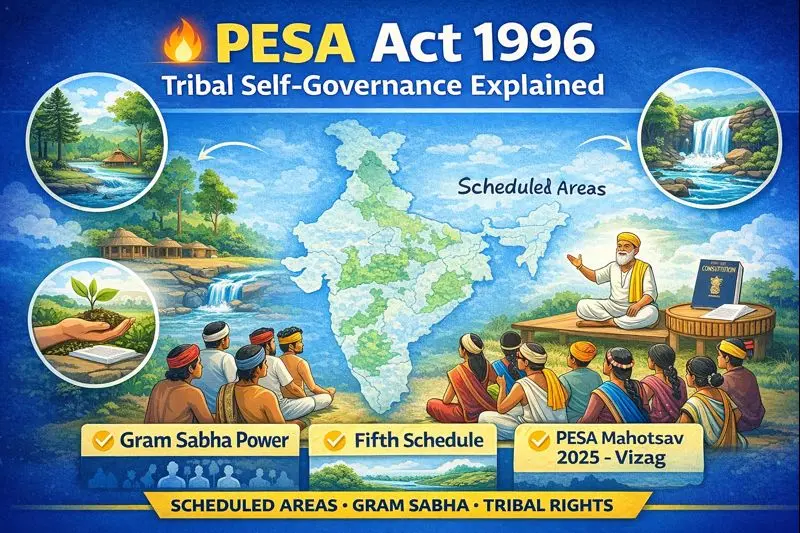
PESA Mahotsav 2025: Celebrating Community-Led Governance
The PESA Mahotsav commemorates the anniversary of the PESA Act, 1996, and aims to strengthen awareness, capacity-building, and cultural pride in Scheduled Areas. PESA Mahotsav 2025 was held in Vishakapatnam, Andhra Pradesh and organised by Ministry of Panchayat Raj.
Objectives of PESA Mahotsav
- Spread awareness about tribal self-governance
- Strengthen local institutions
- Promote tribal culture, cuisine & sports
- Showcase best practices under the PESA Act
Ministry of Panchayati Raj Initiatives for PESA Implementation
Capacity Building
- Two rounds of Master Trainer Programs (2024–25)
- 1+ lakh elected representatives trained
Digital Governance
- PESA–Gram Panchayat Development Plan (GPDP) Portal
- Enables:
- Hamlet-wise planning
- Finance Commission grant utilisation
- Monitoring development aligned with tribal priorities
Institutional Support
- Dedicated PESA Cell in MoPR
- Manuals translated into regional & tribal languages
- Centres of Excellence proposed in 16 universities
- CoE established at Indira Gandhi National Tribal University, Amarkantak, Madhya Pradesh.
Why the PESA-Act is Crucial in our Country?
- Strengthens democratic decentralisation
- Protects tribal land & resources
- Promotes sustainable livelihoods
- Preserves indigenous culture & knowledge
- Ensures inclusive development
👉 Go to Daily Current Affairs Section
Frequently Asked Questions (FAQ)
What is the PESA-Act?
The Panchayats (Extension to Scheduled Areas) Act, 1996 extends Panchayati Raj provisions to Fifth Schedule Areas with special protections for tribal communities.
Which Article of the Constitution relates to PESA?
Article 244, read with the Fifth Schedule.
Who is the most powerful authority under the PESA-Act?
The Gram Sabha.
Does the PESA Act override state Panchayat laws?
Yes. State laws cannot violate PESA provisions.
When is PESA Day observed?
24 December, commemorating the enactment of the PESA-Act.
The PESA-Act represents one of India’s strongest commitments to tribal self-rule and participatory democracy. Through initiatives like PESA Mahotsav, digital platforms, and capacity-building, India is reinforcing Gram Sabha-centric governance in Scheduled Areas. For competitive exams, the PESA Act is a high-probability topic, linking polity, governance, tribal welfare, and constitutional provisions.
Reference: PIB