Sustainable Harnessing and Advancement of Nuclear Energy for Transforming India (SHANTI) Bill, 2025
Table of Contents
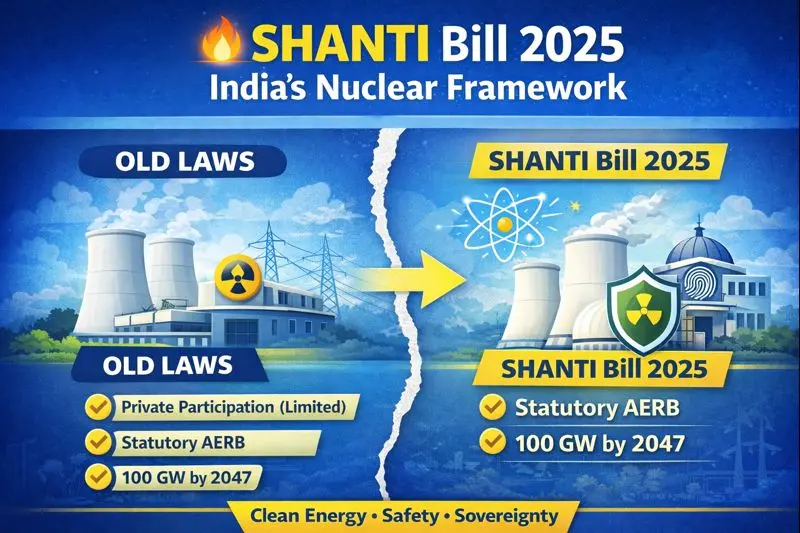
India’s clean energy transition has entered a decisive phase with the introduction of the Sustainable Harnessing and Advancement of Nuclear Energy for Transforming India (SHANTI) Bill, 2025. The Bill seeks to replace outdated nuclear legislations with a unified, future-ready legal framework that supports safety, innovation, and long-term energy security.
With nuclear energy expected to play a critical role in India’s decarbonisation pathway, the SHANTI Bill emerges as a strategic instrument to modernise governance, attract investment under strict regulation, and strengthen institutional oversight all while preserving national security and strategic autonomy.
What is Nuclear Energy?
Nuclear energy is generated through controlled nuclear fission, where the splitting of atoms releases heat to produce electricity.
Key features:
- Low-carbon and clean source of energy
- Provides 24×7 base-load power
- Complements intermittent renewables like solar and wind
- Essential for data centres, heavy industry, and future hydrogen economy
Evolution of India’s Nuclear Legal Framework
India’s nuclear programme has evolved cautiously with a strong emphasis on peaceful use and sovereign control.
| Law | Significance |
|---|---|
| Atomic Energy Act, 1962 | Foundation of India’s nuclear programme |
| Amendments (1986, 1987, 2015) | Allowed government companies & JVs |
| Civil Liability for Nuclear Damage Act, 2010 | No-fault liability & compensation regime |
Despite these laws, fragmentation and rigidity limited expansion necessitating a modern consolidated statute.
Why Was the SHANTI Bill Introduced?
India’s energy ambitions have expanded dramatically.
Present Nuclear Scenario
- Share in power mix: ~3% (3.1% in 2024–25)
- Installed capacity: 8.78 GW
- Projected capacity (2031–32): 22.38 GW
Long-Term Vision
- 100 GW nuclear capacity by 2047
- Net-zero emissions target by 2070
- Clean energy security for a $10-trillion economy
Existing laws were not flexible enough to support this scale and speed.
Nuclear Energy Mission (Budget 2025–26)
| Feature | Details |
|---|---|
| Allocation | ₹20,000 crore |
| Focus | Small Modular Reactors (SMRs) |
| Target | 5 indigenous SMRs by 2033 |
| Key Designs | BSMR-200, SMR-55, HTGR for hydrogen |
This mission directly aligns with the SHANTI Bill framework.
Key Features of the SHANTI Bill, 2025
1. Limited Private Sector Participation
- Permits private companies in:
- Nuclear power generation
- Plant operations
- Equipment manufacturing
- Limited fuel fabrication activities
- Mandatory prior safety authorisation for radiation-related work
2. Activities Reserved Exclusively for the Central Government
Exclusive domains
- Spent fuel reprocessing
- Enrichment & isotopic separation
- High level radioactive waste
- Heavy water production
- Strategic nuclear facilities
Ensures national security & sovereign control
3. Statutory Status to AERB
- Atomic Energy Regulatory Board (AERB) gets formal statutory recognition
- Enhances:
- Regulatory independence
- Safety oversight
- Public confidence
4. Graded Nuclear Liability Framework
- Replaces single liability cap
- Liability varies based on:
- Type of nuclear installation
- Risk profile
- Limits specified in Second Schedule of the Bill
5. Regulation of Non-Power Nuclear Applications
Covers nuclear use in:
- Healthcare
- Agriculture
- Industry
- Research
- Radiation technologies
6. Dispute Resolution & Appeals
| Mechanism | Function |
|---|---|
| Atomic Energy Redressal Advisory Council | Dispute facilitation |
| Claims Commissioners | Compensation adjudication |
| Nuclear Damage Claims Commission | Severe damage cases |
| Appellate Authority | Appellate Tribunal for Electricity |
Strategic Safeguards in the SHANTI Bill
- Sovereign control over fuel cycle & waste
- Enhanced safety, security & emergency response
- Coordinated oversight mechanisms
- Protection of strategic autonomy
Liberalisation without compromising national interest
How SHANTI Bill Supports Clean Energy Goals
- Enables base-load clean power
- Reduces fossil fuel dependency
- Supports data centres & industrial growth
- Strengthens India’s leadership in advanced nuclear technologies
👉 Go to Daily Current Affairs Section
FAQs on SHANTI Bill 2025
What is the SHANTI Bill?
The SHANTI Bill, 2025 is a comprehensive law to modernise India’s nuclear energy framework and replace outdated nuclear legislations.
Does the Nuclear Bill allow private companies in nuclear energy?
Yes, but only limited participation under strict regulatory oversight, while sensitive activities remain with the government.
What is the target of India’s nuclear energy capacity?
India aims to achieve 100 GW nuclear power capacity by 2047.
Which regulator gets statutory status under Nuclear Bill?
The Atomic Energy Regulatory Board (AERB).
How is liability handled under the Nuclear Bill?
Through a graded liability framework based on installation type and risk.
Reference: PIB