Tropical Cyclone Naming
Table of Contents
Tropical Cyclone Naming is an important topic for Geography, Disaster Management, and Current Affairs. Cyclones are named to help forecasters, governments, disaster-response teams, and the public communicate warnings clearly. When multiple cyclones occur in the same basin, names reduce confusion and improve emergency response.
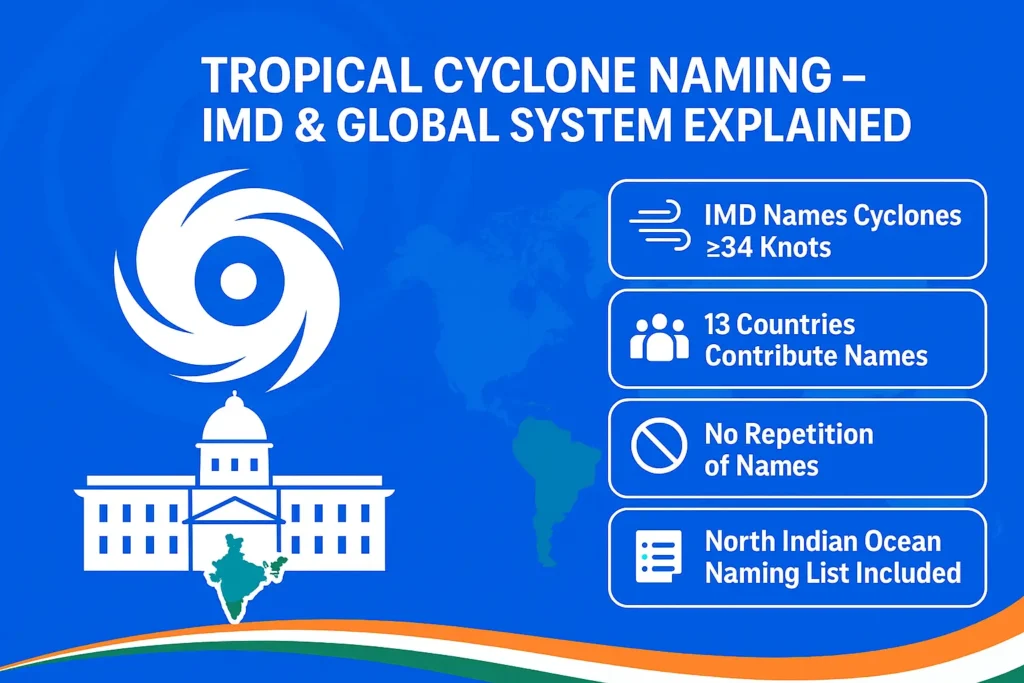
Globally, 11 official warning centers name cyclones. In the North Indian Ocean basin (Arabian Sea + Bay of Bengal), names are assigned by the India Meteorological Department (IMD), New Delhi, once a system reaches cyclonic storm stage (≥34 knots / 63 km/h / 39 mph).
Understanding Tropical Cyclone Naming
Why are Cyclones Named?
- To ensure clear communication between scientists and public
- To avoid confusion when multiple storms occur
- To help quick identification during forecasts
- To standardize warnings across countries
Criteria for Naming a Tropical Cyclone
A cyclone gets a name when:
- Sustained winds exceed 34 knots (63 km/h)
- It reaches cyclonic storm intensity
- It occurs in a basin with an approved name list
- In the Western Pacific, even some tropical depressions are named
- In the Southern Hemisphere, naming requires gale-force winds
If a cyclone moves from another basin, it keeps its original name unless it weakened and re-intensifies in the new basin.
Who Names Tropical Cyclones?
Different regions have different naming agencies. For the North Indian Ocean (45°E – 100°E), India Meteorological Department (IMD/RSMC New Delhi) Assigns names from a list contributed by 13 nations.
Tropical Cyclone Naming System: North Indian Ocean
Participating Countries (13):
Bangladesh, India, Iran, Maldives, Myanmar, Oman, Pakistan, Qatar, Saudi Arabia, Sri Lanka, Thailand, UAE, Yemen.
Naming Rules by IMD
- Names are assigned sequentially from the approved list
- A name cannot be repeated once used
- Names should be:
- Short and easy to pronounce
- Non-offensive
- Culturally meaningful
Complete Tropical Cyclone Naming List (North Indian Ocean)
| No. | Bangladesh | India | Iran | Maldives | Myanmar | Oman | Pakistan | Qatar | Saudi Arabia | Sri Lanka | Thailand | UAE | Yemen |
|---|---|---|---|---|---|---|---|---|---|---|---|---|---|
| 1 | Nisarga | Gati | Nivar | Burevi | Tauktae | Yaas | Gulab | Shaheen | Jawad | Asani | Sitrang | Mandous | Mocha |
| 2 | Biparjoy | Tej | Hamoon | Midhili | Michaung | Remal | Asna | Dana | Fengal | Shakhti | Montha | Senyar | Ditwah |
| 3 | Arnab | Murasu | Akvan | Kaani | Ngamann | Sail | Sahab | Lulu | Ghazeer | Gigum | Thianyot | Afoor | Diksam |
| 4 | Upakul | Aag | Sepand | Odi | Kyarthit | Naseem | Afshan | Mouj | Asif | Gagana | Bulan | Nahhaam | Sira |
| 5 | Barshon | Vyom | Booran | Kenau | Sapakyee | Muzn | Manahil | Suhail | Sidrah | Verambha | Phutala | Quffal | Bakhur |
| 6 | Rajani | Jhar | Anahita | Endheri | Wetwun | Sadeem | Shujana | Sadaf | Hareed | Garjana | Aiyara | Daaman | Ghwyzi |
| 7 | Nishith | Probaho | Azar | Riyau | Mwaihout | Dima | Parwaz | Reem | Faid | Neeba | Saming | Deem | Hawf |
| 8 | Urmi | Neer | Pooyan | Guruva | Kywe | Manjour | Zannata | Rayhan | Kaseer | Ninnada | Kraison | Gargoor | Balhaf |
| 9 | Meghala | Prabhanjan | Arsham | Kurangi | Pinku | Rukam | Sarsar | Anbar | Nakheel | Viduli | Matcha | Khubb | Brom |
| 10 | Samiron | Ghurni | Hengame | Kuredhi | Yinkaung | Watad | Badban | Oud | Haboob | Ogha | Mahingsa | Degl | Shuqra |
| 11 | Pratikul | Ambud | Savas | Horangu | Linyone | Al-jarz | Sarrab | Bahar | Bareq | Salitha | Phraewa | Athmad | Fartak |
| 12 | Sarobor | Jaladhi | Tahamtan | Thundi | Kyeekan | Rabab | Gulnar | Seef | Alreem | Rivi | Asuri | Boom | Darsah |
| 13 | Mahanisha | Vega | Toofan | Faana | Bautphat | Raad | Waseq | Fanar | Wabil | Rudu | Thara | Saffar | Samhah |
👉 Go to Daily Current Affairs Section
FAQs on Tropical Cyclone Naming
Who names tropical cyclones in the North Indian Ocean?
IMD (India Meteorological Department), New Delhi is the official naming authority.
When is a tropical cyclone given a name?
When sustained winds reach ≥34 knots (63 km/h) i.e., cyclonic storm stage.
Can cyclone names repeat?
No. Once used, a name is retired permanently.
What happens if a storm moves from another ocean basin into India’s region?
It keeps its original name, unless it weakens and re-intensifies.
Why do Western Pacific tropical depressions sometimes have names?
Because regional agencies name even weaker systems for tracking purposes.
How are cyclone names selected?
From a pre-submitted list provided by 13 countries.
which country named cyclone ditwah?
Yemen country named cyclone ditwah. The maximum impact of cyclone Ditwah was concentrated in Sri Lanka.
Reference: India Meteorological Department