DPDP Rules 2025
Table of Contents
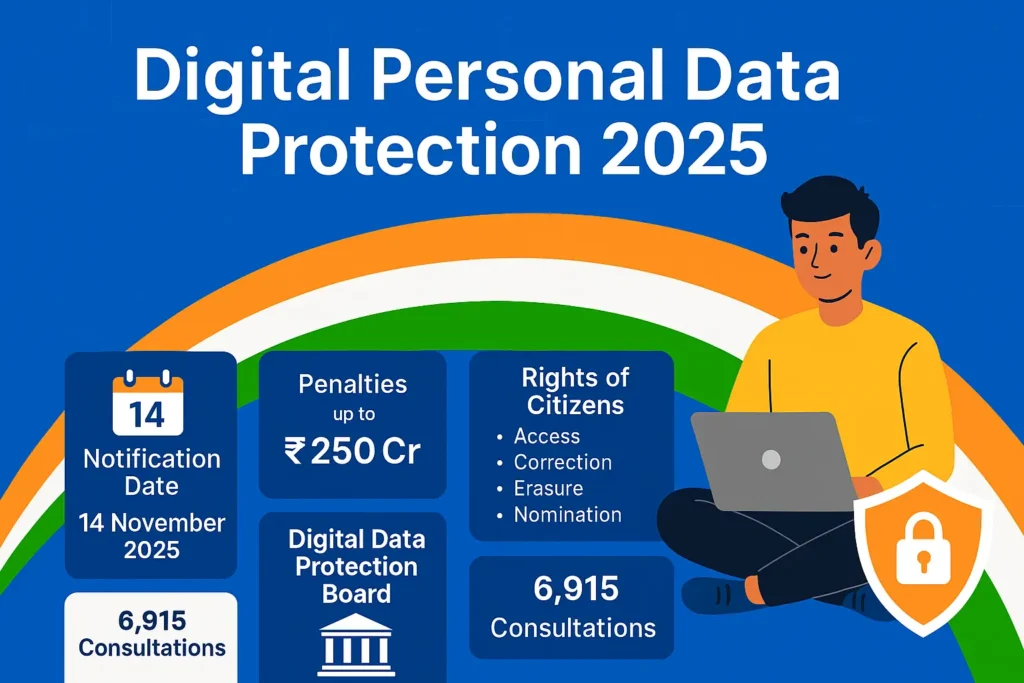
The DPDP Rules 2025 were officially notified on 14 November 2025, giving complete effect to the Digital Personal Data Protection Act, 2023. Together, the Act and the Rules establish India’s first citizen-centric digital data protection framework, balancing privacy rights with lawful and responsible data use.
Why the Digital Personal Data Protection Rules Matter?
- Operationalise the DPDP Act, 2023
- Strengthen privacy and responsible digital governance
- Create enforcement mechanisms through the Digital Data Protection Board
- Balance innovation with security
- Essential for competitive exams (Govt schemes, Acts, digital governance)
Key Highlights of DPDP Rules 2025
1. Phased Implementation (18-Month Transition)
The rules provide an 18-month compliance window, ensuring organisations can:
- Update systems
- Create consent notices
- Appoint officers
- Adopt responsible digital practices
Consent Managers must be India-based companies.
2. Mandatory Consent Requirements
A separate, clear, purpose-based consent notice is compulsory. Consent must be:
- Informed
- Specific
- Revocable
- Transparent
3. Data Breach Notification Protocol
Every Data Fiduciary must:
- Notify affected individuals immediately
- Explain the breach in plain language
- Mention possible impact
- Provide support contact details
4. Transparency & Accountability
All Data Fiduciaries must publicly display:
- Contact details of designated officer or DPO
- Redressal points
- Processing purpose
Significant Data Fiduciaries Face Additional Duties:
- Independent audits
- Data protection impact assessments
- Restrictions on sensitive tech use
- Compliance with government directions
5. Rights Strengthened for Citizens (Data Principals)
The rules enhance all rights given under the DPDP Act.
Every citizen now has:
- Right to consent or refuse
- Right to withdraw consent
- Right to know how data is used
- Right to access personal data
- Right to correct inaccurate data
- Right to update personal details
- Right to erase data (as applicable)
- Right to nominate another person
Mandatory Response Timeline:
All requests must be resolved within 90 days.
6. Child & Disability Protection Rules
- Parental consent required for children’s data
- Special protection for persons with disabilities through verified guardians
7. Digital-First Data Protection Board
- Fully online
- Four-member board
- Complaint filing via portal + mobile app
- Appeals handled by TDSAT
Major Penalties Under the DPDP Act
| Violation | Penalty (Up to) |
|---|---|
| Failure to maintain security safeguards | ₹250 crore |
| Failure to notify data breach | ₹200 crore |
| Violation relating to children’s data | ₹200 crore |
| General non-compliance with Act/Rules | ₹50 crore |
How Digital Personal Data Protection Rules Align with RTI Act
- Section 8(1)(j) updated to balance privacy + transparency
- Does not weaken RTI
- Personal information can still be disclosed if public interest > privacy harm (Section 8(2))
- Follows Supreme Court’s Puttaswamy privacy principles
DPDP Key Terms: Simple Explanation for Aspirants
Who are the “organisations” required to comply with DPDP Rules?
The 18-month compliance window applies to all organisations that collect, store, process, share or use personal data of individuals within India.
These include:
- Government departments
- Private companies
- Banks & financial institutions
- Hospitals & schools
- Startups, MSMEs
- E-commerce platforms
- Apps and websites collecting user data
Anyone who handles personal data becomes responsible under the DPDP Act.
2. Who is a Data Fiduciary?
A Data Fiduciary is any organisation that decides why and how your personal data will be used.
Examples:
- A bank collecting your KYC
- A hospital storing your medical records
- A social media app collecting your photos
- A university handling student data
Think of the Data Fiduciary as the data controller (the one who decides).
3. Who is a Consent Manager?
A Consent Manager is a digital platform that helps citizens give, manage, review, or withdraw consent across multiple services.
Key points:
- They must be registered as a company in India
- Citizens can manage all their data permissions from a single dashboard
- They act as a neutral, trusted intermediary, not owned by any company whose data they manage
Example: In the future, India may approve official apps (like how UPI has BHIM, PhonePe, etc.) that allow people to check who has access to their data.
4. Who gives consent — and to whom?
- Citizens (Data Principals) give consent
- Data Fiduciaries (companies/organisations) receive and store that consent
Example: When you install a mobile app → it shows a consent notice → you decide whether to allow or deny.
5. Who files requests for correction, erasure or access — and who must resolve them within 90 days?
- Citizens ask for access, correction, updating or deletion of their personal data
- Data Fiduciaries must respond within 90 days
| Request Type | Filed By | Must Resolve |
|---|---|---|
| View my data | Citizen | Data Fiduciary |
| Correct my wrong name/number | Citizen | Data Fiduciary |
| Delete my old account | Citizen | Data Fiduciary |
6. What does “separate, clear, purpose-based consent notice” mean?
Before collecting any data, every organisation must give a clear and simple consent notice explaining:
- What data they are collecting
- Why they need it
- How long they will keep it
- How you can withdraw consent
👉 Go to Daily Current Affairs Section
FAQs on Digital Personal Data Protection Rules
What are DPDP Rules?
They are the official rules notified to enforce the Digital Personal Data Protection Act, 2023.
When were the DPDP Rules implemented?
On 14 November 2025.
What is the purpose of DPDP Rules 2025?
To protect personal data, enforce rights of citizens, and ensure accountable data processing.
What are the penalties under the DPDP Act?
Penalties range from ₹50 crore to ₹250 crore, depending on the violation.
Who handles complaints under the DPDP Rules?
The Digital Data Protection Board of India, through a fully digital platform.
Do the DPDP Rules affect RTI?
No. The RTI Act remains operational; only privacy balancing was clarified.
Source: MEITY