National Social Assistance Programme
Table of Contents
The National Social Assistance Programme (NSAP) is one of India’s most significant social welfare initiatives, launched on 15 August 1995. It fulfills the Directive Principles of State Policy (Article 41) of the Constitution — ensuring social security for citizens unable to sustain themselves due to old age, widowhood, or disability.
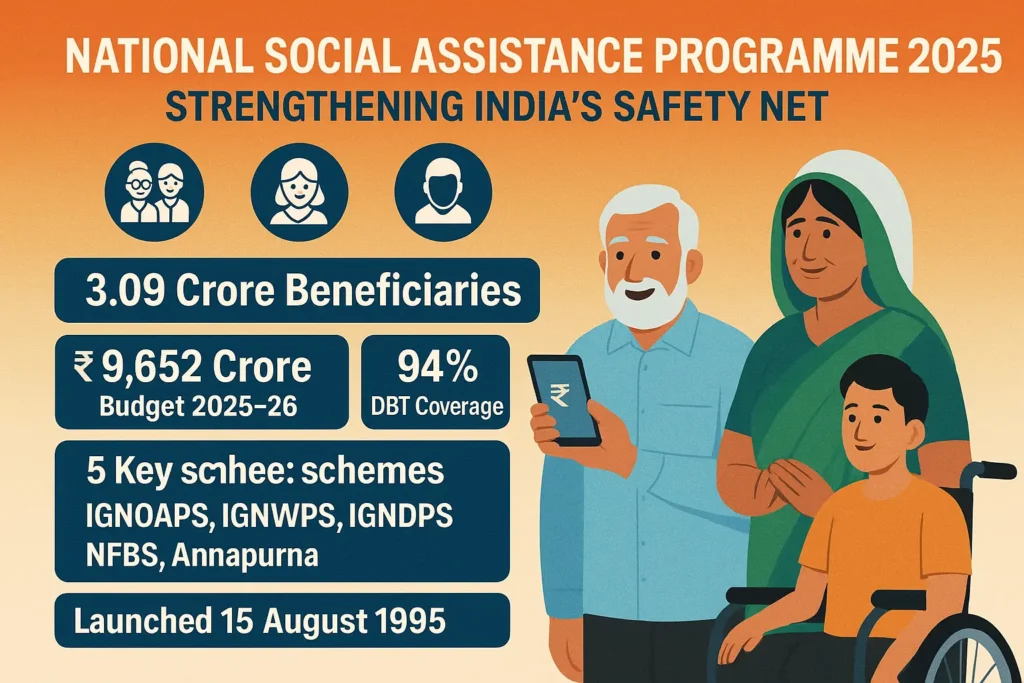
Implemented by the Ministry of Rural Development, NSAP provides financial and food security to vulnerable groups, directly transferring assistance through bank accounts. It currently supports over 3.09 crore beneficiaries across India.
Key Highlights of NSAP 2025
| Feature | Details |
|---|---|
| Launched On | 15 August 1995 |
| Implementing Ministry | Ministry of Rural Development |
| Total Beneficiaries (2025) | 3.09 crore |
| Budget 2025–26 | ₹9,652 crore |
| Mode of Disbursement | 94% via Direct Benefit Transfer (DBT) |
| Digitization | 2.5 crore Aadhaar-linked accounts |
| Launched DLC App | July 15, 2025 (for Digital Life Certificate) |
Objective of NSAP
The objective of the National Social Assistance Programme is to provide a basic level of social security to citizens from Below Poverty Line (BPL) families who are:
- Elderly (above 60 years)
- Widows (40–79 years)
- Persons with disabilities (18–79 years)
- Families who have lost their primary breadwinner
This programme ensures financial stability, dignity, and inclusion for India’s most vulnerable citizens.
Components of National Social Assistance Programme
The NSAP includes five major sub-schemes, each addressing a specific social group.
| Sub-Scheme | Beneficiaries | Central Assistance | Remarks |
|---|---|---|---|
| 1. Indira Gandhi National Old Age Pension Scheme (IGNOAPS) | Elderly (60+ years) | ₹200 (60–79 yrs) / ₹500 (80+ yrs) per month | States can add top-up (₹50–₹5700) |
| 2. Indira Gandhi National Widow Pension Scheme (IGNWPS) | Widows (40–79 yrs) | ₹300 per month; ₹500 for 80+ yrs | Aimed at financial support for widows |
| 3. Indira Gandhi National Disability Pension Scheme (IGNDPS) | Severely disabled (18–79 yrs) | ₹300 per month; ₹500 for 80+ yrs | ₹243.74 crore released in FY 2024–25 |
| 4. National Family Benefit Scheme (NFBS) | BPL families losing breadwinner (18–59 yrs) | ₹20,000 one-time | For immediate financial relief |
| 5. Annapurna Scheme | Senior citizens not covered under IGNOAPS | 10 kg food grains/month free | Ensures food security |
Budget Allocation 2025–26 (₹9,652 Crore)
| Component | Allocation (₹ crore) |
|---|---|
| Indira Gandhi National Old Age Pension Scheme | 6,645.90 |
| Indira Gandhi National Widow Pension Scheme | 2,026.99 |
| National Family Benefit Scheme | 659.00 |
| Indira Gandhi National Disability Pension Scheme | 290.00 |
| Annapurna Scheme | 10.00 |
| Management Cell | 20.11 |
| Total | 9,652.00 |
The NSAP budget increased substantially to ensure coverage for 3+ crore beneficiaries, highlighting India’s growing commitment to inclusive social protection.
Implementation and Monitoring
- Selection of Beneficiaries done by Gram Panchayats and Municipalities.
- Mode of Payment mostly done (94%) through DBT (Direct Benefit Transfer).
- States appoint a Nodal Secretary, and Nodal secretary monitors the scheme functioning and submit quarterly reports to the government as mandatory.
- Technology Integration: Aadhaar-based authentication and Public Financial Management System (PFMS) prevent fraud.
Digital Reforms
In July 2025, the Ministry launched a Mobile App for Digital Life Certification (DLC), making pension verification paperless and easy for beneficiaries.
Impact of NSAP
| Category | Beneficiaries (in lakh) |
|---|---|
| Old Age Pension | 221 |
| Widow Pension | 67 |
| Disability Pension | 8.33 |
| Family Benefit Scheme | 3.5 |
| Annapurna Scheme | 8.31 |
| Total | 309 lakh (3.09 crore) |
The programme provides a lifeline to 3 crore+ citizens, especially senior citizens and widows, ensuring food, dignity, and financial inclusion.
Recent Achievements
- 2.5 crore Aadhaar-linked accounts ensure transparent transfers.
- Digital Life Certificate App launched to simplify pension renewal.
- States also funded to this scheme and increased average old-age pension to ₹1,100/month.
- Enhanced accountability through real-time progress tracking on NSAP Portal.
Why NSAP Matters
- Empowers India’s elderly, widows, and differently-abled.
- Promotes financial inclusion through direct transfers.
- Reduces leakages and corruption via Aadhaar-based systems.
- Aligns with India’s inclusive growth and social justice goals.
FAQs on National Social Assistance Programme
What is the National Social Assistance Programme (NSAP)?
NSAP is a Centrally Sponsored Scheme providing financial and food security assistance to BPL families through pension and family benefit schemes.
When was NSAP launched?
NSAP was launched on 15 August 1995 to fulfill India’s Directive Principles of State Policy for social security.
How many people benefit from NSAP?
Around 3.09 crore beneficiaries across India receive pensions and aid under NSAP.
What is the budget allocation for NSAP 2025–26?
₹9,652 crore has been allocated across five sub-schemes for FY 2025–26.
What are the five schemes under NSAP?
IGNOAPS, IGNWPS, IGNDPS, NFBS, and Annapurna Scheme.
How is the NSAP payment made?
94% of payments are made through Direct Benefit Transfer (DBT) into beneficiaries’ bank accounts.
What is the minimum pension amount under NSAP?
₹200 per month for senior citizens (60–79 yrs) under IGNOAPS.
How is transparency ensured in NSAP?
Through Aadhaar-based PFMS integration and digital tracking on the official NSAP portal.
For Aspirants
For exam aspirants, understanding the National Social Assistance Programme is crucial for topics in Social Justice, and Governance. This scheme exemplifies India’s welfare state vision, ensuring that every citizen — irrespective of age or status — receives basic financial dignity and support.