Jal Jeevan Mission – Transforming Rural India with Tap Water for Every Home
Table of Contents
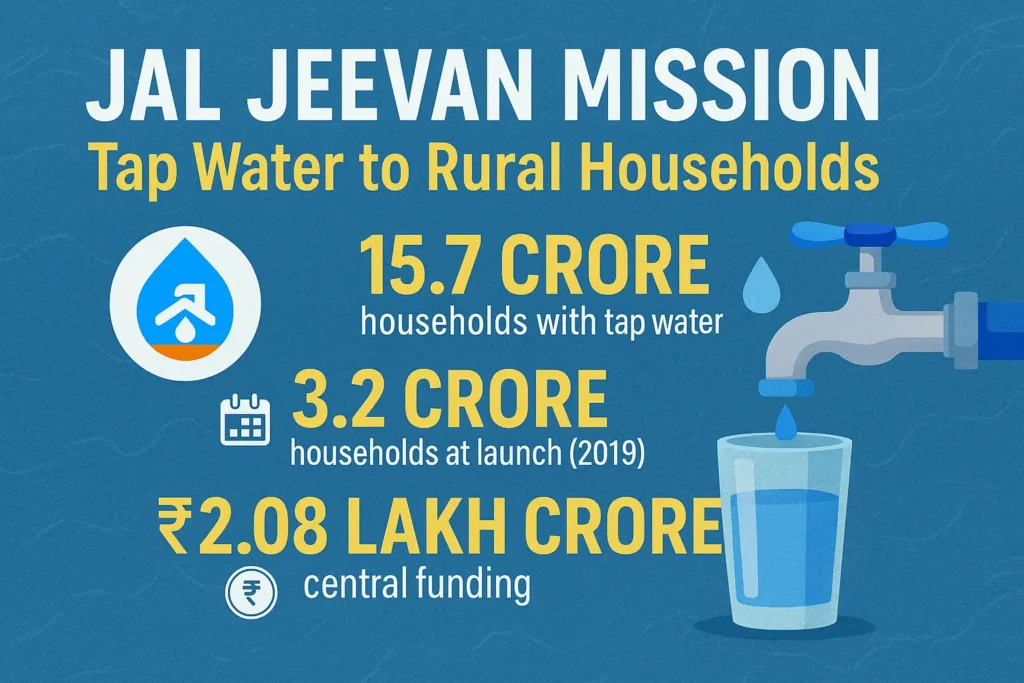
The Jal Jeevan Mission (JJM) is one of India’s most impactful rural development initiatives. Launched by Prime Minister Narendra Modi on 15 August 2019, the Mission aims to provide Functional Household Tap Connections (FHTCs) to every rural household by ensuring safe, adequate, and sustainable drinking water. At its launch, only 3.23 crore households had access to tap water. As of October 2025, more than 15.72 crore rural homes now receive clean drinking water — a remarkable achievement in just six years.
Jal Jeevan Mission Launch Date
- Launch Date: 15 August 2019
- Launched by: Prime Minister Narendra Modi
- Ministry: Ministry of Jal Shakti
- Budget Outlay: ₹2.08 lakh crore (Central allocation)
- Goal: Tap water for every rural household (Har Ghar Jal)
Objectives
The Jal Jeevan Mission (Har Ghar Jal) aims to:
- Provide safe and adequate drinking water to every rural household.
- Reduce the drudgery of women by eliminating the need to fetch water.
- Ensure sustainability of sources through water conservation and recharge.
- Promote community ownership and capacity building in rural areas.
- Strengthen public health, hygiene, and dignity of rural families.
Progress (As of 22 October 2025)
| Indicator | Status |
|---|---|
| Rural households with tap water | 15.72 crore |
| Households connected since 2019 | 12.48 crore |
| Coverage achieved | 81% of total rural households |
| Districts with full coverage | 192 (116 certified by Gram Sabha) |
| Gram Panchayats fully covered | 88,875 |
| Villages fully covered | 1,74,348 |
| States/UTs with 100% coverage | Goa, A&N Islands, DNH & DD, Haryana, Telangana, Puducherry, Gujarat, Himachal Pradesh, Punjab, Mizoram, Arunachal Pradesh |
| Schools covered | 9,23,297 |
| Anganwadi Centres covered | 9,66,876 |
Quality Assurance and Monitoring
- 2,843 water testing laboratories across India (2,184 institutional + 659 WTP-based).
- 38.78 lakh water samples tested in 2025–26.
- 24.8 lakh rural women trained to use Field Testing Kits (FTKs) for water quality testing.
- Strengthened local participation in ensuring safe drinking water.
Key Components of the Jal Jeevan Mission
- In-Village Piped Water Supply: Development of piped systems to ensure tap connections in every home.
- Sustainable Water Sources: Recharge and reuse through rainwater harvesting and greywater management.
- Bulk Water Transfer & Distribution: Construction of treatment plants and large distribution networks.
- Technological Interventions: Use of modern filtration and testing technologies to ensure water purity.
- Retrofitting of Old Schemes: Upgradation of existing systems to meet 55 litres per capita per day standard.
- Community Capacity Building: Training Panchayats, SHGs, and Village Committees for maintenance.
Digital Innovation
The Department of Drinking Water and Sanitation (DDWS) has upgraded the Rural Piped Water Supply Schemes (RPWSS) module.
- Each project now gets a unique RPWSS ID, ensuring transparency and traceability.
- Integrated with GIS Mapping and PM Gati Shakti dashboards.
- Enables real-time monitoring and predictive analytics.
- Promotes digital governance and data-driven planning.
Impact of the Mission
Social and Health Impact (WHO & ILO Studies):
- 4 lakh deaths prevented annually from diarrheal diseases.
- 14 million DALYs (Disability-Adjusted Life Years) saved.
- 5.5 crore hours saved daily, mainly benefitting women.
- 9 crore women freed from fetching water duties.
Economic Impact (IIM & SBI Research):
- 3 crore person-years of employment potential.
- 25 lakh women trained for water testing.
- 7.4% increase in women’s participation in agriculture.
Jal Jeevan Mission UPSC / APPSC Exams Relevance
The Jal Jeevan Mission UPSC / APPSC topic is crucial under:
- GS Paper II (Governance, Social Justice)
- GS Paper III (Infrastructure, Environment)
- Essay and Prelims Current Affairs
Key Point for Exams: It is a Centrally Sponsored Scheme (CSS) implemented by Ministry of Jal Shakti, focusing on Sustainable Rural Water Supply and Community Participation.
Key Facts for Revision
| Topic | Key Points |
|---|---|
| Launch Year | 2019 |
| Launch Date | 15 August |
| Ministry | Jal Shakti |
| Objective | Tap water to all rural households |
| Central Outlay | ₹2.08 lakh crore |
| Rural Households Covered | 15.72 crore |
| States with 100% Coverage | 11 |
| Main Focus | Source sustainability & community participation |
FAQs
What is Jal Jeevan Mission?
The Har Ghar Jal is a Centrally Sponsored Scheme launched in 2019 by the Ministry of Jal Shakti to provide Functional Household Tap Connections (FHTCs) to every rural home in India.
When was the Jal Jeevan Mission launched?
It was launched on 15 August 2019 by Prime Minister Narendra Modi.
How many rural households have been provided tap water under JJM (2025)?
As of October 2025, more than 15.72 crore rural households have access to tap water under the Jal Jeevan Mission.
What is the total budget outlay of Jal Jeevan Mission?
The Mission has a central outlay of ₹2.08 lakh crore to support states and UTs in water infrastructure creation.
What are the key components of the Jal Jeevan Mission?
Key components include:
Piped water infrastructure
Greywater management
Water quality testing
Source sustainability
Community participation
How does Jal Jeevan Mission empower women?
By providing tap water at home, JJM saves 5.5 crore hours daily of water collection work, enabling 9 crore women to focus on health, education, and livelihoods.
What is the Jal Jeevan Mission logo?
The logo features a water droplet and flowing tap, symbolizing India’s vision of Har Ghar Jal — safe water in every household.
Which states have achieved 100% tap water coverage?
As of 2025, Goa, Telangana, Gujarat, Haryana, Himachal Pradesh, Punjab, Mizoram, Arunachal Pradesh, and others have achieved full rural coverage.
The Jal Jeevan Mission is not just an infrastructure project — it’s a social transformation. By ensuring safe tap water in every rural home, it empowers women, protects health, strengthens rural governance, and represents India’s success in sustainable development. For competitive exam aspirants, Jal Jeevan Mission UPSC remains one of the most relevant current affairs topics in 2025.
Source: PIB