UDAN Scheme: Vision 2047
Last Modified: 04 July 2026
Table of Contents
Launched under NCAP 2016, the UDAN Scheme has connected remote regions, boosted airports to 350+ by 2047, and aims to democratise air travel for the common citizen. Here’s the exam-ready guide.
The UDAN Scheme (Ude Desh ka Aam Naagrik) is the Government of India’s Regional Connectivity Scheme (RCS) launched in 2016 under the National Civil Aviation Policy 2016 (NCAP) to make air travel affordable and widespread, especially in Tier-II, Tier-III, remote, hilly and island regions. It is a key pillar of India’s aviation vision for a “Viksit Bharat @ 2047”.
Latest Update: Modified UDAN Scheme (Viksit UDAN) launched
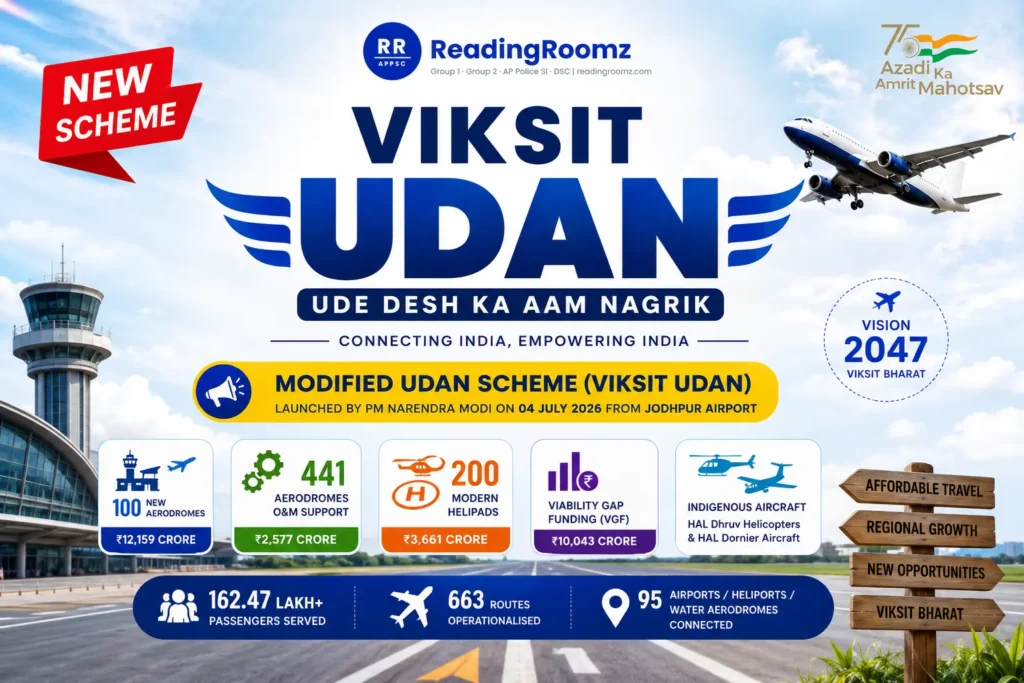
- On 4 July 2026, Prime Minister Narendra Modi launched the Modified UDAN Scheme (Viksit UDAN) from Jodhpur Airport, Rajasthan.
- The modified scheme was approved by the Union Cabinet for 10 years (FY 2026-27 to FY 2035-36).
- Total outlay: ₹28,840 crore.
- This scheme was approved by the Union Cabinet on 25 March 2026.
Objectives of UDAN Scheme
- To expand air connectivity by operationalising under-served and un-served airports and routes.
- To make air travel affordable for the common citizen.
- To promote regional economic development, tourism, and employment generation.
- To enhance regional infrastructure, including heliports, water-aerodromes and seaplane operations.
Key Phases of the Scheme
| Phase | Launch Period | Focus & Features |
|---|---|---|
| UDAN 1.0 | Apr 2017 (first flight: Shimla–Delhi on 27 Apr 2017) | 128 fixed-wing routes to 70 airports (including 36 new) by 5 airlines |
| UDAN 2.0 | 2018 | Added 73 underserved/un-served airports; helipads included |
| UDAN 3.0 | 2019 | Tourism routes, seaplane operations, North-East focus |
| UDAN 4.0 / 4.x | 2020-21 | Hilly, island and remote area coverage (incl. seaplanes) |
| UDAN 5.0+ | 2022 onwards | Last-mile connectivity, Category-2/3 aircraft, no 600 km cap on stage length |
| Viksit UDAN Scheme (Modified UDAN) | FY 2026–27 to FY 2035–36 | Total outlay of ₹28,840 crore, Development of 100 airports, 200 modern helipads |
Features & Incentives
- Viability Gap Funding (VGF): Government subsidy to airlines for non-commercial routes.
- Capped fares: Ensuring affordable flying for citizens.
- Concessions for airports/airlines: Reduced charges, excise duty caps, incentives for operations in priority areas.
- Inclusive infrastructure: Helipads, seaplanes, remote airstrips.
Key Achievements & Impact
- 663 routes and 95 aerodromes/heliports operational under RCS-UDAN by October 2025.
- India’s airport count rose from 74 (2014) to 163 (2025) under expansion plans.
- The aviation sector supports over 7.7 million jobs and is aligned with the vision to grow to 350-400 airports by 2047. (From your source)
- Examples: UDAN Yatri Café initiative, affordable food at airports, Krishi UDAN for agriculture logistics. (From your provided article)
Schemes Supporting the UDAN Scheme
1. Krishi UDAN Scheme (Launched September 2020)
- Facilitates faster transport of agricultural produce & perishables.
- Benefits tribal & northeastern states, reducing spoilage.
- Offers 50% freight subsidy in convergence with Operation Greens Scheme.
- Promotes multi-modal transport and connectivity for horticulture produce.
2. Lifeline UDAN (Launched March 2020 during COVID-19)
- Ensured uninterrupted delivery of medical & essential supplies.
- Operated 588 flights carrying 1,000 tons of cargo across 5.45 lakh km.
- Focused on North-East, Islands & hilly terrains during lockdowns.
- Supported COVID labs, medical teams, and emergency responses (Vizag gas leak).
3. Greenfield Airports Policy
- Framework for new airports on unused land under PPP mode.
- Expands aviation infrastructure and decongests metro hubs.
- Aligned with India’s target of 350-400 airports by 2047.
4. Digi Yatra Initiative (Implemented 2022)
- Enables paperless, contactless processing via facial recognition.
- Used by 52 million passengers as of March 2025.
- App downloads exceed 12 million (Android & iOS).
- Enhances ease of travel and security efficiency.
5. Flight Training & Pilot Development Program
- Addresses demand for 30,000-34,000 pilots in next decade.
- Expansion of Flight Training Organizations (FTOs).
- Promotes gender inclusion: 13-18% women pilots → target 25% by 2025.
6. Drone Rules 2021 & Production-Linked Incentive (PLI)
- Liberalised drone sector & simplified regulations.
- Encourages domestic manufacturing & import reduction.
- ₹34.79 crore PLI disbursed in FY 2024-25.
- Builds India’s self-reliant drone ecosystem supporting aviation logistics.
7. Bharatiya Vayuyan Adhiniyam 2024
- Re-enacts the Aircraft Act 1934 to modernise aviation law.
- Promotes indigenous manufacturing under Make in India & Atmanirbhar Bharat.
- Aligns with ICAO & Chicago Convention standards.
- Simplifies licensing & streamlines regulatory processes.
Significance for Competitive Exams
For UPSC, SSC, State PSCs, the UDAN Scheme is relevant under:
- GS Paper III: Infrastructure, transport, regional development.
- Government policies & schemes: Aviation, Make in India, Atmanirbhar Bharat.
- Current Affairs topics: Budget 2025, airport expansion, drone & PLI scheme in aviation.
Exam tip: Remember key dates (2017 initial flight), number of airports/aircraft targets (350-400 by 2047) and phases of UDAN.
Challenges & Way Forward
Challenges: Operational sustainability of routes, infrastructure delays in remote areas, higher costs for smaller aircraft.
Way Forward:
- Strengthen Greenfield Airports Policy & PPP model.
- Integrate drone & cargo connectivity (Krishi UDAN).
- Focus on remote, hilly, island regions and boosting MRO/aircraft manufacturing under aviation vision.
The UDAN Scheme is a landmark in India’s quest to democratise air travel and foster regional connectivity. For exam aspirants, understanding UDAN’s phases, objectives, features and significance provides a comprehensive view of how transport infrastructure supports national development.
Frequently Asked Questions (FAQs)
-
What is the full form of UDAN Scheme?
The full form is Ude Desh Ka Aam Naagarik Scheme, meaning “Let the common citizen fly”.
-
When was the first UDAN flight launched?
On 27 April 2017, between Shimla and Delhi.
-
What are the phases of the UDAN Scheme?
Phases include UDAN 1.0 (2017), 2.0 (2018), 3.0 (2019), 4.0 (2020+), 5.0+ (2022 onwards).
-
What is the aim of UDAN Scheme?
To expand regional connectivity by operationalising airports/routes and making air travel affordable for the common citizen.
-
Which policy is UDAN part of?
It is part of the National Civil Aviation Policy (NCAP) 2016.
-
What is Viksit UDAN?
The Modified UDAN Scheme was launched in July 2026 to expand regional air connectivity with an outlay of ₹28,840 crore.
-
When was the Modified UDAN Scheme launched?
Prime Minister Narendra Modi launched it on 4 July 2026 from Jodhpur Airport, Rajasthan.
-
What is the total outlay of the Modified UDAN Scheme?
The scheme has a total outlay of ₹28,840 crore for a period of 10 years (FY 2026–27 to FY 2035–36).
Source: PIB