Pradhan Mantri Dhan Dhaanya Krishi Yojana
Table of Contents
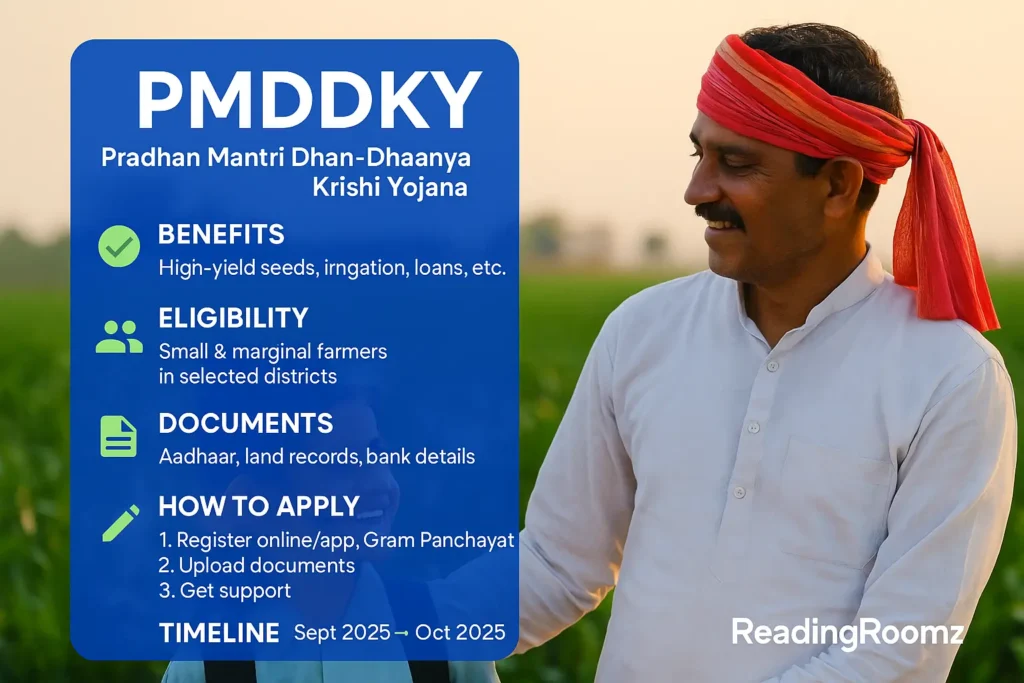
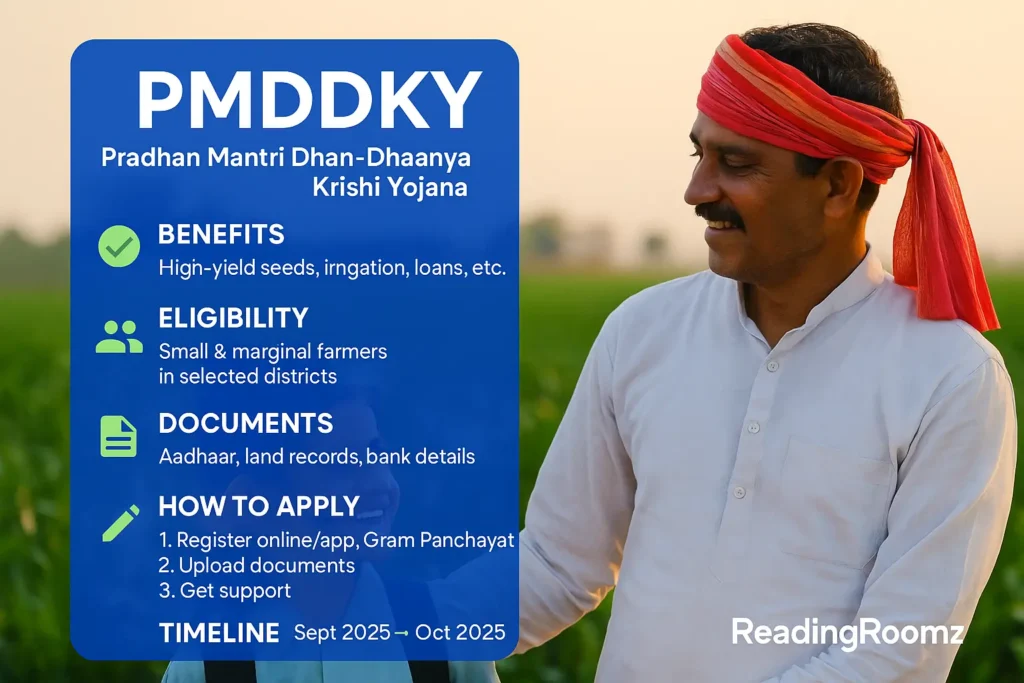
Pradhan Mantri Dhan Dhaanya Krishi Yojana is a flagship agricultural transformation programme announced in the Union Budget 2025-26 (1 Feb 2025)and approved by the Union Cabinet on 16 July 2025. It aims to lift productivity, incomes, and resilience across 100 low-performing districts, with a six-year outlay of ₹1.44 lakh crore (₹24,000 crore annually, 2025-26 to 2030-31). The scheme targets 1.7 crore farmers—especially small and marginal (≤2 ha), who form ~86% of farm households.
Pradhan Mantri Dhan Dhaanya Krishi Yojana converges 36 existing schemes across 11 ministries (e.g., PM-KISAN, PMFBY, PMKSY, RKVY) into one coordinated, district-specific programme—modelled on the Aspirational Districts Programme. PMDDKY scheme was officially launched on 11 October 2025 by Prime Minister of India.
Why PMDDKY?
- Low crop productivity in some parts of Uttar Pradesh (Purvanchal/Bundelkhand), Bihar (Seemanchal), MP (tribal belts), etc.
- Monsoon dependence over ~52% of farmland; frequent drought/flood shocks.
- Small holdings, low incomes (NSSO: avg ₹10,218/month for small/marginal).
- High post-harvest losses (up to 20% in perishables).
- Limited credit/tech/mechanization, weak market access, fragmented schemes.
PMDDKY Objectives
- Raise yields by 20–30% via high-quality inputs & tech.
- Cut monsoon risk using drip/sprinkler and smart irrigation.
- Mechanize & modernize small farms; promote sustainable/organic practices.
- To decrease post-harvest loss to <5% with storage & cold chains.
- Boost farm incomes 20–40% via diversification & direct markets.
- Empower women & youth, build allied sectors (dairy, fisheries, poultry).
- Advance food self-reliance in grains, pulses, oilseeds.
PMDDKY Scheme Nodal Agency
- Ministry of Agriculture & Farmers’ Welfare will be the Nodal agency.
- National Steering Committee → State Nodal Committees → District Dhan-Dhaanya Samitis (chaired by District Collectors).
- Digital dashboard tracks 117 KPIs (yields, credit, storage use, women’s participation, etc.).
- District Plans tailored to local gaps (irrigation, storage, inputs, training, markets).
PMDDKY Features
| Intervention | What Farmers Get | Expected Impact |
|---|---|---|
| High-yield inputs | Hybrid seeds, bio-fertilizers | +20–30% output |
| Irrigation | Drip/sprinkler, moisture sensors | 30–50% water saving |
| Mechanization | Subsidized tractors, seed drills, drones | Lower costs, higher efficiency |
| Storage & cold chain | Village/block warehouses, cold rooms | Cut losses to <5–10% |
| Finance | Subsidies (50–80%), KCC/term loans | Afford inputs, invest in infra |
| Insurance | PMFBY integration | Risk protection, faster claims |
| Markets | e-NAM & PMDDKY apps, FPO linkages | 20–40% better price realization |
| Training | KVKs/universities/private partners; global fellowships (500 farmers) | Modern skills, best practices |
| Women focus | 10,000 women producer groups, micro-finance | Higher incomes, leadership |
Budget split (indicative): 40% subsidies • 30% infra • 20% credit • 10% training & market support.
Who Can Apply for PMDDKY Scheme?
- Small & marginal farmers (≤2 ha)—core priority.
- Women farmers (esp. in registered producer groups).
- Youth adopting smart/organic/value-added agribusinesses.
- FPOs & allied workers (dairy, fisheries, poultry, apiculture).
- Large farmers & private firms via PPP for infra (storage/processing/tech).
Eligibility is district-linked. Farmers must reside/farm in one of the 100 selected districts.
District Selection: How the 100 Will Be Chosen
- Low yields (e.g., wheat <3.5 t/ha; rice <2.7 t/ha).
- Cropping intensity <155%.
- Low credit/KCC penetration.
- Geographic spread: at least one district per State/UT.
- Expected priority clusters include: UP (Purvanchal/Bundelkhand), Bihar (Seemanchal), MP tribal belts, Rajasthan (arid), NE states, plus pockets of Odisha, Jharkhand, Chhattisgarh, Andhra Pradesh (Anantapur), etc.
- Final list to be published by NITI Aayog.
How to Apply PMDDKY scheme?
- Check district inclusion (after list release).
- Approach the District Dhan-Dhaanya Samiti / KVK / Gram Panchayat.
- Register (name, Aadhaar, land details, crops, allied activities).
- Upload/submit documents (see below).
- Choose benefits (irrigation, storage, loans, training, etc.).
- Verification (desk/field/digital).
- Benefit delivery (within ~2–4 weeks post-verification).
Women-Centric Measures
- 10,000 Women Producer Groups (target 5 lakh women): training, micro-finance (₹10k–₹1 lakh), market linkages.
- Dedicated modules: value addition (cheese, jams), organic veggies, beekeeping, digital selling.
- Representation in district Samitis to shape local plans.
Smart, Organic & Climate-Resilient Farming
- Drones for spraying/monitoring (↓ labor by ~30%).
- IoT sensors for moisture/nutrients; advisory apps (weather, pest alerts, mandi prices).
- Organic push (bio-inputs, certification support; 20–50% price premium).
- Climate-resilient varieties + contingency cropping plans.
PMDDKY vs Other Schemes
| Scheme | Focus | What PMDDKY Adds |
|---|---|---|
| PM-KISAN | Direct income support | Infra, markets, training, convergence |
| PMFBY | Crop insurance | Plus credit, storage, diversification |
| PMKSY | Irrigation | Also mechanization, markets, women groups |
| RKVY | State agri projects | National convergence + district-wise KPIs |
Challenges & Built-in Solutions
| Challenge | Built-in Response |
|---|---|
| 36-scheme convergence | Central Nodal Officers; monthly reviews |
| Awareness gaps | Radio/SMS/WhatsApp/KVK drives; local languages |
| Weather shocks | PMFBY, drought-resistant seeds, smart irrigation |
| Equity across districts | 117 KPI dashboard, third-party audits |
| Infra deficits | PPPs for storage/cold chains/processing; phased targets |
Vision 2030
- Double farm incomes (avg ₹20,000/month).
- Food self-reliance in pulses/oilseeds; lower import bill.
- 50% districts adopting climate-smart/organic practices.
- Scale AI/IoT to ~50% farmers in target districts; expand women groups to 20,000 (impacting 10 lakh women).
- Export push for high-value/organic produce.
Quick Revision (for Exams)
- Pradhan Mantri Dhan Dhaanya Krishi Yojana: Agricultural convergence mission (36 schemes, 11 ministries).
- Tenure & Outlay: 2025-26→2030-31; ₹1.44 lakh crore.
- Coverage: 100 districts, 1.7 crore farmers; small/marginal priority.
- Core Tools: Inputs, irrigation, mechanization, storage, credit, insurance, markets, training.
- Governance: National/State/District Samitis; 117 KPI dashboard.
- Women & Youth: 10,000 groups; micro-finance; tech & value-addition.
- Start: Applications Sept 2025; rollout Oct 2025 (Rabi).
FAQs on Pradhan Mantri Dhan Dhaanya Krishi Yojana
What is PMDDKY?
Pradhan Mantri Dhan Dhaanya Krishi Yojana is a converged, KPI-driven programme to boost yields, incomes, and resilience in 100 under-performing districts, integrating inputs, irrigation, storage, credit, insurance, markets, training, and women-youth empowerment.
Who is eligible for Pradhan Mantri Dhan Dhaanya Krishi Yojana scheme?
Farmers residing/farming in selected districts—especially small/marginal, women, youth, FPOs, and allied workers.
When and how to apply?
Sept 2025 (expected) via online portal/app, CSCs, or KVK/Gram Panchayat/Samiti offices. Keep Aadhaar, land records, bank details ready.
What benefits can I choose?
Subsidies (50–80%), KCC/term loans, PMFBY, drip/sprinkler, storage/cold chain, training (incl. 500 global fellowships), e-NAM/PMDDKY app access.
What’s new vs PM-KISAN/PMKSY/PMFBY?
Pradhan Mantri Dhan Dhaanya Krishi Yojana unifies them, adds storage, mechanization, market linkages, women leadership, and district-wise KPI monitoring.
How many districts will be covered under the Pradhan Mantri Dhan Dhaanya Krishi Yojana in 2025-26?
A total of 100 Districts covered from the low crop productivity areas of some parts of Uttar Pradesh (Purvanchal/Bundelkhand), Bihar (Seemanchal), MP (tribal belts), etc.